








How to Choose a Wheel Motor for a Heavy-Duty AGV? Key Challenges from Dynamic Loads to 120-Ton AGV Drive Wheel Systems
For a heavy-duty AGV, choosing a Wheel Motor is not simply a matter of selecting a motor with a sufficiently high torque rating based on the vehicle's total weight. As AGV payloads increase from several tons to tens or even more than one hundred tons, the drive wheel system must simultaneously deal with vertical loads, starting torque, acceleration and braking forces, turning loads, tire-to-ground friction, shock loads, and long-term fatigue. Therefore, Heavy-Duty AGV Wheel Motor Selection is essentially a process of matching the drive capability, wheel load capacity, traction, steering method, suspension system, and chassis structure under real dynamic operating conditions.
For large industrial AGVs, this matching process can directly affect the overall chassis design and long-term operating reliability.
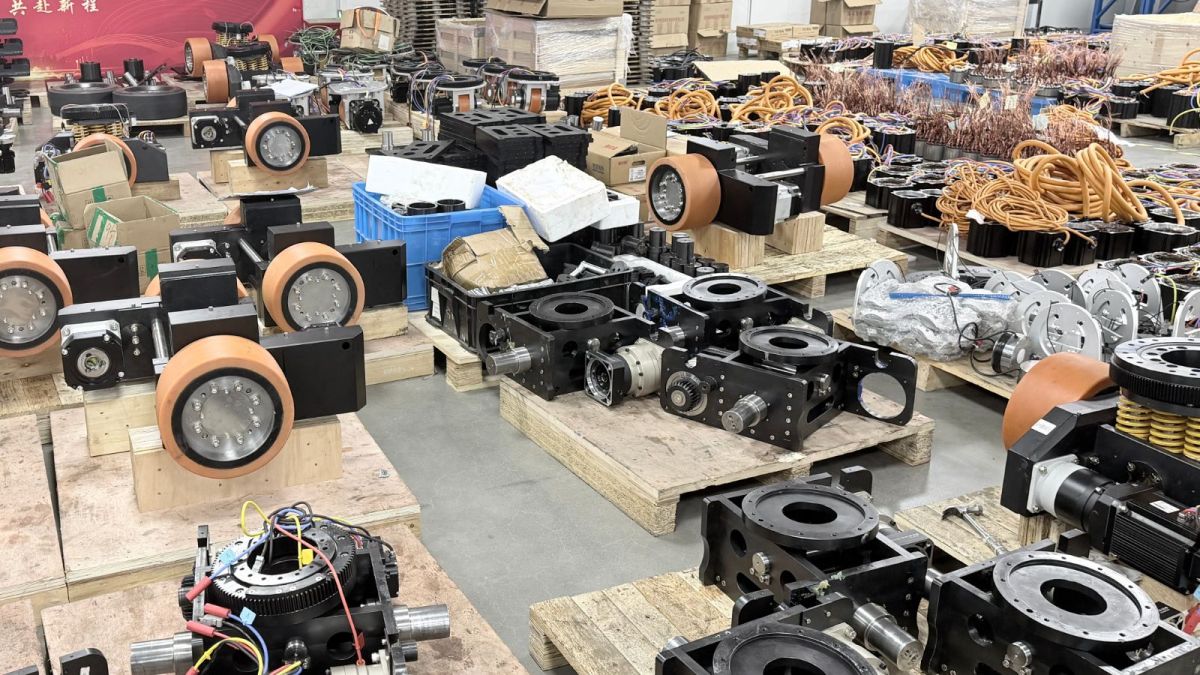
Why Is Wheel Motor Selection More Difficult for Heavy-Duty AGVs?
For a conventional AGV, drive wheel selection is usually based on several basic parameters, including total AGV weight, maximum payload, travel speed, acceleration, gradeability, number of drive wheels, wheel diameter, motor power, and gear ratio. However, these parameters alone are not sufficient for a heavy-duty AGV because the actual load on the drive wheel is not simply equal to the static vehicle weight.
During starting, acceleration, deceleration, emergency braking, turning, or operation on uneven surfaces, the actual load carried by the drive wheel system changes continuously. Under high-load conditions, the short-term dynamic force can be significantly higher than the static load calculated from the vehicle's rated payload.
For example, a 1-ton AGV cannot be evaluated simply by assuming that the drive wheel always experiences a 1-ton load. During rapid acceleration, emergency braking, or operation under uneven road conditions, the dynamic load depends on factors such as vehicle mass distribution, acceleration and deceleration, braking method, wheel arrangement, and the applicable shock factor. The actual peak value therefore needs to be calculated and verified according to the specific vehicle design and operating conditions.
This leads to the first major question in Heavy-Duty AGV Wheel Motor Selection: What dynamic load does the drive wheel system actually need to withstand?
Dynamic Matching Between Load and Drive Capability
For a heavy-duty AGV, the drive wheel has two fundamental responsibilities. It must support the vertical load generated by the vehicle and payload, while also continuously delivering the required driving force and wheel-end torque. This means that the gears, bearings, wheel hub, axle, housing, and wheel material inside a Wheel Motor system do not operate under a single type of load. In actual operation, they may simultaneously experience radial load, driving torque, shock load, and lateral load.
How to Calculate Wheel-End Torque for a Heavy-Duty AGV
During preliminary sizing, the required traction force can be calculated first, followed by the required wheel-end torque based on the wheel radius:
T = F × r
Here, T represents the required wheel-end torque, F represents the traction force that the drive wheel needs to generate, and r represents the wheel radius.
This is only a basic calculation. A complete Heavy-Duty AGV Wheel Motor selection process also needs to consider the total AGV mass, maximum payload, acceleration, maximum travel speed, slope, rolling resistance, ground friction coefficient, number of drive wheels, load distribution among drive wheels, transmission efficiency, and dynamic shock factor.
For this reason, the rated torque of a Wheel Motor cannot simply be treated as the same value as the actual peak torque required by the AGV. For a heavy-duty AGV, it is more important to verify whether the Wheel Motor can continuously deliver the required torque under peak operating conditions while ensuring that the gearbox, bearings, axle, wheel, and housing remain within their allowable mechanical loads.
Do Not Select the Drive Wheel Based Only on Total AGV Weight
This is another common mistake in heavy-duty AGV design. If an AGV has a total weight of 120 tons, it does not mean that the actual load on each Wheel Motor can be calculated simply by dividing 120 tons by the number of drive wheels.
The real wheel load distribution is affected by many factors, including the payload center of gravity, battery position, drive wheel location, supporting wheel location, number of wheel modules, suspension structure, floor flatness, acceleration and braking conditions, turning conditions, and the ability of the wheel system to balance loads between different wheel groups.
Therefore, heavy-duty AGV Wheel Motor selection should focus on the maximum dynamic wheel load rather than the average wheel load. This is also why the drive wheel system of a heavy-duty AGV often needs to be designed together with the suspension, floating mechanism, and chassis structure instead of being treated as an independent standard component.
What Does a 120-Ton AGV Require from Its Wheel Motor System?
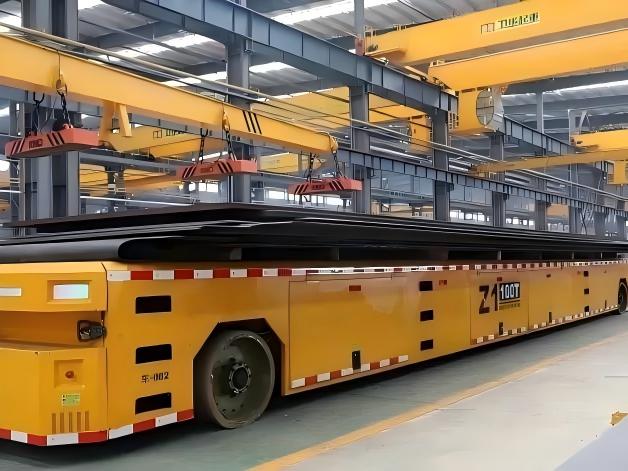
When the total weight of an AGV reaches the 120-ton class, the Wheel Motor is no longer simply a device used to rotate a wheel. It becomes a critical mechanical connection between the power system, chassis, wheels, suspension, and ground.
At this level of vehicle weight, the drive wheel system needs to be evaluated from at least five important engineering perspectives.
Single Drive Wheel Load Capacity Determines Chassis Layout Flexibility
A 120-ton AGV cannot continuously increase the number of drive wheel groups without limits. If one drive wheel group can only carry around 10 or 15 tons, the vehicle may require eight or more drive units to meet the overall load requirement. As the number of drive units increases, the chassis becomes more complicated, drive control becomes more difficult, load distribution between wheel groups becomes harder to manage, and the overall system cost and maintenance requirements increase.
For this reason, the load capacity of a single drive wheel group becomes an important parameter in the chassis design of an ultra-heavy-duty AGV. A higher single-unit load capacity can provide engineers with greater flexibility when designing the drive wheel arrangement, chassis structure, and available installation space.
Stable Torque Output Under Heavy Vertical Loads
One of the most direct challenges for a heavy-duty AGV is that the heavier the load carried by the drive wheel, the more demanding the traction and torque requirements become. During full-load starting, climbing, or low-speed heavy-load operation, the Wheel Motor needs to provide sufficient wheel-end torque while simultaneously supporting a very large vertical load from the vehicle.
A Wheel Motor designed for heavy-duty AGV applications therefore needs to be evaluated as an integrated mechanical system consisting of the gearbox, bearing, wheel, axle, and housing. These components must be able to withstand the combined effects of radial load and driving torque.
For high-load applications, it is not sufficient to look only at motor rated power or gearbox rated torque. Engineers also need to verify maximum wheel load, peak wheel-end torque, bearing life, gear life, axle strength, wheel strength, wheel material durability, and resistance to mechanical shock. This is one of the fundamental differences between a heavy-duty AGV drive wheel and a conventional industrial caster or light-duty AGV wheel.
Should a Heavy-Duty AGV Use a Steering Drive Wheel or a Differential Drive Wheel?
This is one of the most common questions in AGV drive system design. Steering Drive Wheels and Differential Drive Wheels are not simply two products that can be ranked as better or worse. They use different vehicle motion control principles and therefore fit different AGV architectures.
A steering drive wheel combines propulsion with an independent steering mechanism, allowing the system to directly control both the wheel direction and driving speed. A differential drive system, on the other hand, uses the speed difference between the left and right drive wheels to control the vehicle's turning motion.
For a heavy-duty AGV, the appropriate solution depends on the total vehicle weight, number of drive wheels, vehicle dimensions, minimum turning radius, aisle width, requirement for in-place rotation, lateral movement requirements, positioning accuracy, floor conditions, chassis height, and overall system cost.
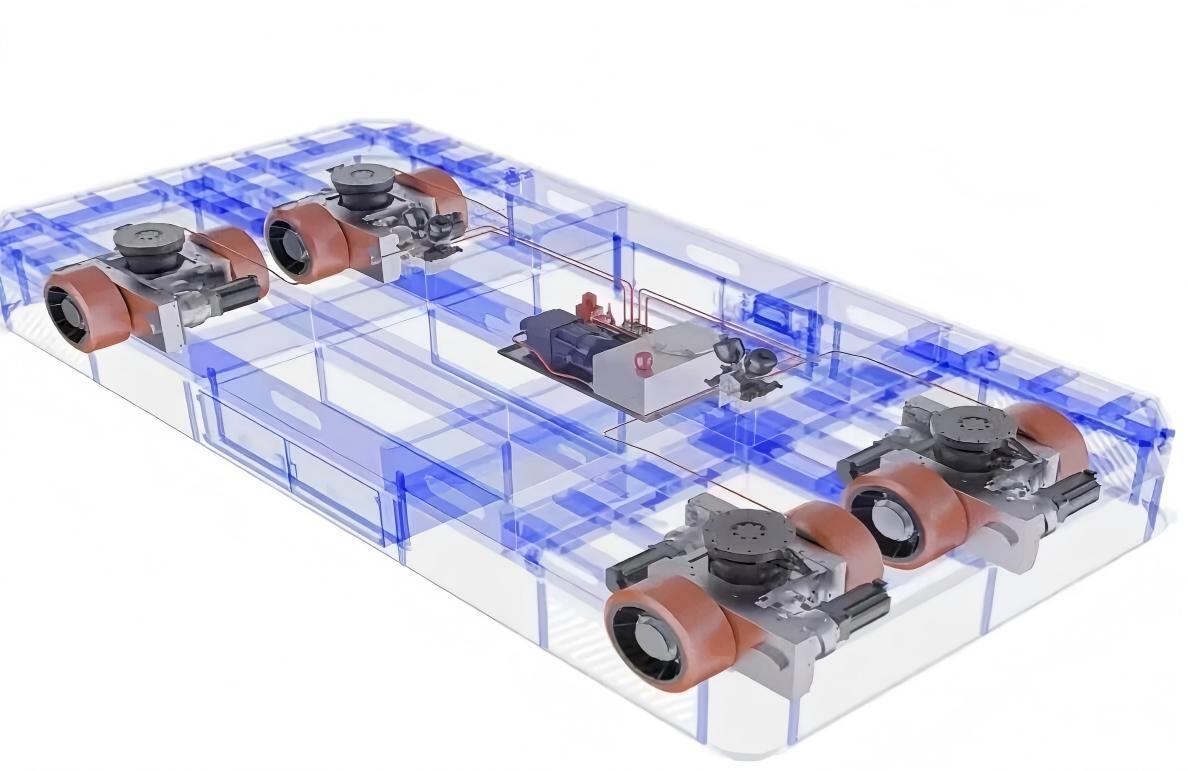
When to Consider a Steering Drive Wheel
For applications requiring complex paths, accurate positioning, narrow aisles, and flexible vehicle movement, a steering drive wheel can provide direct control of steering angle and driving speed. This type of configuration can be considered for heavy-duty AGVs, automated forklifts, large material handling vehicles, automotive manufacturing logistics, wind power equipment transportation, and aerospace manufacturing logistics.
When to Consider a Differential Drive Wheel
Differential drive systems control vehicle direction through the speed difference between the left and right drive wheels, which can provide a relatively direct mechanical architecture. They can be suitable for AGVs with relatively simple routes, lower chassis height requirements, or applications where an independent steering mechanism is not necessary.
However, when a differential drive system is used on a very heavy AGV, engineers need to pay particular attention to tire-ground lateral friction during turning, as well as load distribution and speed synchronization between different drive wheel groups.
Therefore, the selection between a Steering Drive Wheel and a Differential Drive Wheel should not be reduced to the simple assumption that a heavier AGV must use a steering wheel. The decision should be based on the vehicle's actual motion requirements and chassis architecture.
Why Is Differential Steering More Challenging for Ultra-Heavy AGVs?
For an ultra-heavy AGV, the key question with differential steering is not simply whether the vehicle can turn. The more important question is whether the wheel groups can maintain stable, synchronized, and controllable motion under extremely high vertical loads.
A four-wheel-group or multi-wheel-group differential drive layout can use the speed difference between the left and right sides to control vehicle direction without requiring an independent steering mechanism for every wheel group. This can simplify part of the mechanical architecture, but it also places greater demands on load balancing, drive synchronization, tire-ground friction, lateral stiffness, and motion control accuracy.
If significant differences occur between drive wheel loads or wheel speeds, the tires may experience additional slip and wear under heavy-load turning conditions, while the mechanical load on the drive system can also increase.
For this reason, the design of a large differential-drive AGV should not focus only on whether the motor provides sufficient torque. The synchronization of the entire drive system and the mechanical stiffness of the wheel modules must also be evaluated.
Why Should Vertical Adjustment Be Considered for Heavy-Duty AGV Wheel Motors?
When an AGV reaches tens or even 120 tons, floor irregularities, changes in the payload center of gravity, and uneven wheel loading become increasingly important engineering issues.
For example, the wheel loading and vehicle height requirements can change significantly between fully loaded and unloaded conditions, or when the AGV enters a docking station where a specific vehicle height needs to be maintained.
For this reason, some heavy-duty AGVs incorporate vertical adjustment or hydraulic lifting functions into the drive wheel system, allowing the wheel position or vehicle height to be adjusted according to operating conditions.
If the Wheel Motor does not integrate this function, an additional suspension, floating mechanism, or hydraulic height-adjustment system may need to be installed between the chassis and the drive wheel. This increases the required installation space and can affect chassis height, mechanical complexity, and overall system integration.
Therefore, for ultra-heavy-duty AGVs, a Wheel Motor should not simply be viewed as a combination of a motor, gearbox, and wheel. It is more appropriate to consider it as a complete Heavy-Duty Drive Wheel Module.
Why Does Long-Term Reliability Matter More Than Peak Torque Alone?
Another defining characteristic of a heavy-duty AGV is the high cost of downtime. When a conventional AGV drive wheel fails, replacing a wheel module may be a relatively manageable maintenance task. However, when an AGV carries 100 tons or more, a failure of a critical drive unit can stop material transportation and affect upstream and downstream production processes. Large wheel modules can also require specialized maintenance equipment and significantly more time to replace.
Therefore, the reliability of a Heavy-Duty AGV Wheel Motor cannot be evaluated only through a single peak-torque test. Long-term reliability depends on the combined performance of the gearbox, bearings, wheel, housing, encoder, brake, sealing system, and overall mechanical structure.
Key Components Affecting Wheel Motor Reliability
The gearbox needs to be evaluated in terms of gear material, tooth strength, reduction ratio, lubrication, and sealing. The bearing system must be able to withstand radial, axial, and shock loads while achieving the required service life. The wheel itself needs to be selected according to wheel diameter, material, tread structure, hardness, and wear resistance. The housing must provide sufficient rigidity and impact resistance, while the encoder needs to maintain stable speed and position feedback during long-term operation. Where braking and holding are required, the brake system must also be evaluated under full-load stopping, slope parking, and power-loss conditions.
In other words, the reliability of a heavy-duty AGV drive wheel is the result of the combined performance of its mechanical structure, drive system, and control system.
How Should a Heavy-Duty AGV Wheel Motor Be Selected?
For an actual AGV project, the selection process should begin with the total vehicle mass, including the AGV's own weight and maximum payload. The next step is to determine the maximum dynamic wheel load rather than relying only on average wheel loading. The calculation should take into account the payload center of gravity, suspension system, acceleration, braking, and possible shock conditions.
The required traction force can then be determined according to rolling resistance, slope, acceleration, ground friction, and operating speed. Based on the required traction force and wheel diameter, the required wheel-end torque can be calculated, after which the motor, gearbox, and reduction ratio can be selected according to wheel speed and torque requirements.
Mechanical load verification should then be performed for the Wheel Motor system, including wheel load, gearbox torque, bearing load, axle strength, wheel strength, and housing stiffness. Finally, the appropriate steering architecture should be selected according to the vehicle's route, maneuverability, chassis structure, and positioning requirements.
Validate the Wheel Motor Under Real Operating Conditions
The final validation should not be limited to normal straight-line operation. A heavy-duty AGV Wheel Motor should also be evaluated under full-load starting, emergency braking, maximum grade, low-traction surfaces, turning, uneven floors, and extended continuous operation to confirm that the drive wheel system remains stable and controllable under dynamic conditions.
From “Motor” to “Drive Wheel Module”: A Different Way to Think About Heavy-Duty AGV Design
For a conventional AGV, engineers may start with motor power, gear ratio, and wheel diameter. For a heavy-duty AGV, a more complete design approach starts with vehicle weight, dynamic wheel load, traction, wheel-end torque, gearbox, motor, steering, suspension, and control.
This is why heavy-duty AGV Wheel Motor development cannot focus only on motor power. What determines whether the drive wheel can operate reliably over the long term is the interaction between the complete mechanical and control system.
The challenges become particularly significant when an AGV reaches 50, 80, 100, or even 120 tons. At this point, the Wheel Motor becomes an important load-bearing component of the vehicle chassis rather than simply a source of propulsion.
Conclusion: The Drive Wheel of a Heavy-Duty AGV Is First a Load-Bearing Component, Then a Power Component
Heavy-duty AGV Wheel Motor selection is essentially a system engineering problem involving mechanical load capacity, power transmission, vehicle motion, and long-term reliability.
For a light-duty AGV, motor power and wheel-end torque may be the primary selection parameters. As the AGV enters the heavy-duty and ultra-heavy-duty range, engineers need to consider single-unit load capacity, dynamic wheel load, peak torque, traction, steering method, tire-ground lateral forces, vertical adjustment, and long-term reliability.
The challenges of a 120-ton AGV make this particularly clear. Its drive wheel system must not only move the vehicle, but also continuously withstand enormous vertical loads, driving torque, shock loads, and lateral forces.
Therefore, when selecting a Heavy-Duty AGV Wheel Motor, the key question is not simply whether a motor has enough power or whether a gearbox has enough rated torque. The more important question is whether the complete Drive Wheel Module is properly matched to the AGV's weight, motion characteristics, chassis structure, and real operating environment.
That is the core of heavy-duty AGV drive wheel selection.
Read More
Learn more about the story of HONPINE and industry trends related to precision transmission.
 What is robot joint actuator?How to Choose the Best Robot Rotary Joint Actuator?In core robot joint transmission solutions, planetary and harmonic rotary actuators each have their own strengths. Choosing the right type based on application requirements is essential to achieve the optimal balance between performance and cost.
 DD Motors VS Harmonic Rotary ActuatorsThis article provides an in-depth comparison between Direct Drive (DD) motors and harmonic rotary actuators, covering their transmission principles, advantages and disadvantages, and typical application fields.
 OMG Ultra Compact Harmonic Drive Joint Module with Built-in Torque SensorHONPINE TCHL series harmonic drive joint module is a game-changing product that achieves disruptive improvements in multiple aspects such as lightweight design, integration level, and connection convenience. This article will analyze its revolutionary enhancements with you.
 The Role of Harmonic Drive Gears in Achieving 5–10 μm Accuracy in Dental Milling MachinesA dental milling machine is a CNC machining system used to directly process digital dental models into restorations such as crowns, bridges, veneers, inlays, and implant abutments. Dental milling machines require far higher operational accuracy and motion stability than ordinary equipment. This article explains how harmonic drive gear help dental milling machines achieve stable, continuous, and controllable operation.
 Why Are Harmonic Rotary Actuators Perfect for Medical Equipment?Harmonic rotary actuators (typically integrated systems consisting of a harmonic drive reducer, frameless torque motor, encoder, and optional brake) are regarded as key components in medical equipment. The core reason is that they simultaneously meet the most stringent medical requirements for precision, compact size, safety, and controllability. The following explanation is structured from three perspectives: technical characteristics, application scenarios, and medical value.
 High-Precision RV Reducers Perfectly Matched for Walking RobotsThe walking axis of a robot is a core component for power transmission and support. RV reducers provide extremely high rigidity, precision, and torque while maintaining a compact size and exceptional reliability, making them an ideal match for the demanding requirements of walking robot joints in terms of load capacity, impact resistance, and precision.
 How to Choose a Small Harmonic Actuator?HONPINE Series 11 small harmonic actuators provide a compact, high-performance rotary motion solution for precision automation applications. Available with hollow or solid shafts, 48V or 220V options, optional brakes, absolute encoders, and different reduction ratios, the Series 11 is designed for applications requiring compact dimensions, controlled torque, and precise positioning.
 How to Choose a Wheel Motor for a Heavy-Duty AGV? Key Challenges from Dynamic Loads to 120-Ton AGV Drive Wheel SystemsSelecting a Heavy-Duty AGV Wheel Motor is more than matching motor power or rated torque to the vehicle's payload. As AGVs move from conventional material handling to multi-ton and even 120-ton-class applications, the drive wheel system must handle dynamic loads, acceleration, braking, turning forces, traction, and long-term mechanical stress. The actual challenge lies in matching wheel load capacity, wheel-end torque, gearbox performance, steering architecture, suspension, and chassis design under real operating conditions. This article examines the key challenges of Heavy-Duty AGV Wheel Motor selection and explains how Steering Drive Wheels and Differential Drive Wheels can be evaluated for different heavy-duty AGV applications.
 DD Motor Servo System: How to Understand Mechanical Resonance and Solve Machine Vibration?This article explains the relationship between DD motor servo tuning, mechanical resonance, and servo bandwidth in direct drive motion systems. It examines why vibration and instability can occur even after repeated servo parameter adjustments, and explains how mechanical stiffness, moving mass, bearing conditions, load distribution, and structural geometry affect resonance frequency. The article also compares approaches for high- and low-frequency resonance, explains when digital notch filtering can be effective, and provides a practical tuning strategy for engineers working with DD motors, direct drive torque motors, and linear motors.
 High Precision Harmonic Drive Robot Joint Actuator Solution for Robotic ElbowsThe robotic elbow joint plays a critical role in arm flexion, posture adjustment, and end-effector positioning. As humanoid robots, collaborative robots, and robotic arms become more capable, elbow actuators need to deliver high torque and precise motion within increasingly limited installation spaces. A high precision harmonic drive robot joint actuator integrates the harmonic reducer, motor, encoder, brake, and drive system into a compact unit, providing low backlash, high stiffness, high torque density, and accurate motion control. In this article, HONPINE introduces three joint actuator series suitable for robotic elbow applications, covering different requirements for size, torque, speed, precision, and integration.
 Explosion-Proof Robot Joint Solution for Chemical Inspection Quadruped Robots: Planetary Joint Actuator with Up to 500 N·m Peak TorqueIn petrochemical, mining, power, and other hazardous environments, inspection robots are moving beyond simple monitoring toward practical operations such as tool handling, equipment inspection, and emergency response. This shift places higher demands on robot joint actuators, particularly in explosion protection, torque output, thermal management, environmental resistance, and mobility. HONPINE's explosion-proof robot joint actuator is designed for quadruped inspection robots and other hazardous-environment robotic platforms, integrating high-load planetary transmission with explosion-proof design and reliable motion performance. With up to 500 N·m peak torque per joint, optional IP67 protection, and Ex db IIB T4 Gb certification, the solution is designed to support demanding robotic applications in high-risk industrial environments.
 Planetary Drive Actuator for AGV Wheel Hub Motors: Solving Torque, Turning Radius and Drive Integration ChallengesHello everyone, I’m Theodore Li, Technical Director at HONPINE. Today, I’d like to discuss how a planetary drive actuator can solve practical challenges in AGV wheel hub motor systems. AGVs and AMRs require sufficient wheel torque for heavy-load starting, acceleration, slope climbing, and frequent reversing, while the drive system must remain compact enough for limited chassis space. A planetary drive actuator combines a motor with a planetary reduction mechanism to convert high-speed motor output into the lower-speed, higher-torque motion required at the wheel. In this article, I will examine the relationship between planetary drive actuators and AGV wheel hub motors, including torque, gear ratio, wheel diameter, climbing ability, turning radius, direct-drive systems, and harmonic drive actuators.
Double Click
We provide harmonic drive reducer,planetary reducer,robot joint motor,robot rotary actuators,RV gear reducer,robot end effector,dexterous robot hand
 What is robot joint actuator?How to Choose the Best Robot Rotary Joint Actuator?In core robot joint transmission solutions, planetary and harmonic rotary actuators each have their own strengths. Choosing the right type based on application requirements is essential to achieve the optimal balance between performance and cost.
 DD Motors VS Harmonic Rotary ActuatorsThis article provides an in-depth comparison between Direct Drive (DD) motors and harmonic rotary actuators, covering their transmission principles, advantages and disadvantages, and typical application fields.
 OMG Ultra Compact Harmonic Drive Joint Module with Built-in Torque SensorHONPINE TCHL series harmonic drive joint module is a game-changing product that achieves disruptive improvements in multiple aspects such as lightweight design, integration level, and connection convenience. This article will analyze its revolutionary enhancements with you.
 How to Choose a Small Harmonic Actuator?HONPINE Series 11 small harmonic actuators provide a compact, high-performance rotary motion solution for precision automation applications. Available with hollow or solid shafts, 48V or 220V options, optional brakes, absolute encoders, and different reduction ratios, the Series 11 is designed for applications requiring compact dimensions, controlled torque, and precise positioning.
 How to Choose a Wheel Motor for a Heavy-Duty AGV? Key Challenges from Dynamic Loads to 120-Ton AGV Drive Wheel SystemsSelecting a Heavy-Duty AGV Wheel Motor is more than matching motor power or rated torque to the vehicle's payload. As AGVs move from conventional material handling to multi-ton and even 120-ton-class applications, the drive wheel system must handle dynamic loads, acceleration, braking, turning forces, traction, and long-term mechanical stress. The actual challenge lies in matching wheel load capacity, wheel-end torque, gearbox performance, steering architecture, suspension, and chassis design under real operating conditions. This article examines the key challenges of Heavy-Duty AGV Wheel Motor selection and explains how Steering Drive Wheels and Differential Drive Wheels can be evaluated for different heavy-duty AGV applications.
 DD Motor Servo System: How to Understand Mechanical Resonance and Solve Machine Vibration?This article explains the relationship between DD motor servo tuning, mechanical resonance, and servo bandwidth in direct drive motion systems. It examines why vibration and instability can occur even after repeated servo parameter adjustments, and explains how mechanical stiffness, moving mass, bearing conditions, load distribution, and structural geometry affect resonance frequency. The article also compares approaches for high- and low-frequency resonance, explains when digital notch filtering can be effective, and provides a practical tuning strategy for engineers working with DD motors, direct drive torque motors, and linear motors.
 High Precision Harmonic Drive Robot Joint Actuator Solution for Robotic ElbowsThe robotic elbow joint plays a critical role in arm flexion, posture adjustment, and end-effector positioning. As humanoid robots, collaborative robots, and robotic arms become more capable, elbow actuators need to deliver high torque and precise motion within increasingly limited installation spaces. A high precision harmonic drive robot joint actuator integrates the harmonic reducer, motor, encoder, brake, and drive system into a compact unit, providing low backlash, high stiffness, high torque density, and accurate motion control. In this article, HONPINE introduces three joint actuator series suitable for robotic elbow applications, covering different requirements for size, torque, speed, precision, and integration.
 Explosion-Proof Robot Joint Solution for Chemical Inspection Quadruped Robots: Planetary Joint Actuator with Up to 500 N·m Peak TorqueIn petrochemical, mining, power, and other hazardous environments, inspection robots are moving beyond simple monitoring toward practical operations such as tool handling, equipment inspection, and emergency response. This shift places higher demands on robot joint actuators, particularly in explosion protection, torque output, thermal management, environmental resistance, and mobility. HONPINE's explosion-proof robot joint actuator is designed for quadruped inspection robots and other hazardous-environment robotic platforms, integrating high-load planetary transmission with explosion-proof design and reliable motion performance. With up to 500 N·m peak torque per joint, optional IP67 protection, and Ex db IIB T4 Gb certification, the solution is designed to support demanding robotic applications in high-risk industrial environments.
 Planetary Drive Actuator for AGV Wheel Hub Motors: Solving Torque, Turning Radius and Drive Integration ChallengesHello everyone, I’m Theodore Li, Technical Director at HONPINE. Today, I’d like to discuss how a planetary drive actuator can solve practical challenges in AGV wheel hub motor systems. AGVs and AMRs require sufficient wheel torque for heavy-load starting, acceleration, slope climbing, and frequent reversing, while the drive system must remain compact enough for limited chassis space. A planetary drive actuator combines a motor with a planetary reduction mechanism to convert high-speed motor output into the lower-speed, higher-torque motion required at the wheel. In this article, I will examine the relationship between planetary drive actuators and AGV wheel hub motors, including torque, gear ratio, wheel diameter, climbing ability, turning radius, direct-drive systems, and harmonic drive actuators.
 How to Choose a Reliable Robot Joint Motor Manufacturer for Humanoid Robots?Choosing a reliable robot joint motor manufacturer is a critical step when developing humanoid robots and other advanced robotic systems. A robotic joint must balance torque, speed, precision, torque density, thermal performance, feedback, mechanical stiffness, and long-term reliability within a compact structure. For B2B robotics companies, supplier evaluation should therefore go beyond a product datasheet and consider engineering capability, manufacturing capacity, joint integration, testing, and production scalability. In this article, Allen Li, Founder of HONPINE, explains the key factors to consider when selecting a robot joint motor manufacturer and how integrated harmonic robot joint technology can support humanoid robot development.
 Lightweight Humanoid Robots Start with Precision TransmissionAs humanoid robots move from experimental prototypes toward practical applications, lightweight design, energy efficiency, motion performance, and long-term reliability are becoming increasingly important. At the center of these challenges is precision transmission. From harmonic reducers and lightweight robot joints to integrated development kits, the design of each core component directly affects the overall performance of a humanoid robot. In this article, Allen Li, Founder of HONPINE, shares his perspective on how precision transmission technology can support the development of lightweight humanoid robots and how HONPINE is extending its expertise from harmonic reducers toward lightweight robot joints and integrated robotics solutions.
 Hollow-Shaft Direct Drive Motor for Heavy-Duty Precision Positioning and Industrial AutomationIn heavy-duty automation, precision positioning depends not only on the motor but also on the mechanical transmission between the motor and the load. A hollow shaft direct drive motor delivers torque directly to the load while providing a central passage for cables, pneumatic lines and other components. This makes it a practical solution for CNC machining, photovoltaic, lithium battery, optical inspection and semiconductor equipment.