

EU CE Rule Makes PL Certification Mandatory
Image placement plan: 1 image is recommended near the opening section to visually support the policy update and improve readability for an industry news page.
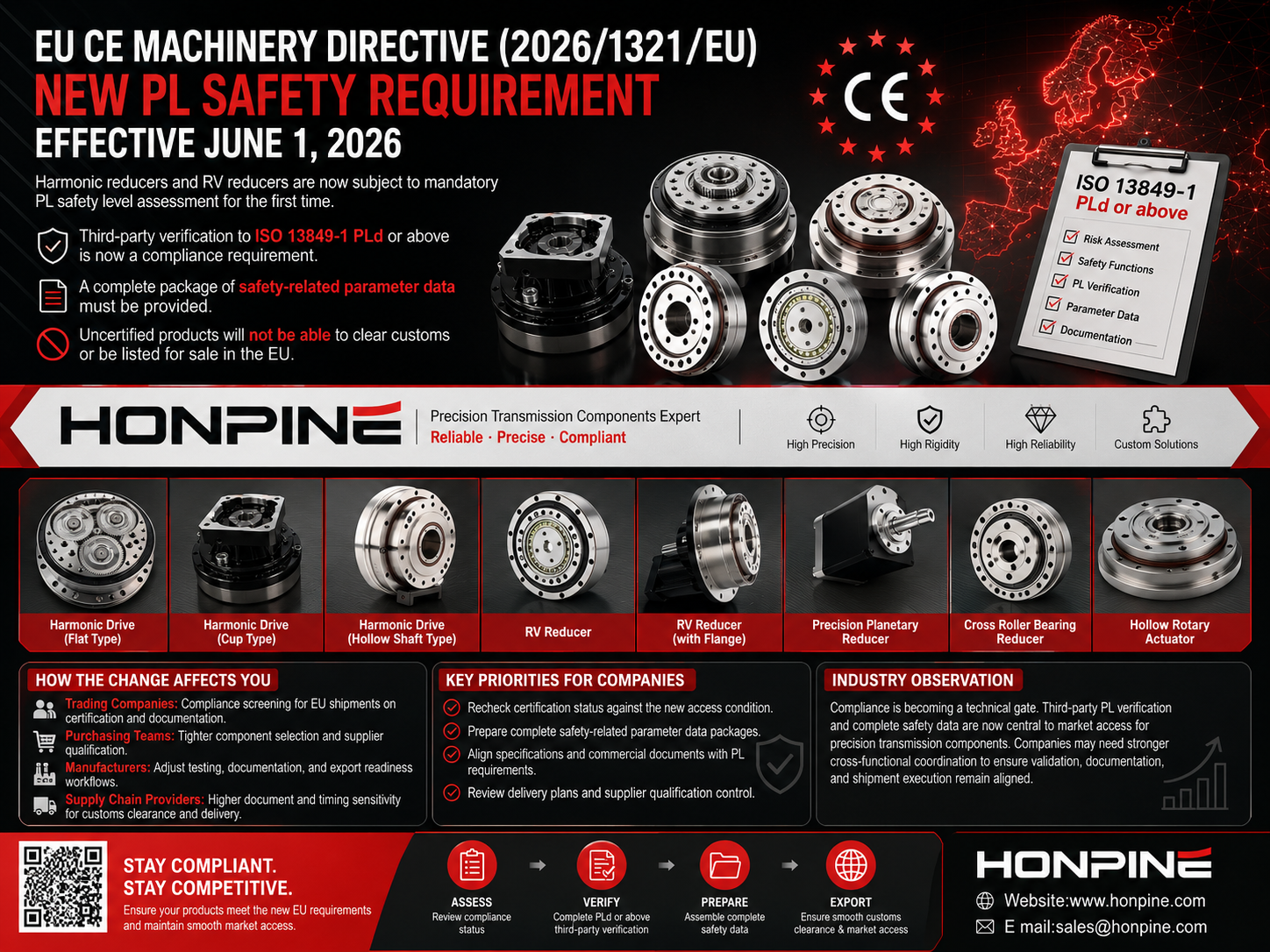
On June 1, 2026, the EU began formally implementing the revised CE Machinery Directive (2026/1321/EU), bringing precision transmission components such as harmonic reducers and RV reducers into the scope of mandatory PL safety level assessment for the first time. For harmonic reducers sold into the EU, third-party verification to ISO 13849-1 PLd or above, together with a complete package of safety-related parameter data, has become a compliance requirement. This change directly affects the export compliance path of Chinese harmonic reducer manufacturers, as uncertified products will not be able to clear customs or be listed for sale.
Image placement note: place the following placeholder before the main factual section.
What the New EU Requirement Confirms
According to the provided event information, the revised CE Machinery Directive (2026/1321/EU) took effect on June 1, 2026. The update newly places precision transmission parts including harmonic reducers and RV reducers within the mandatory assessment scope for PL (Performance Level) safety classification. It also requires all harmonic reducers sold to the EU market to complete ISO 13849-1 PLd or higher level verification through a third-party certification body and to provide a complete set of safety-related parameter data. The provided information further states that products without certification will be unable to complete customs clearance or be placed on the market for sale.
How the Change Reaches Different Market Participants
Exporting trading companies face immediate compliance screening pressure
Trading companies directly involved in EU-bound shipments are affected because market access now depends on whether the product has completed the required third-party certification and supporting technical documentation. The impact appears in quotation review, contract confirmation, customs preparation, and listing readiness. What deserves close attention is whether product files, declarations, and parameter packages can consistently match the new regulatory expectations before shipment.
Upstream purchasing teams may need to tighten component selection
Purchasing enterprises are affected because downstream compliance obligations can change sourcing standards for precision transmission components. The impact may show up in supplier selection, technical requirement alignment, and procurement approval. From a practical perspective, buyers may need to pay closer attention to whether purchased reducers can support PL-related verification and whether suppliers can provide complete safety-related data packages.
Manufacturers must adjust testing and technical documentation workflows
Processing and manufacturing enterprises are directly affected because the rule change shifts compliance from a voluntary advantage to a market-entry requirement for relevant products sold into the EU. The impact may extend to product validation, documentation control, conformity preparation, and export delivery planning. What requires attention is the ability to complete ISO 13849-1 PLd or above verification through a third-party body and to maintain full technical records needed for market access.
Supply chain service providers may see higher document and timing sensitivity
Supply chain service companies, including those supporting shipment coordination and export processes, are affected because uncertified products will not be able to clear customs or be listed for sale according to the provided summary. The impact is likely to appear in booking preparation, document review, delivery scheduling, and customer communication. A key point to monitor is whether clients have completed certification and assembled the required safety parameter data before dispatch.
Key Priorities for Companies Responding to the Rule
Recheck certification status against the new access condition
Companies shipping harmonic reducers to the EU should review whether existing product compliance files actually meet the new requirement described in the event summary. The critical point is not only possession of CE-related market access documentation, but also completion of third-party verification to ISO 13849-1 PLd or above where required.
Prepare complete safety-related parameter data packages
The event information specifically states that a complete package of safety-related parameter data must be provided. This means companies should focus on document completeness, internal consistency, and readiness for review during export and sales processes. Missing or fragmented technical records could become a practical obstacle even before products reach end customers.
Align specifications and commercial documents with the new requirement
Where technical specifications, tender-style requirement sheets, product descriptions, or customer confirmation documents are used, enterprises should ensure that PL level verification requirements are clearly reflected. This is especially relevant for export transactions in which buyers may now treat PLd or above as a baseline qualification condition rather than an optional technical preference.
Review delivery plans and supplier qualification control
Because uncertified products will not be able to clear customs or be listed for sale, delivery timing and supplier readiness become more sensitive. Enterprises should pay closer attention to whether suppliers can support certification progress, technical file completion, and traceable product information, particularly for orders intended for the EU market.
Industry Observation: Compliance Is Becoming a Technical Gate
From an industry perspective, this development is more appropriately understood not simply as a paperwork adjustment, but as a stronger integration of safety validation into market access for precision transmission components. Analysis suggests that when third-party PL verification and complete safety parameter data become mandatory, manufacturers may face a longer preparation cycle before export, especially if their earlier processes were not built around this level of documentation and validation.
Observably, the rule change may also influence purchasing behavior. Buyers, distributors, and project-side evaluators could place greater weight on verifiable safety classification and documentation readiness during product selection. It is reasonable to view this as a potential rise in the technical compliance threshold for suppliers targeting the EU market.
What deserves closer attention is that the practical impact may extend beyond certification itself. Companies may need stronger coordination between engineering, quality, regulatory, and export teams so that technical validation, document control, and shipment execution remain aligned. This is an analytical observation rather than a confirmed outcome, but it is consistent with the compliance direction described in the provided event summary.
Why This Update Matters
The implementation of the revised EU CE machinery rule marks a clear shift in how certain precision transmission components are assessed for market access. For harmonic reducer suppliers serving the EU, PL-related third-party verification and safety data preparation now stand closer to the center of export readiness. A rational takeaway is that the change should be treated as a concrete compliance requirement with operational consequences, while its broader market effects will need continued observation.
Source Note and Follow-up Focus
This article was generated based on the user-provided news title, event date, and event summary. Specific official source links were not provided in the input and should be verified continuously.
For follow-up monitoring, readers should continue to watch for implementing details, certification interpretation in practice, changes in technical and commercial documentation requirements, updates in buyer-side specification language, and broader industry feedback related to the new rule.
Read More
Learn more about the story of HONPINE and industry trends related to precision transmission.
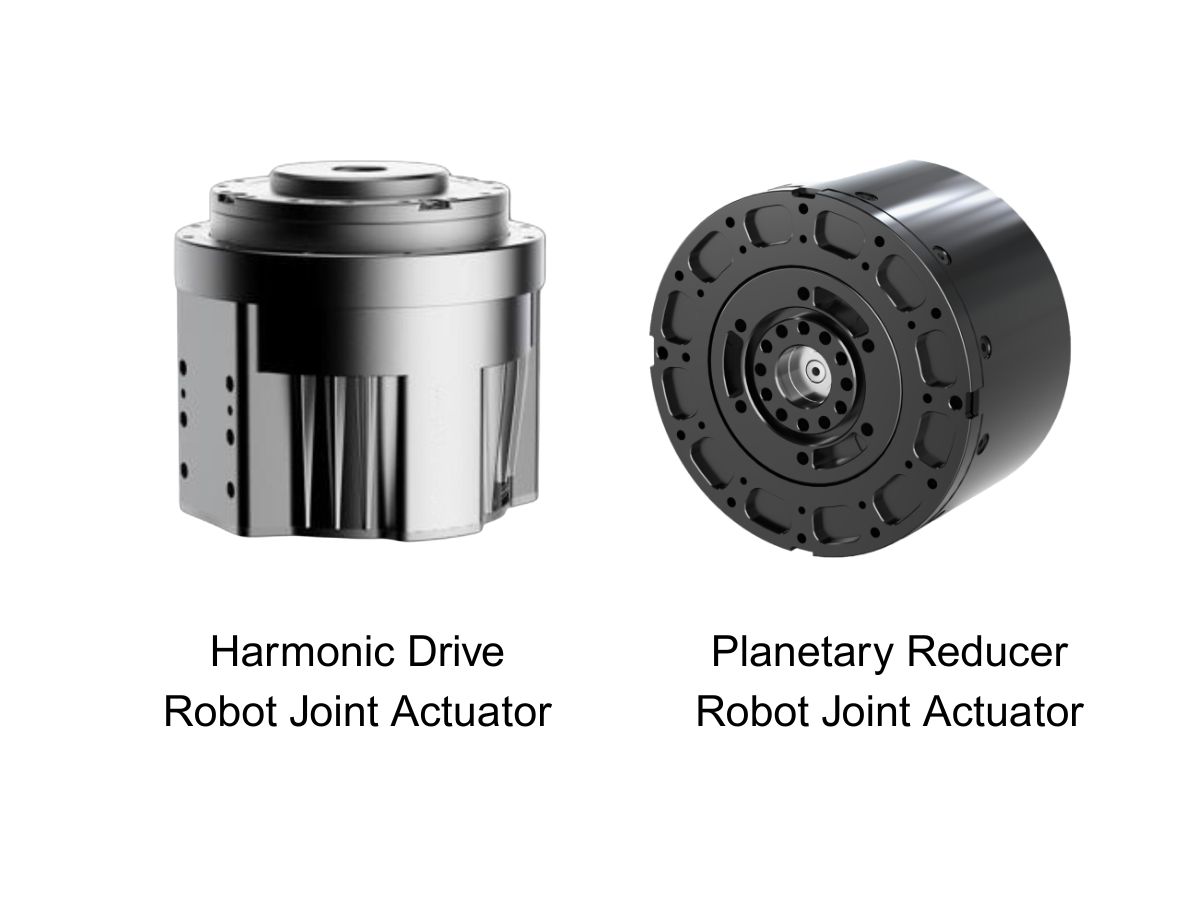
 What is robot joint actuator?How to Choose the Best Robot Rotary Joint Actuator?In core robot joint transmission solutions, planetary and harmonic rotary actuators each have their own strengths. Choosing the right type based on application requirements is essential to achieve the optimal balance between performance and cost.
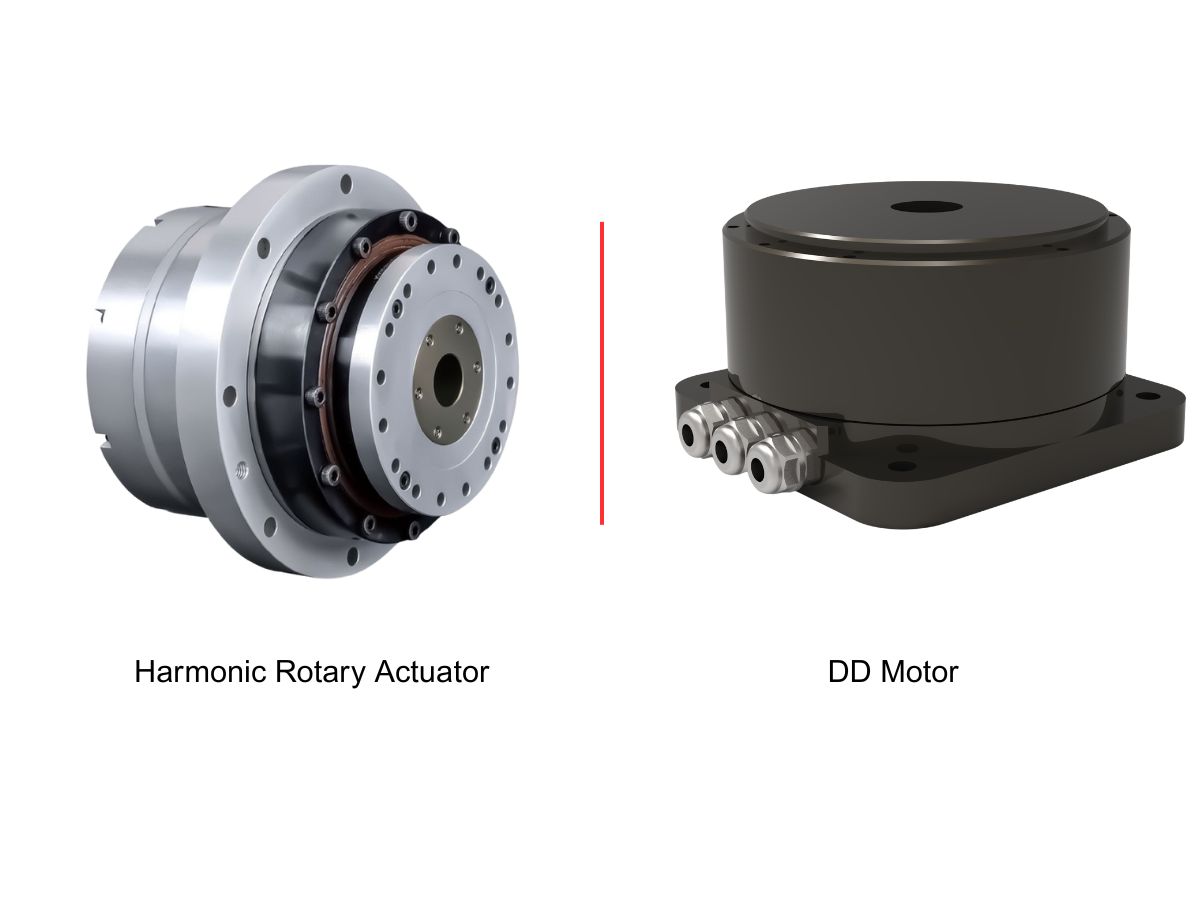
 DD Motors VS Harmonic Rotary ActuatorsThis article provides an in-depth comparison between Direct Drive (DD) motors and harmonic rotary actuators, covering their transmission principles, advantages and disadvantages, and typical application fields.
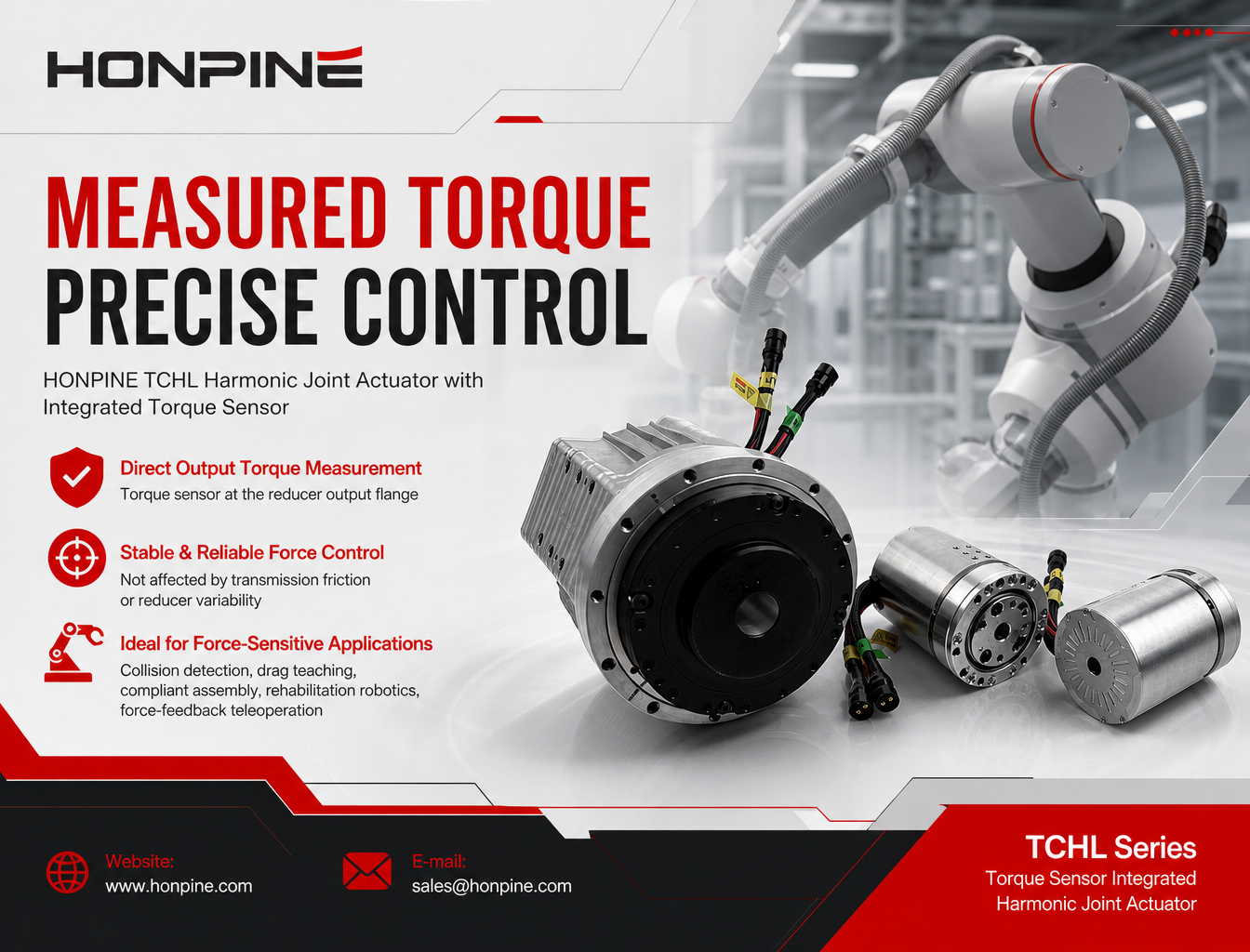
 OMG Ultra Compact Harmonic Drive Joint Module with Built-in Torque SensorHONPINE TCHL series harmonic drive joint module is a game-changing product that achieves disruptive improvements in multiple aspects such as lightweight design, integration level, and connection convenience. This article will analyze its revolutionary enhancements with you.
 The Role of Harmonic Drive Gears in Achieving 5–10 μm Accuracy in Dental Milling MachinesA dental milling machine is a CNC machining system used to directly process digital dental models into restorations such as crowns, bridges, veneers, inlays, and implant abutments. Dental milling machines require far higher operational accuracy and motion stability than ordinary equipment. This article explains how harmonic drive gear help dental milling machines achieve stable, continuous, and controllable operation.
 Why Are Harmonic Rotary Actuators Perfect for Medical Equipment?Harmonic rotary actuators (typically integrated systems consisting of a harmonic drive reducer, frameless torque motor, encoder, and optional brake) are regarded as key components in medical equipment. The core reason is that they simultaneously meet the most stringent medical requirements for precision, compact size, safety, and controllability. The following explanation is structured from three perspectives: technical characteristics, application scenarios, and medical value.
 High-Precision RV Reducers Perfectly Matched for Walking RobotsThe walking axis of a robot is a core component for power transmission and support. RV reducers provide extremely high rigidity, precision, and torque while maintaining a compact size and exceptional reliability, making them an ideal match for the demanding requirements of walking robot joints in terms of load capacity, impact resistance, and precision.
 How Does a Harmonic Joint Actuator with a Torque Sensor Improve Robot Force Control?Learn how the HONPINE TCHL harmonic joint actuator uses an integrated output torque sensor to support force feedback, collision detection, compliant assembly, rehabilitation robotics, and teleoperation.
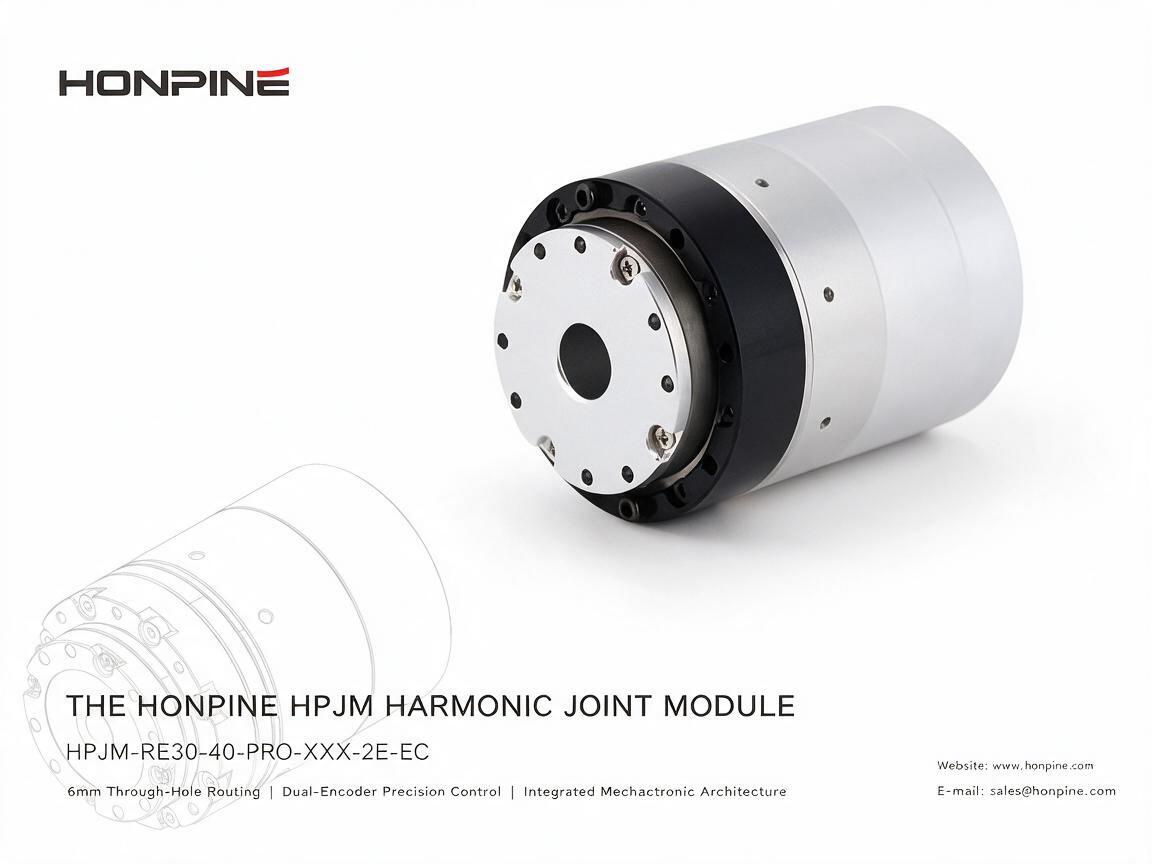
 Ultra-Compact Harmonic Joint Module with a 6 mm Hollow ShaftAs humanoid robots and compact robotic systems evolve, joint modules must deliver high torque density, precise motion control, and flexible cable routing within increasingly limited installation space. The HONPINE HPJM-RE30-40-PRO harmonic joint module addresses these challenges with a compact design, a 6 mm hollow shaft, dual-encoder feedback, and an integrated motor and FOC drive. In this article, we explore its key design features and explain how its hollow-shaft structure, EtherCAT connectivity, and flexible mounting options support the development of humanoid robots, drones, optical platforms, and precision automation equipment.
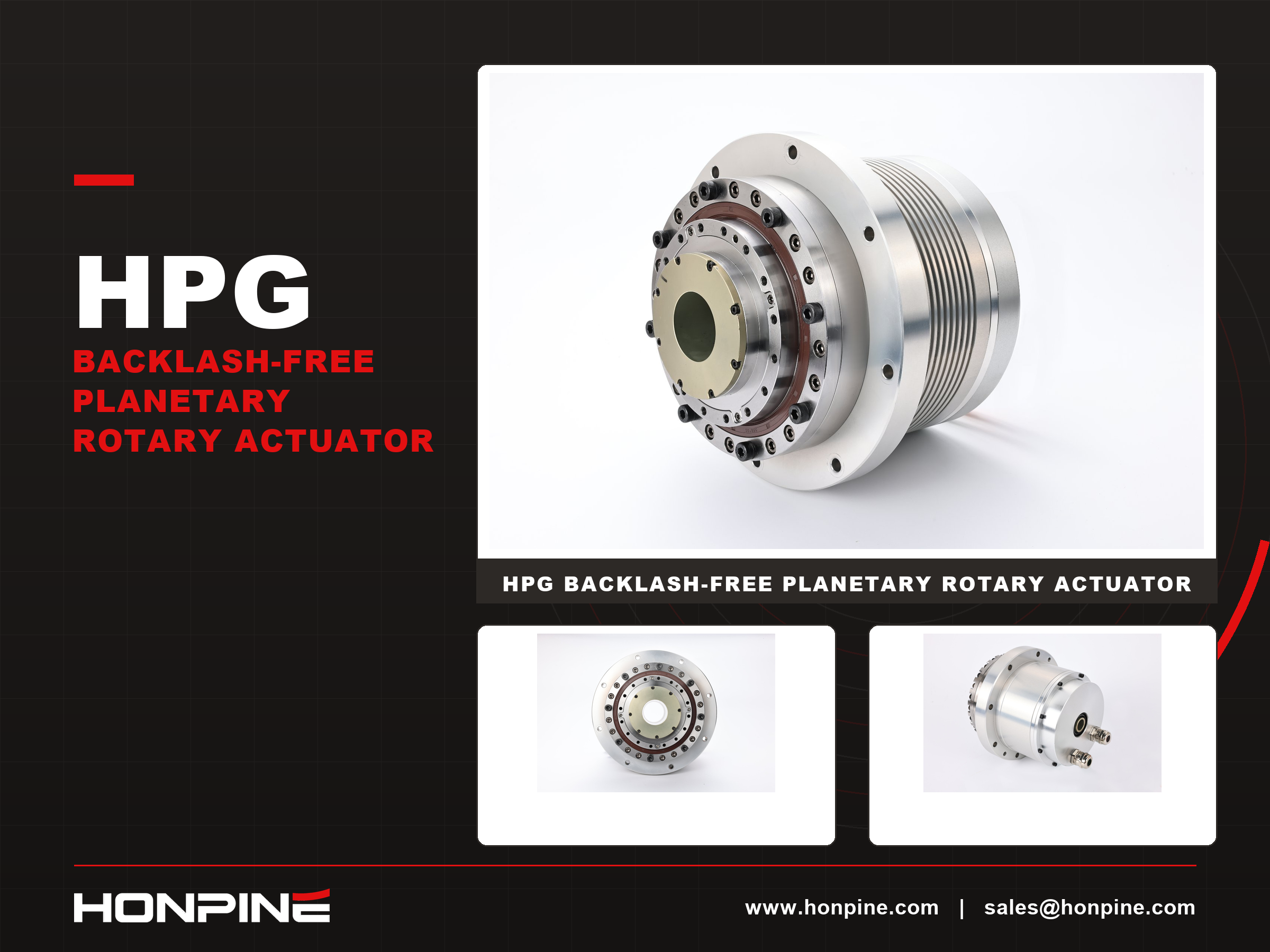
 How Does the HONPINE HPG Backlash-Free Planetary Rotary Actuator Balance CNC Accuracy and Rigidity?Discover the HONPINE HPG precision backlash-free planetary rotary actuator for CNC rotary tables. Explore positioning accuracy, torsional rigidity, low backlash, and drive selection.
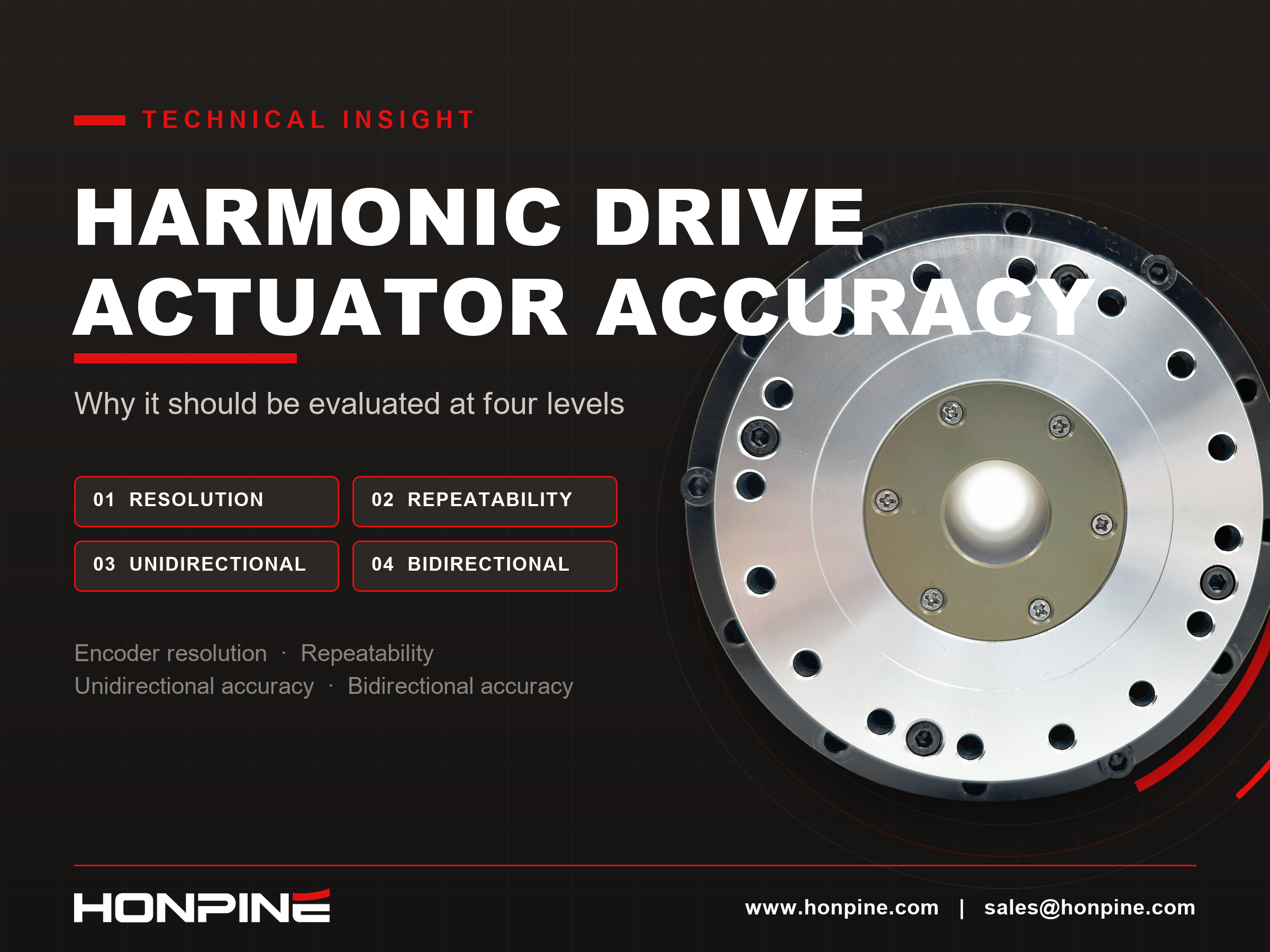
 Harmonic Drive Actuator Accuracy: Why It Should Be Evaluated at Four LevelsHarmonic drive actuator accuracy involves more than encoder resolution. Why should engineers evaluate it at four levels? Resolution, repeatability, unidirectional positioning accuracy, and bidirectional positioning accuracy describe different aspects of motion performance. Understanding these differences helps engineers select harmonic rotary actuators for semiconductor equipment, EFEM systems, and 3C automation without confusing theoretical encoder increments with actual positioning performance.
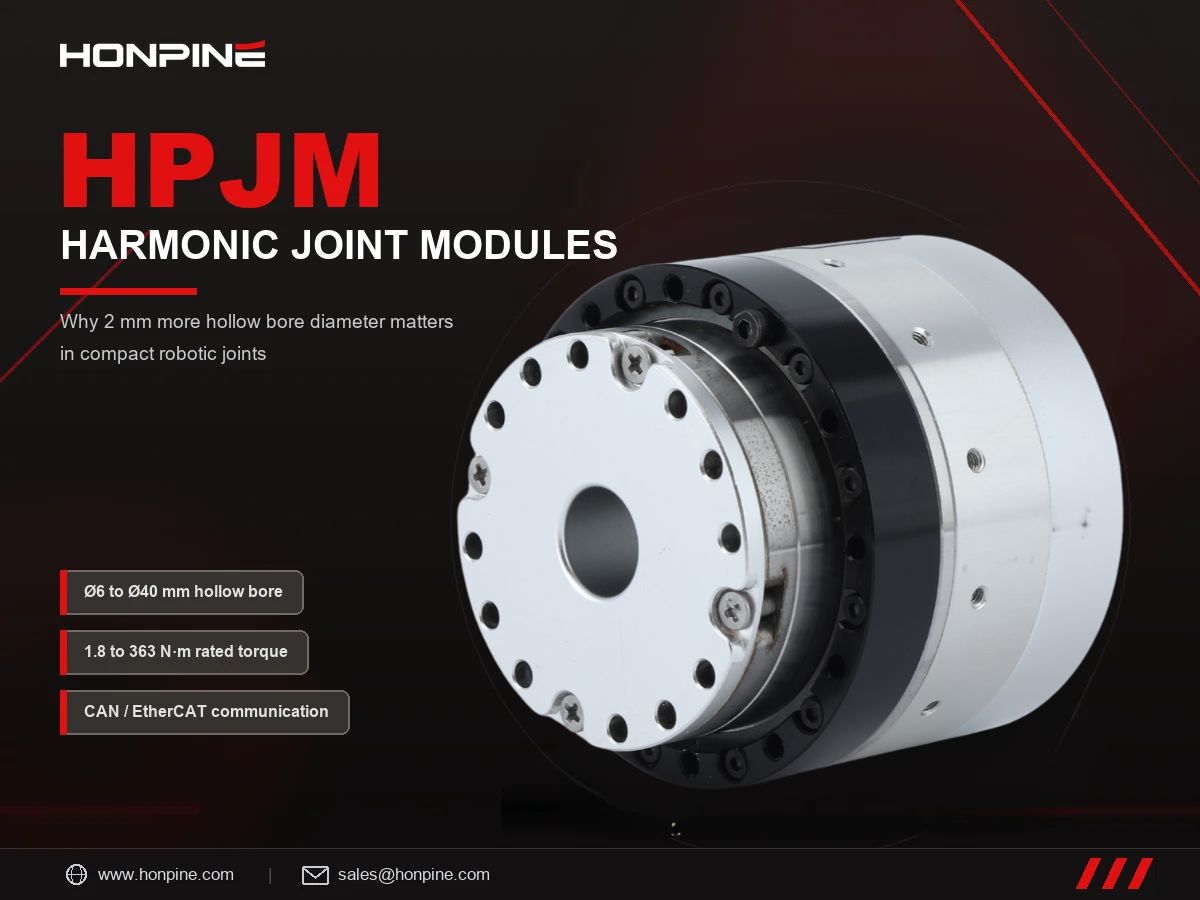
 Why Do Many Customers Choose HONPINE HPJM Harmonic Joint Modules for Just 2 mm More Hollow Bore Diameter?Why do many customers choose HONPINE HPJM harmonic joint modules for just 2 mm more hollow bore diameter? In compact robotic joints, this small dimensional difference can create a surprisingly large increase in available space. Because the cross-sectional area of a circular bore increases with the square of its diameter, an extra 2 mm can significantly improve internal cable routing and simplify system integration. This article examines the impact of hollow bore diameter, compares selected HONPINE HPJM models with comparable harmonic joint modules, and explains why bore size matters in humanoid robots, collaborative robots, and industrial automation.
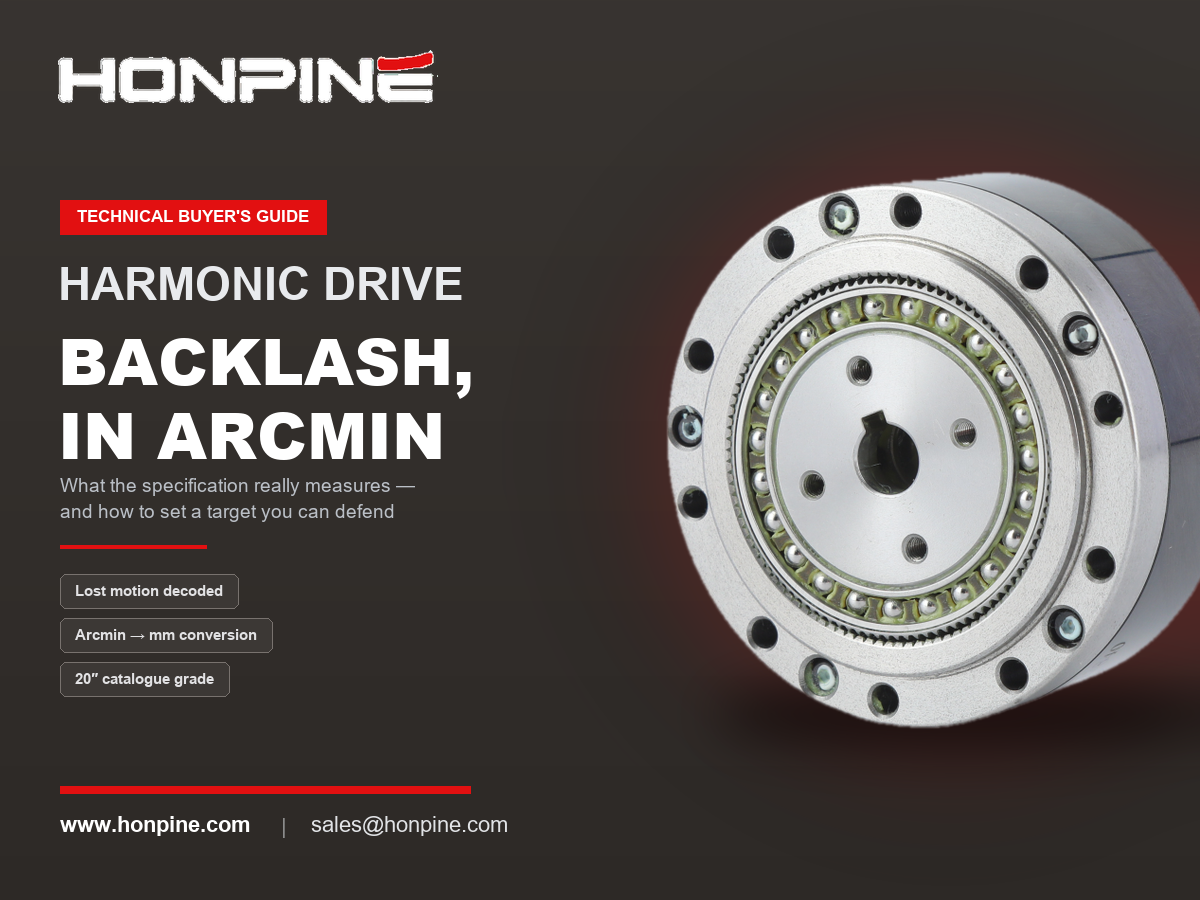
 Harmonic Drive Backlash in Arcmin: What the Specification Really Tells YouChoosing the right force control harmonic joint actuator involves more than comparing torque and dimensions. Torque sensor specifications, encoder feedback, communication protocols, functional safety, and hollow-shaft size can all affect system integration and control performance. In this guide, HONPINE Technical Director compares the TCHL and HAG harmonic joint actuator series, explaining their key differences and providing a practical selection framework for humanoid robots, collaborative manipulators, precision assembly, polishing, and other force-controlled applications.
Double Click
We provide harmonic drive reducer,planetary reducer,robot joint motor,robot rotary actuators,RV gear reducer,robot end effector,dexterous robot hand