








How to Select and Use Robotic Joint Modules?
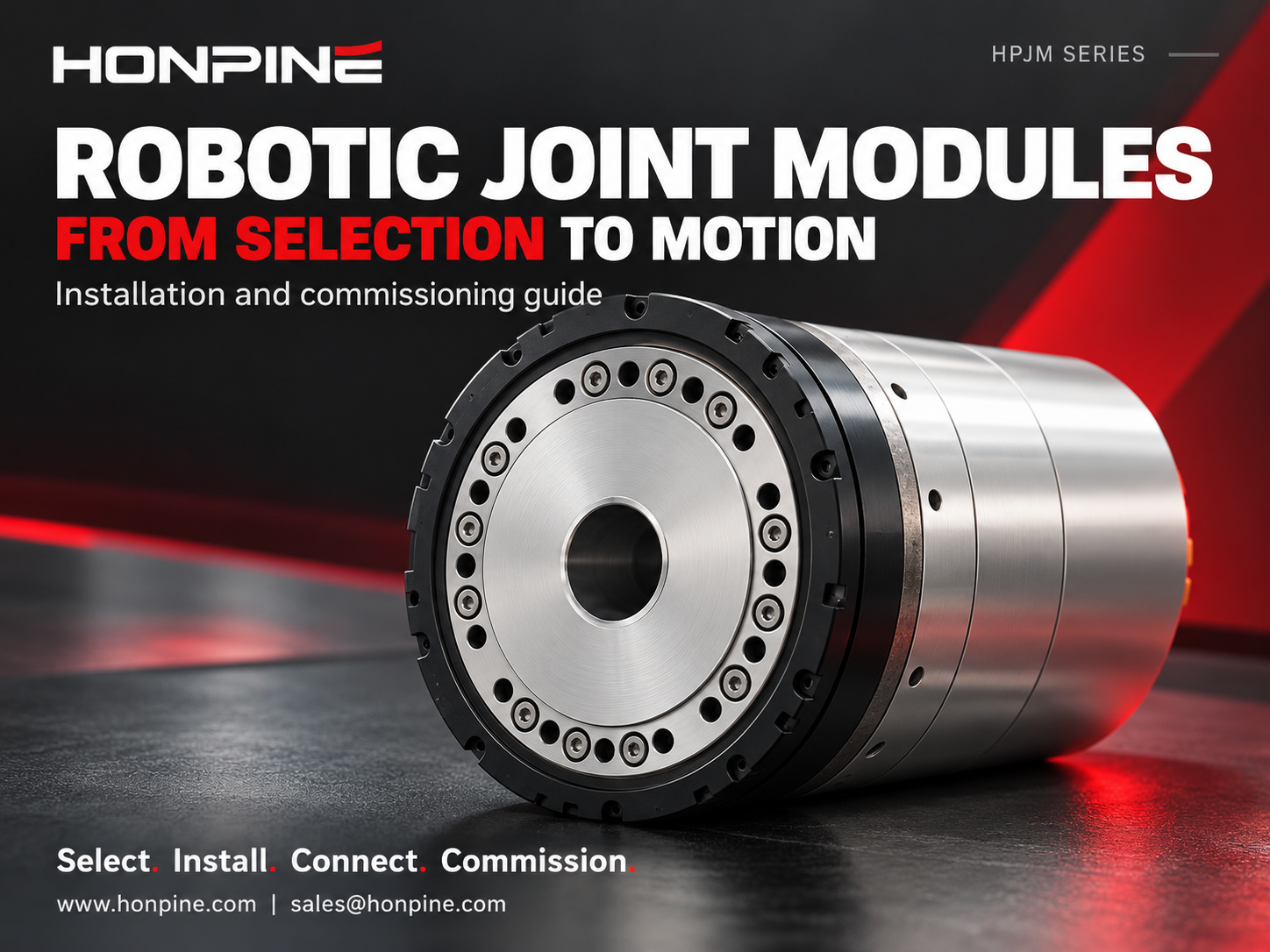
Hello, I’m Theodore Li, Technical Director at HONPINE. In this article, I’ll use the HONPINE HPJM harmonic joint module series to explain how to select and commission robotic joint modules, covering mechanical installation, electrical wiring, communication configuration, and control setup.
A robotic joint module integrates the drive electronics, reduction mechanism, encoders, and brake into a compact cylindrical assembly. However, receiving the module does not mean your robot is ready to move. An incorrect selection can force you to redesign the wiring and communication architecture, while improper connections can cause communication errors and repeated alarms during commissioning.
What often slows down implementation is the lack of a clear process connecting product selection with successful operation. Understanding the complete workflow helps engineers avoid unnecessary modifications and get their systems running more efficiently.
1. How to Select a Robotic Joint Module: The HPJM Series as an Example
The HONPINE HPJM series covers outer diameters from 30 to 170 mm, with single-encoder and dual-encoder configurations available across the range. This provides options for joints of different sizes, from compact joints in dexterous hands to larger humanoid hip joints.
One decision that should be finalized early is the communication interface. Single-encoder HPJM modules use CAN communication, while dual-encoder versions support CAN and EtherCAT. Hand applications commonly use RS-485, depending on the selected actuator and system architecture.
At HONPINE, we emphasize defining the communication bus and power supply architecture before completing the mechanical design. These decisions affect the controller, wiring layout, and integration strategy. Leaving them until after prototype assembly can lead to unnecessary modifications.
2. Why Are Integrated Joint Modules Easier to Install and Use?
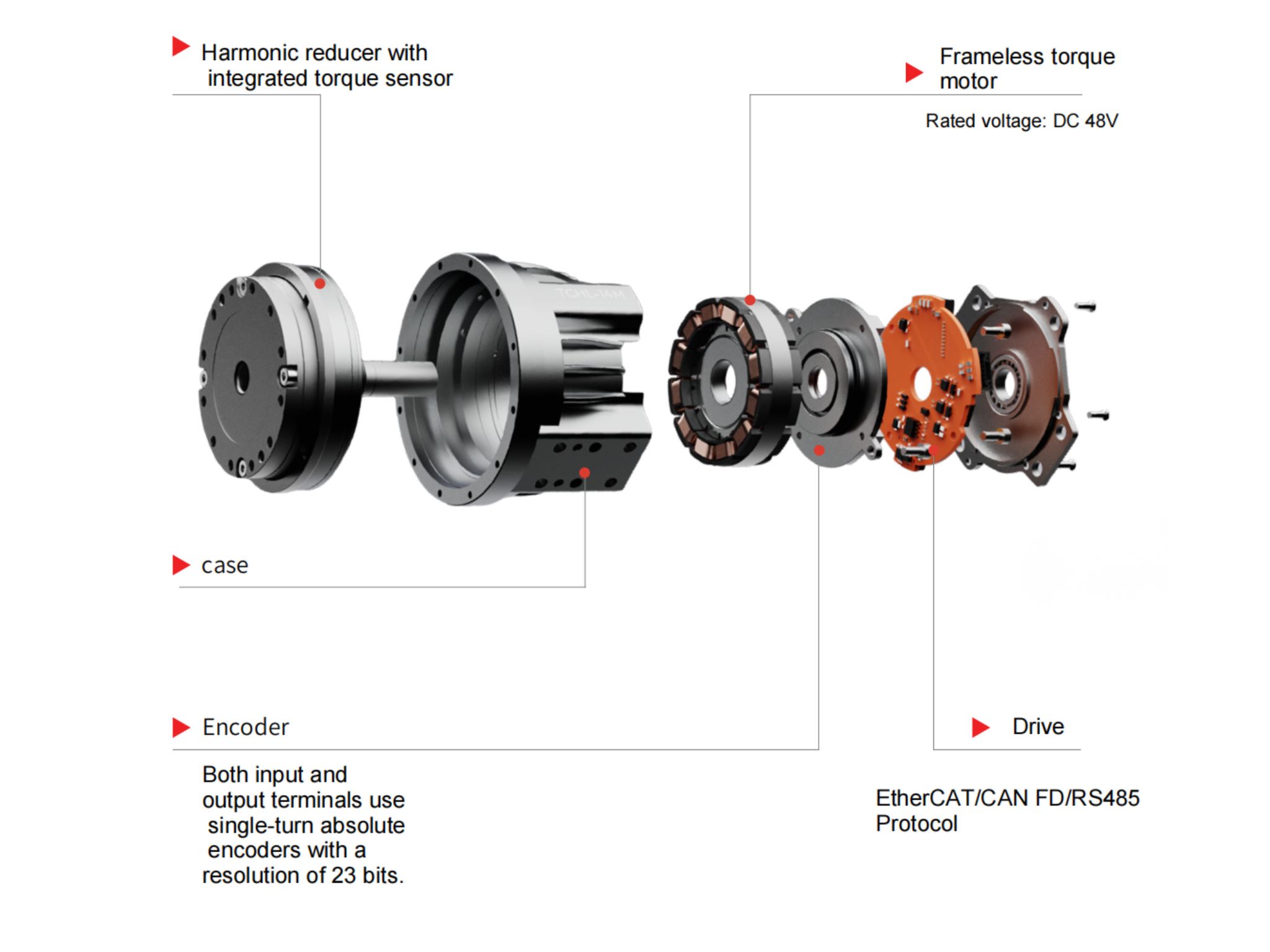
One of the main advantages of modern lightweight joint modules is that much of the integration work is completed at the factory, simplifying implementation for the customer. The HPJM harmonic joint module combines a servo drive, encoder system, frameless torque motor, brake, and harmonic reducer in a single assembly.
This integrated design simplifies installation and operation while reducing routine maintenance requirements. The large through-hole also provides space for routing cables and pneumatic tubing, helping engineers organize connections throughout the robot.
Mechanical installation still requires careful attention. Although the module simplifies integration, its mounting accuracy must be provided by the surrounding structure. The mounting surfaces and alignment must be properly established by your mechanical components. An integrated design does not eliminate the need for accurate and secure installation.

3. Electrical Wiring: Power and Communication
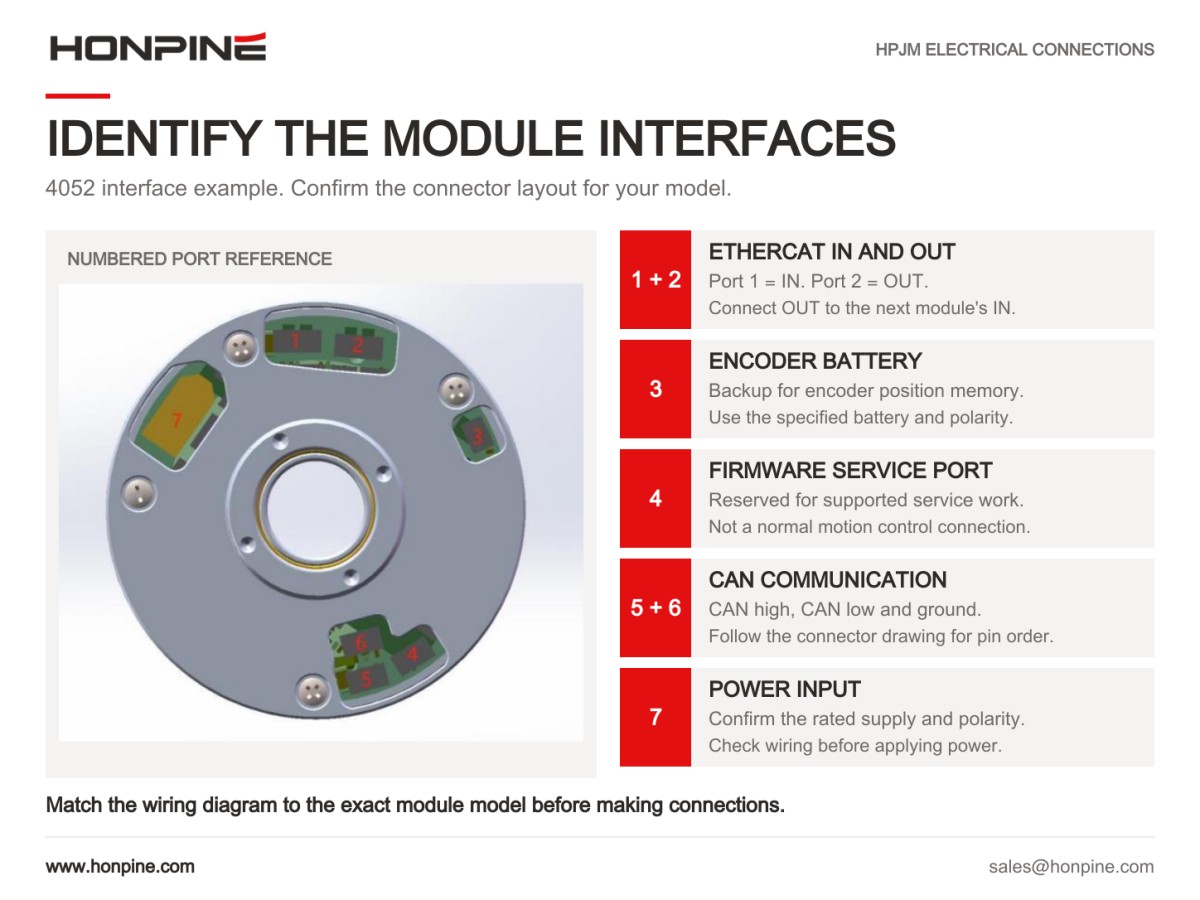
Electrical wiring involves two main connections: power and communication. Both require careful attention, because an incorrect connection can prevent the module from operating or cause faults during commissioning.
The HPJM module uses a rectangular power connector with designated positive and negative terminals. Confirm the polarity using the connector drawing for the specific model before connecting the power supply. The CAN interface uses three connections: H for CAN high, L for CAN low, and G for ground.
The EtherCAT interface provides separate IN and OUT ports, with Tx+, Tx−, Rx+, and Rx− communication signals. With T568B cable color coding, these correspond to white/orange, orange, white/green, and green. Always follow the module’s specified connector pinout when preparing or checking cables.
On dual-encoder modules, EtherCAT and CAN interfaces can coexist. However, control commands from both interfaces cannot be active simultaneously. EtherCAT takes priority over CAN, so the controller configuration must account for the intended command source.
4. Communication Configuration: CAN and EtherCAT
Communication connects individual joints into a coordinated robotic system. CAN and EtherCAT each have their own configuration requirements, and the choice should reflect the controller platform, number of joints, and required update rate.
For the HPJM series, the stated CAN communication rate is 1 Mbps. In an application with seven motors, the communication update rate is approximately 300 Hz. Each module must have a unique CAN ID. Assigning IDs sequentially makes a system with multiple modules easier to manage, troubleshoot, and expand.
The HPJM series supports EtherCAT communication at 100 Mbps, with supported communication update rates of up to 4 kHz. EtherCAT is designed to maintain short communication cycles across multiple slave devices. The achievable update rate should still be confirmed for the actual master, network configuration, and process data requirements.
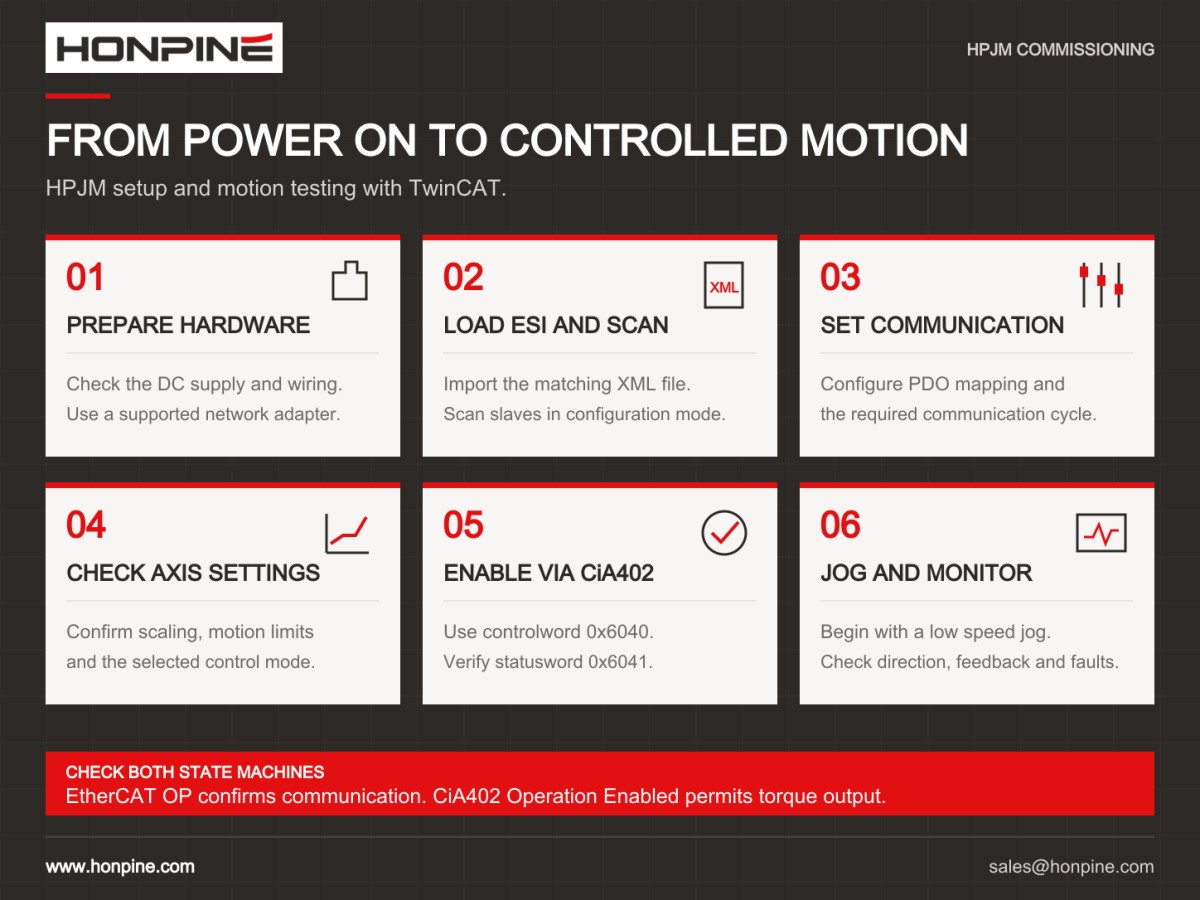
An EtherCAT system consists of a master and multiple slaves. The master can be a software platform such as TwinCAT or CODESYS, or a compatible PLC from manufacturers such as Inovance and HCFA. During initial testing, a computer running TwinCAT or CODESYS provides a convenient platform for verifying communication and basic operation.
When connecting the network, run the master’s EtherCAT connection to the IN port of the first slave, then connect that slave’s OUT port to the IN port of the next slave. Continue this sequence through the remaining modules. Maintaining the correct IN-to-OUT sequence helps preserve the expected network topology and slave identification.
5. Control and Commissioning: Getting the Joint Moving
Once the wiring and communication configuration are complete, the next step is to make the joint respond correctly to your controller. Available operating modes include position control, velocity control, current or torque control, and hybrid force-position control. These modes support applications ranging from positioning and trajectory tracking to compliant interaction with people, tools, and the surrounding environment.
HPJM joint motors follow the IEC 61800-7 framework and the CiA 402 drive state machine. In practical terms, commissioning progresses through initialization, a disabled state, readiness, enabling, and operation. The controller must issue the appropriate commands for each state transition rather than sending motion commands immediately after power-up. The exact transition sequence and controlword settings should follow the documentation for the selected module.
HPJM modules also provide alarm codes and green and blue status indicators to assist troubleshooting. Typical issues include failure to open the CAN interface, a communication device already being used by another application, drive chip faults, overvoltage, undervoltage, and encoder faults. The corresponding troubleshooting instructions explain how to check and resolve these conditions.
During commissioning, read the statusword and any active fault information before issuing motion commands. This helps identify the actual problem and reduces unnecessary trial and error.
6. How HONPINE Helps Customers Avoid Selection Mistakes
HONPINE offers several robotic joint module series for different application requirements. Our harmonic joint modules include the HPJM, TCHL, and HAG series, while our planetary joint modules include the JRM and HPA series. At the beginning of the selection process, we assess the customer’s budget and operating conditions to recommend a suitable configuration.
Successfully implementing a robotic joint module involves five connected steps: selecting the correct specifications, installing the module accurately and securely, completing the electrical wiring, configuring the communication network, and commissioning the module according to its drive state machine. Each step contributes to reliable operation, and decisions made early in the process affect the work that follows.
HONPINE provides dedicated, one-to-one technical support throughout selection, prototyping, small-batch production, and volume delivery. Tell us your joint load requirements, controller platform, and production schedule, and we will help you select a robotic joint module suited to your application.

About Author
Theodore Li serves as the Technical Director at HONPINE, overseeing the R&D strategy for replication products, guiding team selection, and managing both pre-sales and after-sales operations.

Read More
Learn more about the story of HONPINE and industry trends related to precision transmission.
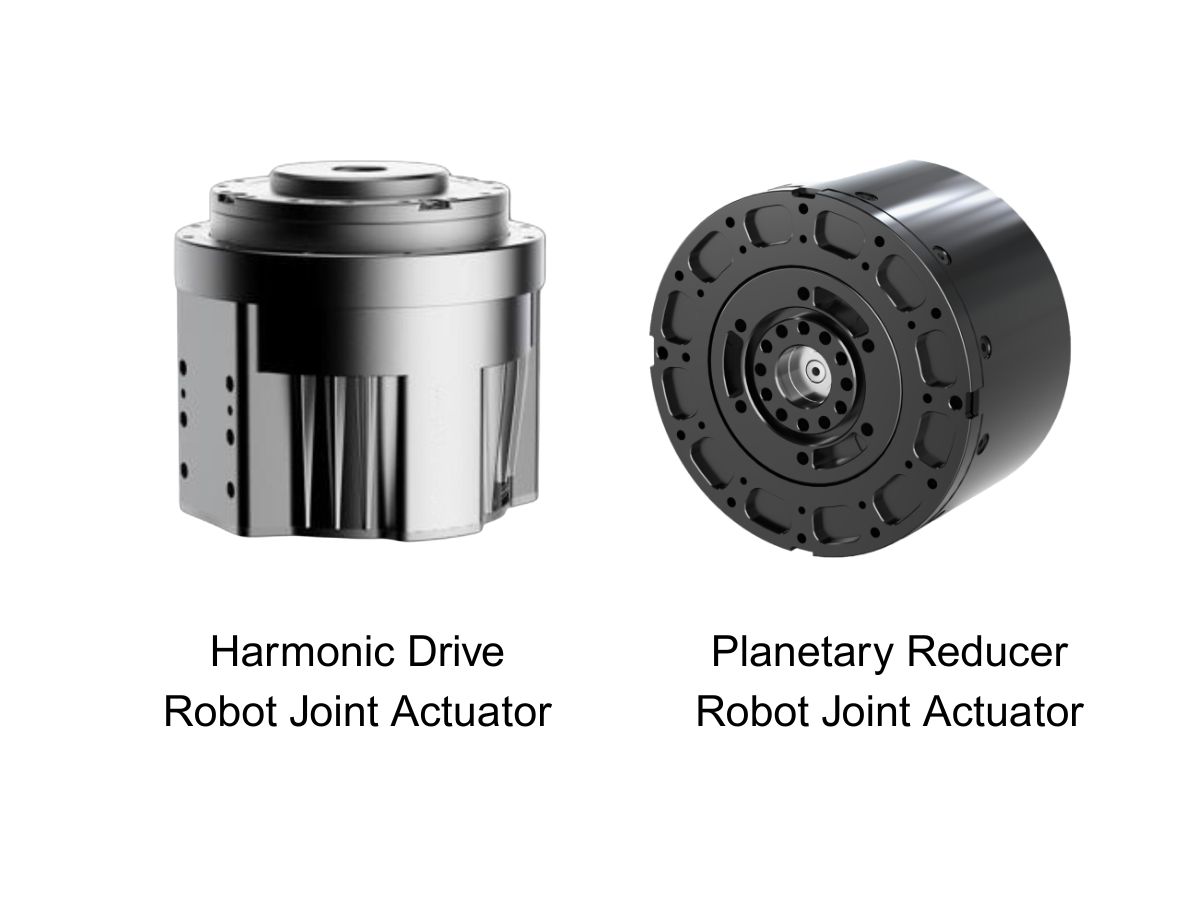
 What is robot joint actuator?How to Choose the Best Robot Rotary Joint Actuator?In core robot joint transmission solutions, planetary and harmonic rotary actuators each have their own strengths. Choosing the right type based on application requirements is essential to achieve the optimal balance between performance and cost.
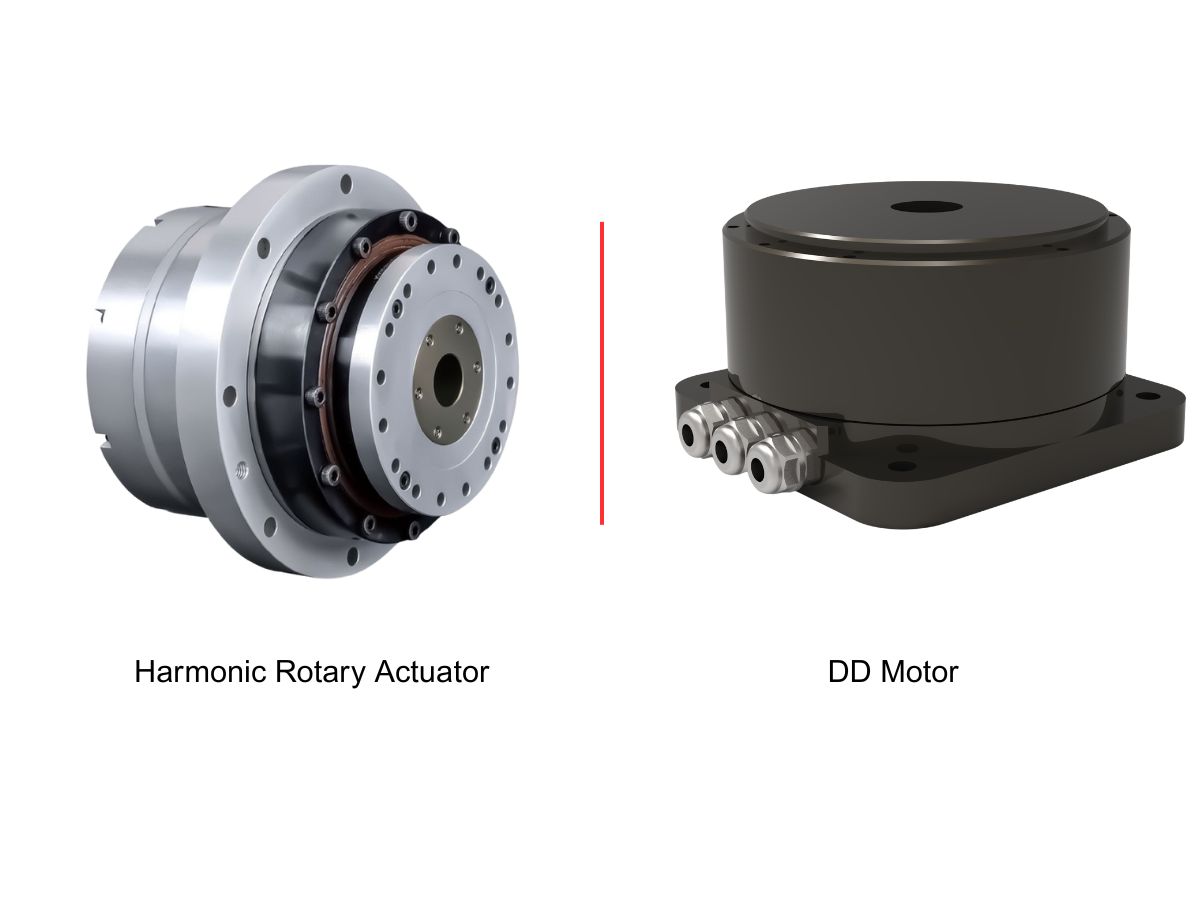
 DD Motors VS Harmonic Rotary ActuatorsThis article provides an in-depth comparison between Direct Drive (DD) motors and harmonic rotary actuators, covering their transmission principles, advantages and disadvantages, and typical application fields.
 OMG Ultra Compact Harmonic Drive Joint Module with Built-in Torque SensorHONPINE TCHL series harmonic drive joint module is a game-changing product that achieves disruptive improvements in multiple aspects such as lightweight design, integration level, and connection convenience. This article will analyze its revolutionary enhancements with you.
 The Role of Harmonic Drive Gears in Achieving 5–10 μm Accuracy in Dental Milling MachinesA dental milling machine is a CNC machining system used to directly process digital dental models into restorations such as crowns, bridges, veneers, inlays, and implant abutments. Dental milling machines require far higher operational accuracy and motion stability than ordinary equipment. This article explains how harmonic drive gear help dental milling machines achieve stable, continuous, and controllable operation.
 Why Are Harmonic Rotary Actuators Perfect for Medical Equipment?Harmonic rotary actuators (typically integrated systems consisting of a harmonic drive reducer, frameless torque motor, encoder, and optional brake) are regarded as key components in medical equipment. The core reason is that they simultaneously meet the most stringent medical requirements for precision, compact size, safety, and controllability. The following explanation is structured from three perspectives: technical characteristics, application scenarios, and medical value.
 High-Precision RV Reducers Perfectly Matched for Walking RobotsThe walking axis of a robot is a core component for power transmission and support. RV reducers provide extremely high rigidity, precision, and torque while maintaining a compact size and exceptional reliability, making them an ideal match for the demanding requirements of walking robot joints in terms of load capacity, impact resistance, and precision.
 How to Select and Use Robotic Joint Modules?How do you take robotic joint modules from selection to controlled motion? Using the HONPINE HPJM harmonic joint module as an example, Technical Director Theodore Li explains the key steps in mechanical installation, electrical wiring, CAN and EtherCAT configuration, and control commissioning. Learn what to confirm before integration and how to approach setup so each joint can respond correctly to your controller.
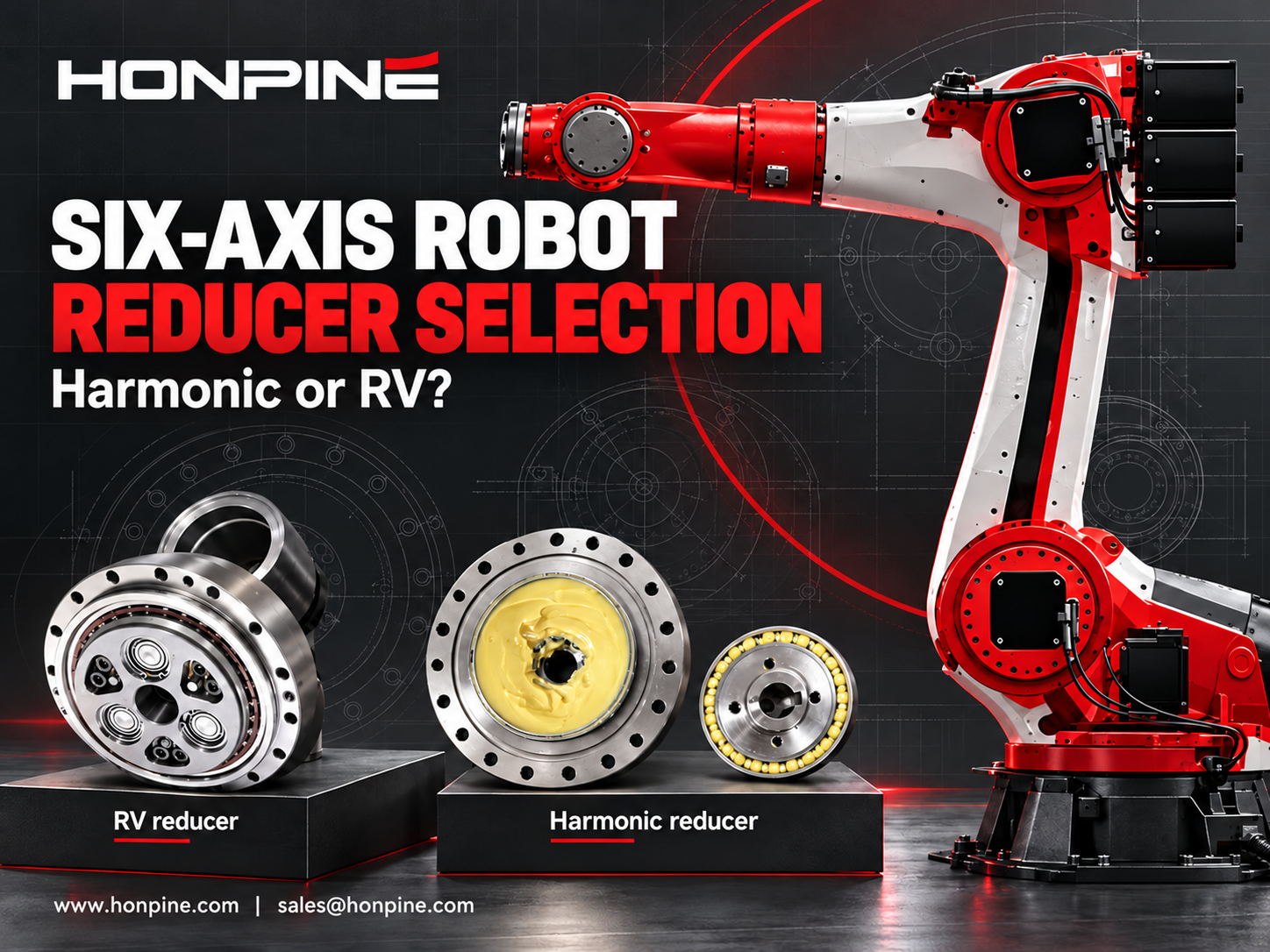
 How to Select Harmonic and RV Reducers for Each Axis of a Six-Axis Robot?What determines whether a six-axis robot joint needs a harmonic reducer or an RV reducer? The answer depends on torque, inertia, impact loads, bearing loads and installation space. This guide explains how to evaluate harmonic and RV reducers for the base, shoulder, elbow and wrist, with practical checks for stiffness, backlash and service life. Use the requirements of each axis to select a suitable reducer configuration.
 Top 7 RV Reducer Gearbox Manufacturers: Why Does Nabtesco Still Dominate?What sets RV reducer gearbox manufacturers apart, and why does Nabtesco remain a benchmark in this market? RV reducer production demands precise component machining, careful assembly and extensive engineering know-how. This article introduces seven manufacturers across RV reducers and related transmission technologies, examines the strengths behind Nabtesco's position, and explores HONPINE's development capabilities to help you understand the supplier landscape.
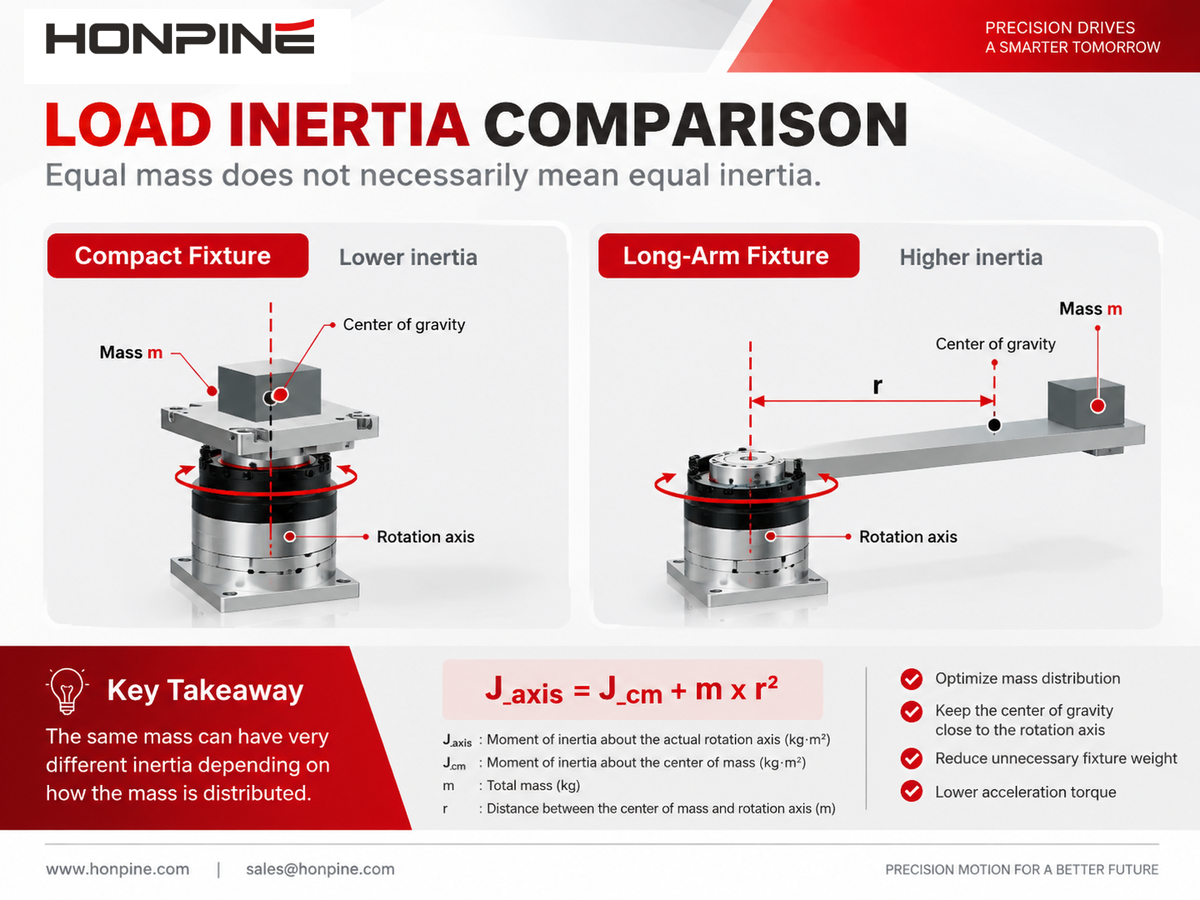
 How to Calculate Torque for a Harmonic Rotary Actuator in a Flipping Mechanism?How much torque does a harmonic rotary actuator need to flip a 10 kg load through 180 degrees? The answer depends on more than weight. Center-of-gravity offset, load inertia, acceleration and operating frequency all affect actuator selection. In this guide, Theodore Li, Technical Director at HONPINE, explains the calculation process using a horizontal-axis flipping example and outlines the checks needed for peak torque, continuous operation, output speed and bearing loads.
 Why Are Harmonic Reducers Suitable for CNC Machine Tool Rotary Tables?Why choose harmonic reducers for CNC rotary tables? Accurate indexing depends on more than the motor: backlash, torsional stiffness and torque capacity all affect how reliably a rotary table holds its position during machining. This guide explains the key transmission requirements of fourth and fifth axis rotary tables, explores common machine tool applications, and introduces HONPINE harmonic reducer configurations for different installation and load requirements.
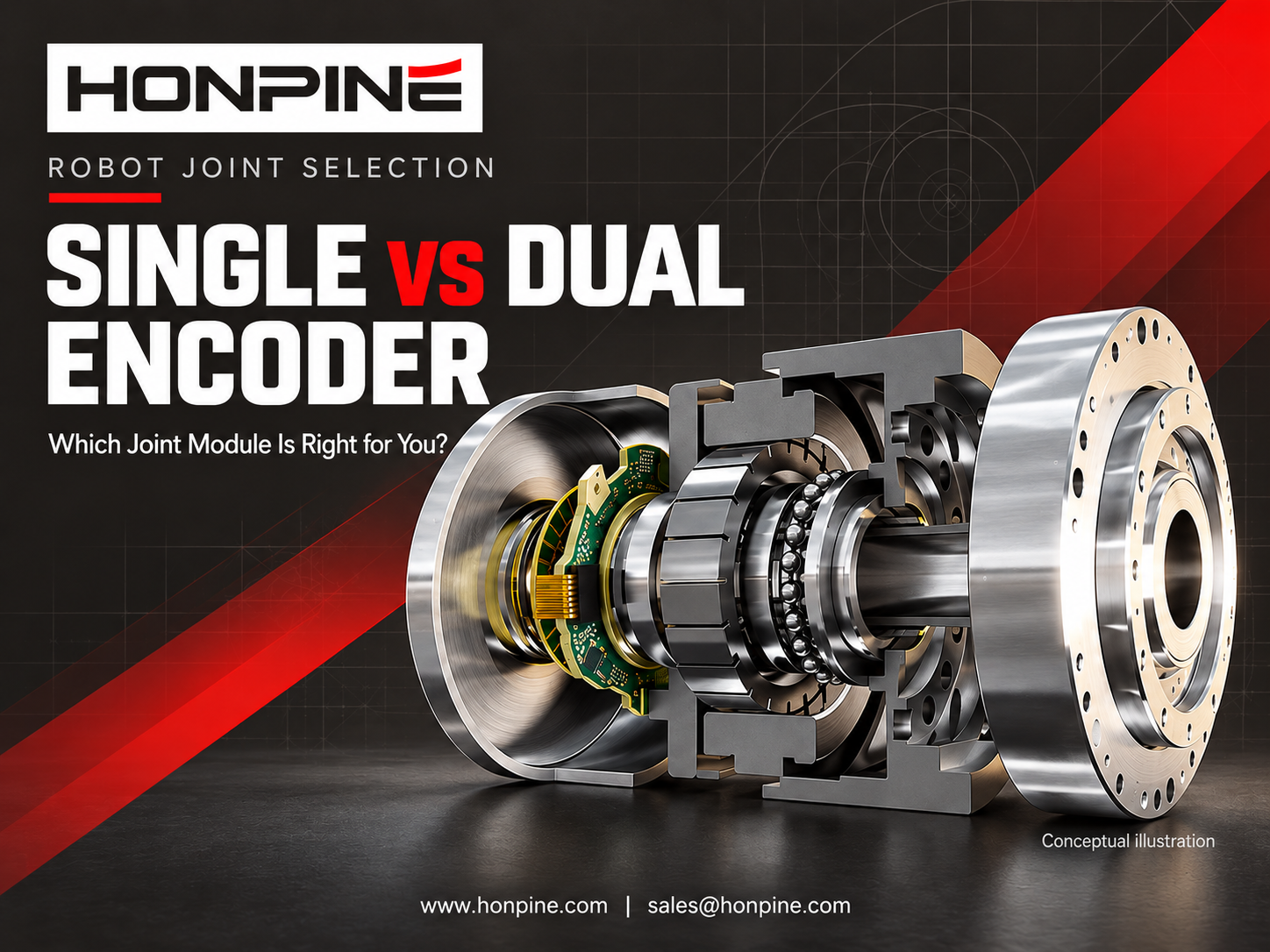
 What’s the Difference Between Single and Dual Encoder Robot Joint Modules?Does your robot need a dual encoder joint module, or is a single encoder enough? The answer depends on positioning requirements, transmission behavior, force control strategy and budget. This guide compares motor-side and output-side feedback, explains where dual encoders can improve control, and examines their costs and limitations. Learn when a single encoder can meet your needs and when additional output feedback is worth considering.
Double Click
We provide harmonic drive reducer,planetary reducer,robot joint motor,robot rotary actuators,RV gear reducer,robot end effector,dexterous robot hand
 What is robot joint actuator?How to Choose the Best Robot Rotary Joint Actuator?In core robot joint transmission solutions, planetary and harmonic rotary actuators each have their own strengths. Choosing the right type based on application requirements is essential to achieve the optimal balance between performance and cost.
 DD Motors VS Harmonic Rotary ActuatorsThis article provides an in-depth comparison between Direct Drive (DD) motors and harmonic rotary actuators, covering their transmission principles, advantages and disadvantages, and typical application fields.
 OMG Ultra Compact Harmonic Drive Joint Module with Built-in Torque SensorHONPINE TCHL series harmonic drive joint module is a game-changing product that achieves disruptive improvements in multiple aspects such as lightweight design, integration level, and connection convenience. This article will analyze its revolutionary enhancements with you.
 How to Select and Use Robotic Joint Modules?How do you take robotic joint modules from selection to controlled motion? Using the HONPINE HPJM harmonic joint module as an example, Technical Director Theodore Li explains the key steps in mechanical installation, electrical wiring, CAN and EtherCAT configuration, and control commissioning. Learn what to confirm before integration and how to approach setup so each joint can respond correctly to your controller.
 How to Select Harmonic and RV Reducers for Each Axis of a Six-Axis Robot?What determines whether a six-axis robot joint needs a harmonic reducer or an RV reducer? The answer depends on torque, inertia, impact loads, bearing loads and installation space. This guide explains how to evaluate harmonic and RV reducers for the base, shoulder, elbow and wrist, with practical checks for stiffness, backlash and service life. Use the requirements of each axis to select a suitable reducer configuration.
 Top 7 RV Reducer Gearbox Manufacturers: Why Does Nabtesco Still Dominate?What sets RV reducer gearbox manufacturers apart, and why does Nabtesco remain a benchmark in this market? RV reducer production demands precise component machining, careful assembly and extensive engineering know-how. This article introduces seven manufacturers across RV reducers and related transmission technologies, examines the strengths behind Nabtesco's position, and explores HONPINE's development capabilities to help you understand the supplier landscape.
 How to Calculate Torque for a Harmonic Rotary Actuator in a Flipping Mechanism?How much torque does a harmonic rotary actuator need to flip a 10 kg load through 180 degrees? The answer depends on more than weight. Center-of-gravity offset, load inertia, acceleration and operating frequency all affect actuator selection. In this guide, Theodore Li, Technical Director at HONPINE, explains the calculation process using a horizontal-axis flipping example and outlines the checks needed for peak torque, continuous operation, output speed and bearing loads.
 Why Are Harmonic Reducers Suitable for CNC Machine Tool Rotary Tables?Why choose harmonic reducers for CNC rotary tables? Accurate indexing depends on more than the motor: backlash, torsional stiffness and torque capacity all affect how reliably a rotary table holds its position during machining. This guide explains the key transmission requirements of fourth and fifth axis rotary tables, explores common machine tool applications, and introduces HONPINE harmonic reducer configurations for different installation and load requirements.
 What’s the Difference Between Single and Dual Encoder Robot Joint Modules?Does your robot need a dual encoder joint module, or is a single encoder enough? The answer depends on positioning requirements, transmission behavior, force control strategy and budget. This guide compares motor-side and output-side feedback, explains where dual encoders can improve control, and examines their costs and limitations. Learn when a single encoder can meet your needs and when additional output feedback is worth considering.
 RV vs Harmonic Reducer: How to Choose the Right Gearbox for Robot Joints?RV vs harmonic reducer: which gearbox is right for your robot joint? The answer depends on torque, rigidity, accuracy, installation space and operating conditions. This guide compares their working principles and five key performance factors, then explains how to evaluate joint loads, reducer life, temperature and lubrication. Whether you are designing a robot base, shoulder, elbow or wrist, use these considerations to match the reducer to the requirements of each joint.
 How to Find a Reliable Robotic Joint Actuator Supplier?Choosing the right robotic joint actuator supplier is essential for reliable performance, smooth integration and long-term project success. Beyond product specifications, you need to understand a supplier’s technical expertise, production capacity and after-sales support. In this guide, Allen Li, Founder of HONPINE, explains how to assess these three factors when sourcing harmonic and planetary joint actuators for robotics and industrial automation.
 Harmonic Reducer vs. Harmonic Rotary Actuator: Which Is Better for CNC Machine Tools?Choosing between a harmonic reducer and a harmonic rotary actuator is an important decision in CNC machine tool design. Both solutions offer high-precision motion control, but they differ in integration, installation requirements, rigidity, and system flexibility. For CNC fourth-axis rotary tables and compact five-axis machining systems, selecting the right harmonic drive can significantly influence machine performance. In this article, HONPINE Technical Director Theodore Li compares harmonic reducers and harmonic rotary actuators to help engineers identify the most suitable solution for their CNC applications.