








How to Select Harmonic and RV Reducers for Each Axis of a Six-Axis Robot?
When selecting reducers for a six-axis robot, customers often ask a seemingly simple question:
“Should the first three axes use RV reducers and the last three axes use harmonic reducers?”
In practice, this rule is too rigid to apply to every robot.
A more useful approach is to ask:
- What equivalent torque must each axis withstand over its operating cycle?
- How severe are the acceleration, deceleration, emergency-stop, and process-related impact loads?
- What overturning moments act on the joint, and how sensitive is the application to backlash and torsional stiffness?
- Is there enough installation space for an RV reducer?
Evaluating these factors for each axis is more reliable than selecting a reducer solely according to its J1–J6 designation.
1. Understand the Selection Boundaries Between RV and Harmonic Reducers
RV Reducers: High Rigidity, Load Capacity, and Shock Resistance
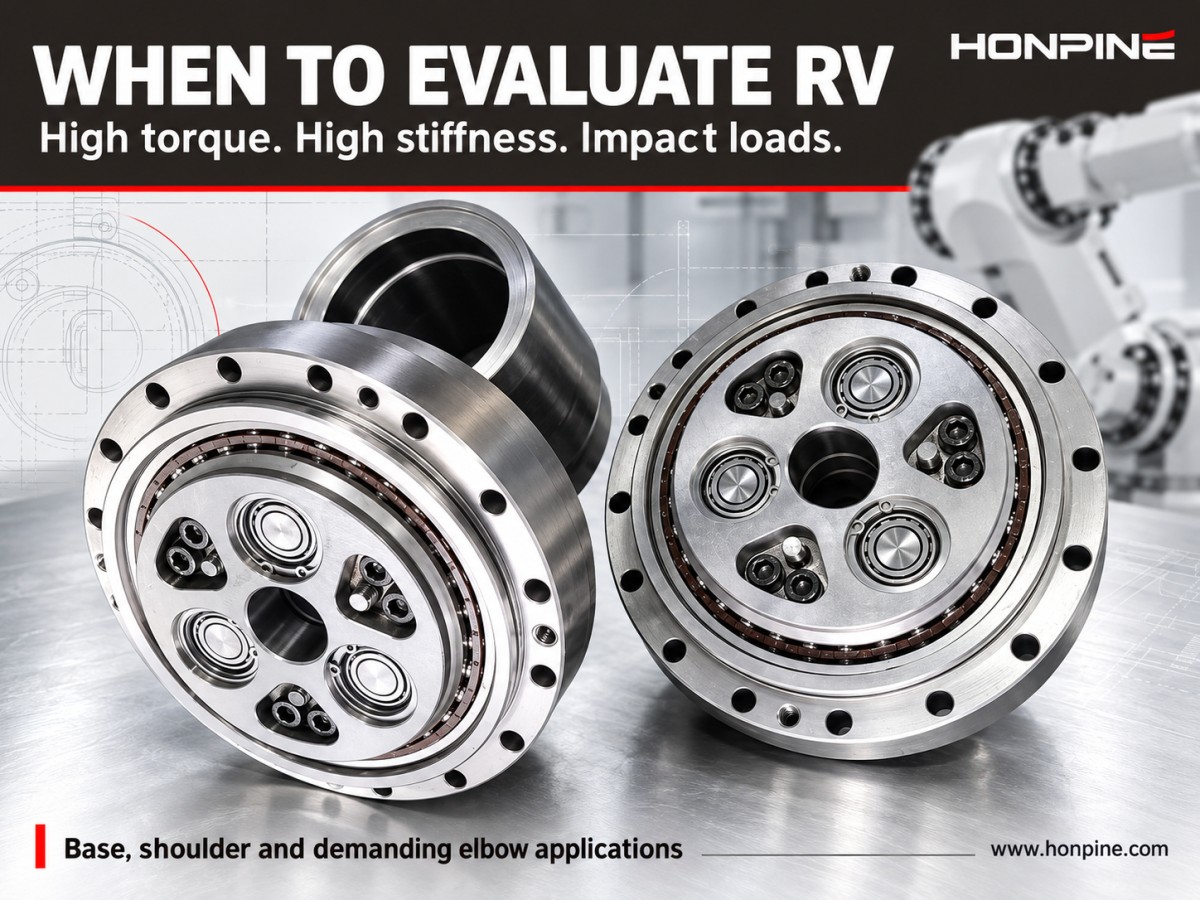
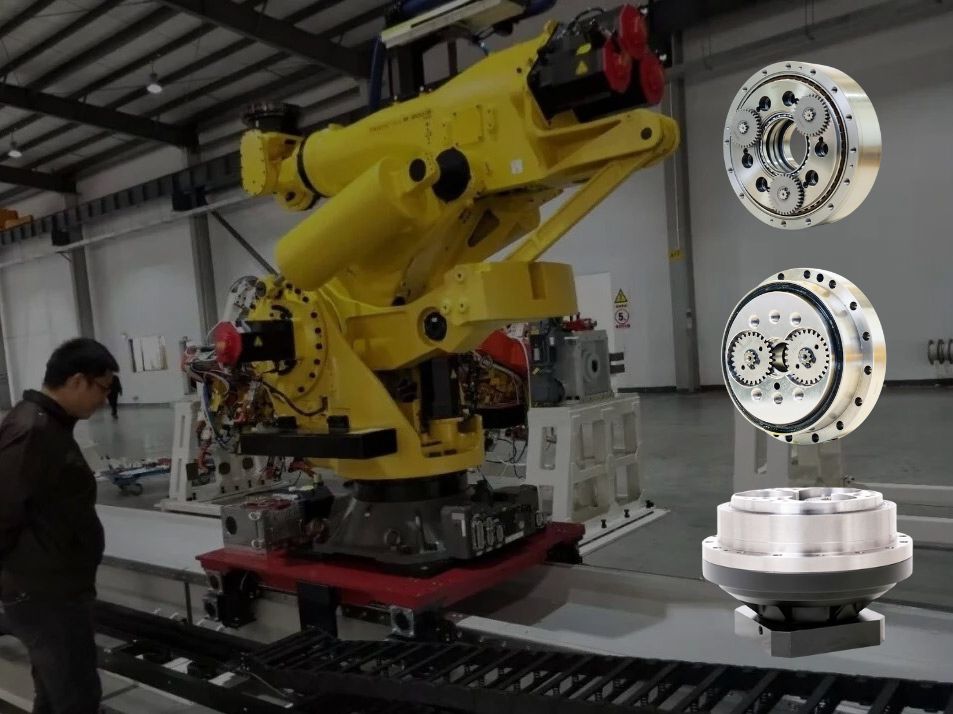
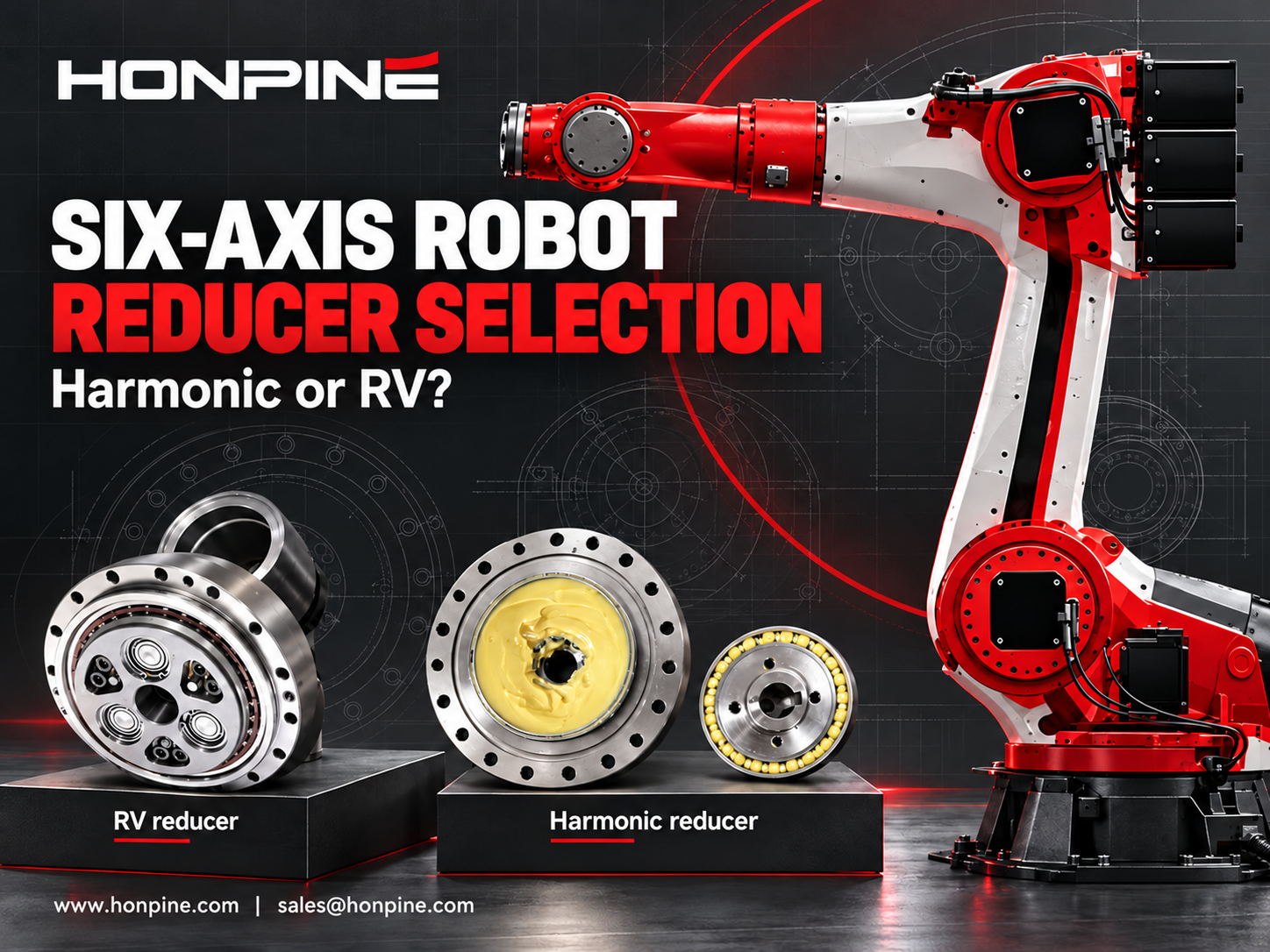
RV reducers, also known as precision planetary cycloidal reducers, are typically selected for their high rigidity, substantial load capacity, shock resistance, integrated main bearings, and stable backlash performance.
Using the quoted Nabtesco RV-N catalog data as an example, the 10N–500N frame sizes cover approximately:
- Rated torque: 80–5,000 N·m
- Reduction ratio: 31–171
- Lost motion: ≤1 arcmin
- Efficiency at the rated operating point: commonly specified as ≥85%
Actual efficiency varies with operating speed, temperature, and lubrication conditions.
The allowable output speeds quoted for individual frame sizes are shown below.
The RV-E and RV-C series incorporate angular contact main bearings and specify lost motion of ≤1 arcmin. Shock-load checks may be performed against catalog limits of approximately five times the rated torque, where applicable to the selected model.
Harmonic Reducers: Compact Size, Low Weight, and High Reduction Ratios
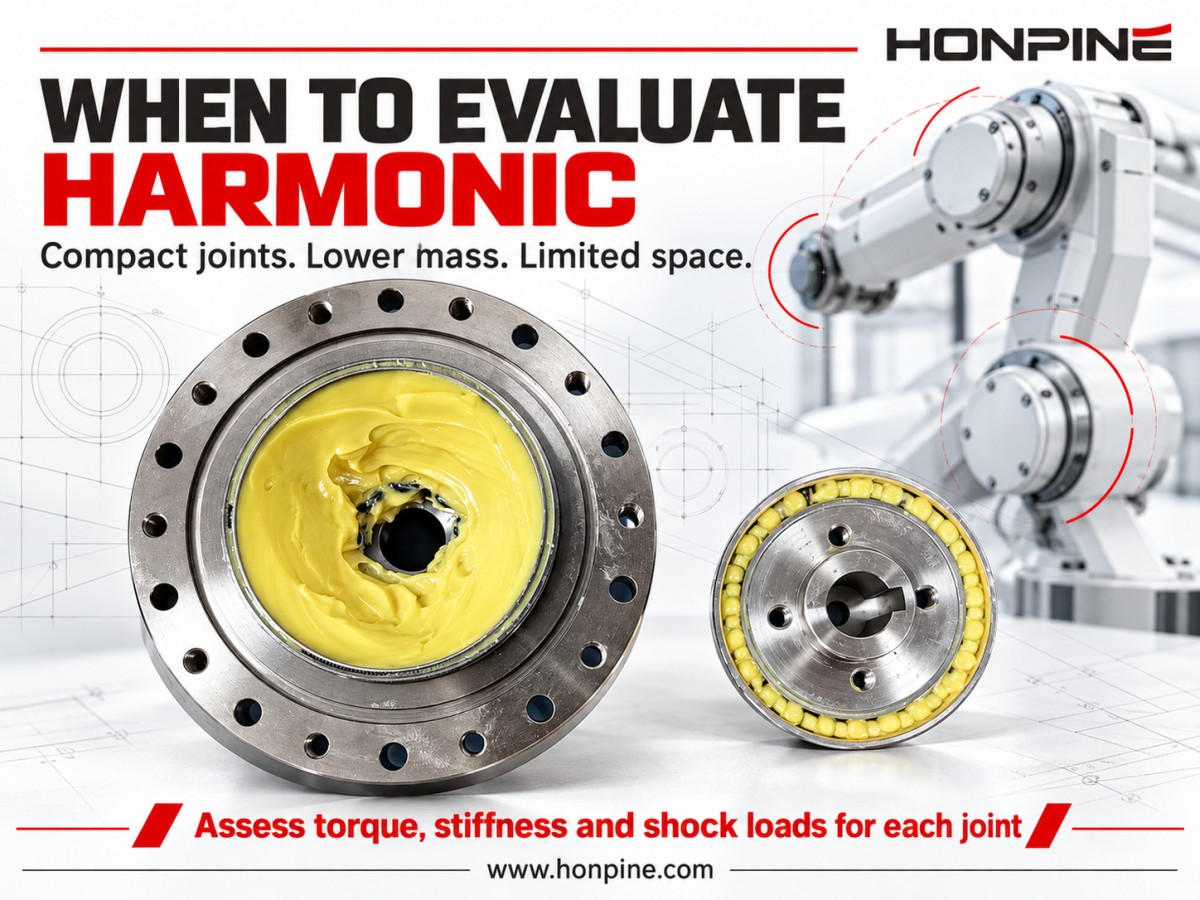
Harmonic reducers are typically chosen for their compact dimensions, high reduction ratios, low weight, and low backlash.
However, their flexspline load capacity and their ability to accommodate radial loads and overturning moments can be more limited than those of RV reducers.
The accuracy grades referenced in this article are summarized below.
In general applications, harmonic reducers are often used in lightweight wrist joints and collaborative robot end joints. RV reducers are more commonly used in shoulder joints and other heavily loaded axes.
A harmonic-only solution should be evaluated carefully when the mechanism has a long overhang or is exposed to substantial impact loads.
Select According to Operating Conditions
The selection principle is more detailed than “heavy loads require RV reducers, while light loads require harmonic reducers.”
RV reducers generally deserve priority when:
- Equivalent torque is high.
- Acceleration, deceleration, emergency stops, or process impacts generate substantial loads.
- The joint supports a long overhang or a large overturning moment.
- The application is sensitive to torsional deformation.
Harmonic reducers generally deserve priority when:
- Installation space is extremely limited.
- Required torque is relatively low.
- Low joint weight is important.
- Hollow-shaft cable routing is required.
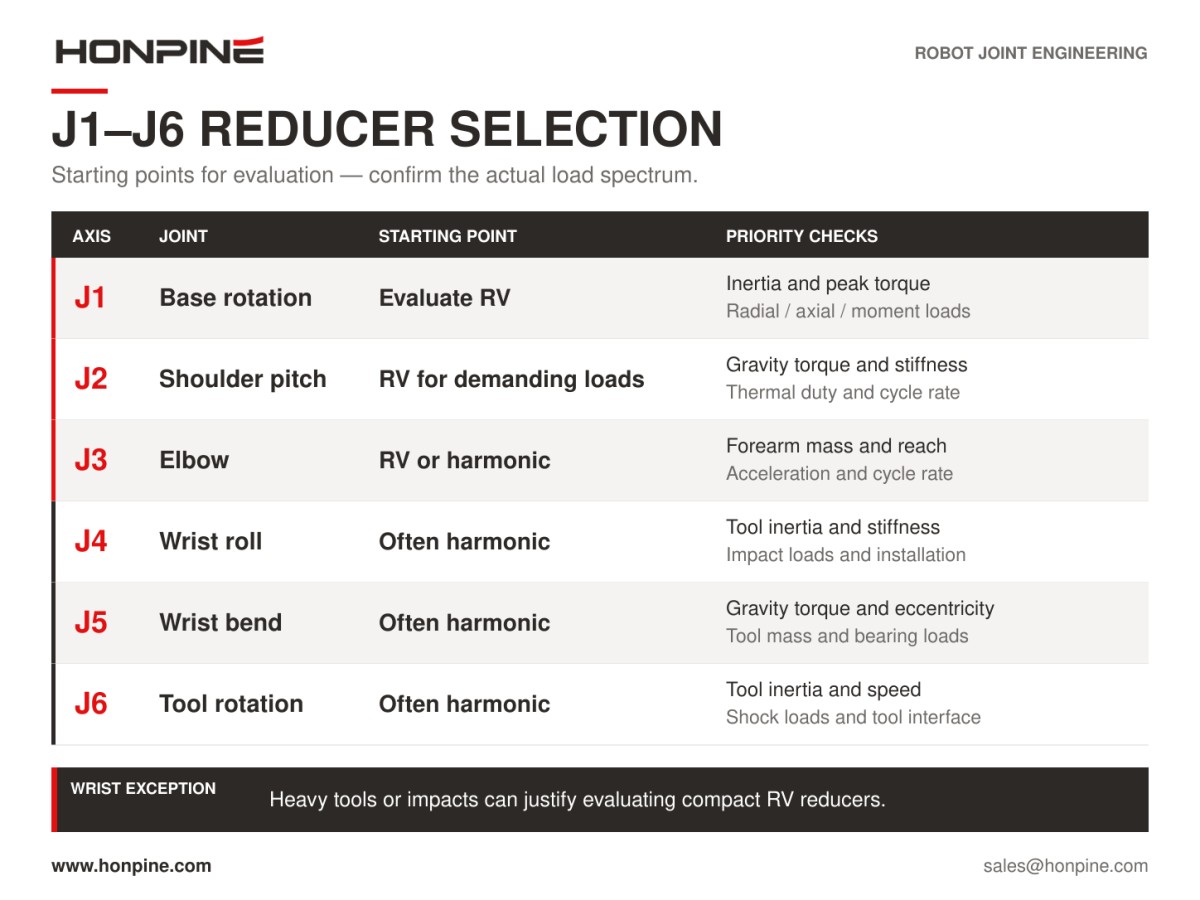
Wrist joints carrying spot-welding guns, grinding tools, or equipment exposed to handling collisions may benefit from compact RV reducers. Harmonic reducers should not be selected automatically simply because the joint is located at the wrist.
2. J1 Base Rotation: Start by Evaluating an RV Reducer
J1 must accelerate and decelerate the inertia of the robot structure above the base.
In applications such as automotive welding and palletizing, continuous three-shift operation also places demanding requirements on service life and long-term positioning consistency.
Three factors are particularly important when selecting a J1 reducer:
1. Equivalent torque and peak acceleration torque with the robot fully extended or at its maximum reach.
2. Base overturning moment and radial loads caused by arm weight and an eccentric payload.
3. The influence of backlash and lost motion on overall robot repeatability.
An RV reducer with integrated main bearings can accommodate part of the radial, axial, and moment loads, potentially simplifying the external bearing arrangement.
Selection should include separate checks of:
- Rated torque
- Allowable acceleration and deceleration torque
- Maximum instantaneous torque
- Allowable bending or overturning moment
- Allowable radial and axial loads
RV reducer sizing references commonly calculate an equivalent torque weighted by the duration of the operating conditions, then apply a safety factor of approximately 1.5–2.0. Output bearing loads must be checked separately.
For a small, lightweight six-axis robot with low J1 equivalent torque and extremely restricted installation space, a high-ratio precision planetary reducer or harmonic reducer may also be considered.
For general-purpose industrial robots with payloads of approximately 50 kg or more, RV reducers usually remain the preferred starting point.
3. J2 Shoulder Axis: Prioritize Rigidity and Resistance to Arm Sag
J2 experiences its highest gravity torque when the upper arm extends horizontally. Acceleration torque adds to this load, making the shoulder axis a major contributor to end-effector sag and path stiffness.
Consider an illustrative 6 kg-payload arc-welding robot with a 650 mm upper arm and a 600 mm forearm:
- Maximum J2 gravity torque: approximately 595 N·m
- Peak J2 torque including acceleration: approximately 1,249 N·m
Industry examples for this configuration commonly evaluate an RV-80E reducer with a reduction ratio around 100.
A smaller RV-40E may also be examined. Third-party summaries quote approximately:
- Rated torque: 412 N·m
- Allowable acceleration and deceleration torque: 1,000 N·m
- Maximum instantaneous torque: 1,960 N·m
Although the smaller reducer can be assessed against the operating requirements, the available margin may be limited. The final choice should account for start-stop frequency, load inertia, and impact conditions instead of relying on a fixed frame-size recommendation.
Key Checks When Selecting an RV Reducer for J2
Rated torque and operating margin
As a preliminary selection approach, rated torque may be evaluated at approximately 1.2–1.5 times the calculated RMS or equivalent torque, as applicable to the sizing method.
Applications with substantial impact loads, such as automotive spot welding, may require a larger margin.
Torsional stiffness
Torsional stiffness determines angular deformation under load and affects small-angle position corrections.
Heavy machining, spot welding, and grinding applications using high-gain control are particularly sensitive to joint compliance.
Lost motion and backlash
Acceptance checks should include rated-load conditions, operating temperature, and bidirectional movement across the full working range.
An unloaded nominal backlash value alone is not sufficient.
Efficiency and thermal behavior
An efficiency of ≥85% at the catalog-rated operating point may be used for preliminary estimates. Transmission losses generate heat.
Continuous operation at high cycle rates requires an assessment of housing temperature, lubricant conditions, and any necessary derating.
For collaborative robots with low payloads, low cycle rates, and strict weight or cost constraints, J2 may use a harmonic reducer or an integrated harmonic joint module.
For industrial robots with payloads above approximately 30–50 kg, long reach, or significant inertial impact loads, RV reducers are generally preferred.
4. J3 Elbow Axis: Select According to Forearm Load and Cycle Rate
J3 does not automatically require an RV reducer.
The decision should be based on the combined gravity torque generated by the forearm, wrist assembly, and end payload, together with the inertial torque associated with maximum angular acceleration.
An RV reducer is generally appropriate when these requirements exceed the practical load range of a similarly sized harmonic reducer, especially under frequent reversals and demanding starts.
A harmonic reducer may be suitable when the forearm and end payload are light and the robot primarily performs assembly, dispensing, or light welding.
Using the same illustrative 6 kg arc-welding robot:
- Maximum J3 gravity torque: approximately 198 N·m
- Peak J3 torque including acceleration: approximately 342 N·m
Industry examples commonly evaluate an RV-20E with a reduction ratio of approximately 80 for this axis.
For smaller robots in the 3–10 kg class with short reach and low-speed assembly duties, medium or large harmonic reducers are often considered for J3 to reduce weight and installation space.
A heavy-duty robot may use RV reducers for the base, shoulder, and elbow, with harmonic reducers at the lightweight wrist. A heavy spot-welding robot may also require compact RV reducers on J4–J6, depending on impact conditions.
The boundary for J3 selection is therefore determined by its load spectrum, rather than its axis number.
Check Elbow Bearing Loads Separately
When selecting an RV reducer for J3, allowable bending moments and radial loads require particular attention.
A longer forearm increases load eccentricity. Selecting the reducer solely according to output torque can therefore overlook important bearing loads.
Bending moments, center-of-gravity distance, and eccentric inertial forces during acceleration and deceleration should all be included in bench acceptance testing under relevant GB/T 37718 and GB/T 37165 requirements.
5. J4–J6 Wrist Axes: Harmonic Reducers Are Common, but Three Conditions Favor RV Evaluation
The wrist axes of light- and medium-duty six-axis robots generally have limited space, relatively low torque requirements, and a strong need for low weight and low backlash.
Harmonic reducers are widely used because they provide high reduction ratios, thin profiles, and options for hollow-shaft cable routing.
However, the following three conditions require a more careful assessment.
Condition 1: Spot-Welding Gun Wrist Assemblies
Electrode clamping forces, welding-gun inertia, and frequent starts and stops can combine to create substantial impact and fatigue loads.
These conditions increase the importance of evaluating flexspline fatigue and shock resistance.
Compact RV reducers may be considered for J4–J6 on heavy-duty spot-welding robots.
The decision should be based on welding-gun mass and inertia, together with the torque spectra of J4 rotation, J5 bending, and J6 tool rotation.
Condition 2: Heavy Wrist Assemblies or High-Inertia End Effectors
Examples include:
- Large vision-system enclosures
- Heavy grinding heads
- Large-diameter tools
Such equipment can create a high gravity torque on J5 and sustained eccentric loading on J4.
Equivalent torque and overturning moments should be evaluated before choosing between a compact RV reducer and a high-rigidity harmonic reducer.
Condition 3: Small-Angle Motion Requiring High Rigidity
Semiconductor inspection and precision assembly applications can be particularly sensitive to hysteresis.
When torque is extremely low, harmonic reducers may remain the preferred choice.
When small-angle motion is combined with radial preload, a compact RV reducer or a specialized high-rigidity harmonic reducer may be worth evaluating.
Additional Checks for Wrist Reducers
For small-frame RV reducers, such as RV-10N, RV-20N, and RV-40N models with quoted rated torques in the approximate 80–400 N·m range, the main checks include:
- Allowable output speed
- Torsional stiffness
- Backlash
- Performance at operating temperature
For harmonic reducers, acceptance should follow the relevant grades in GB/T 30819-2024.
A manufacturer’s internal specification, such as “≤10 arcsec,” should not be treated as a universal value defined by the national standard.
6. An Illustrative Reducer Selection Matrix by Robot Payload
The following matrix provides an experience-based starting point for discussing reducer configurations with customers.
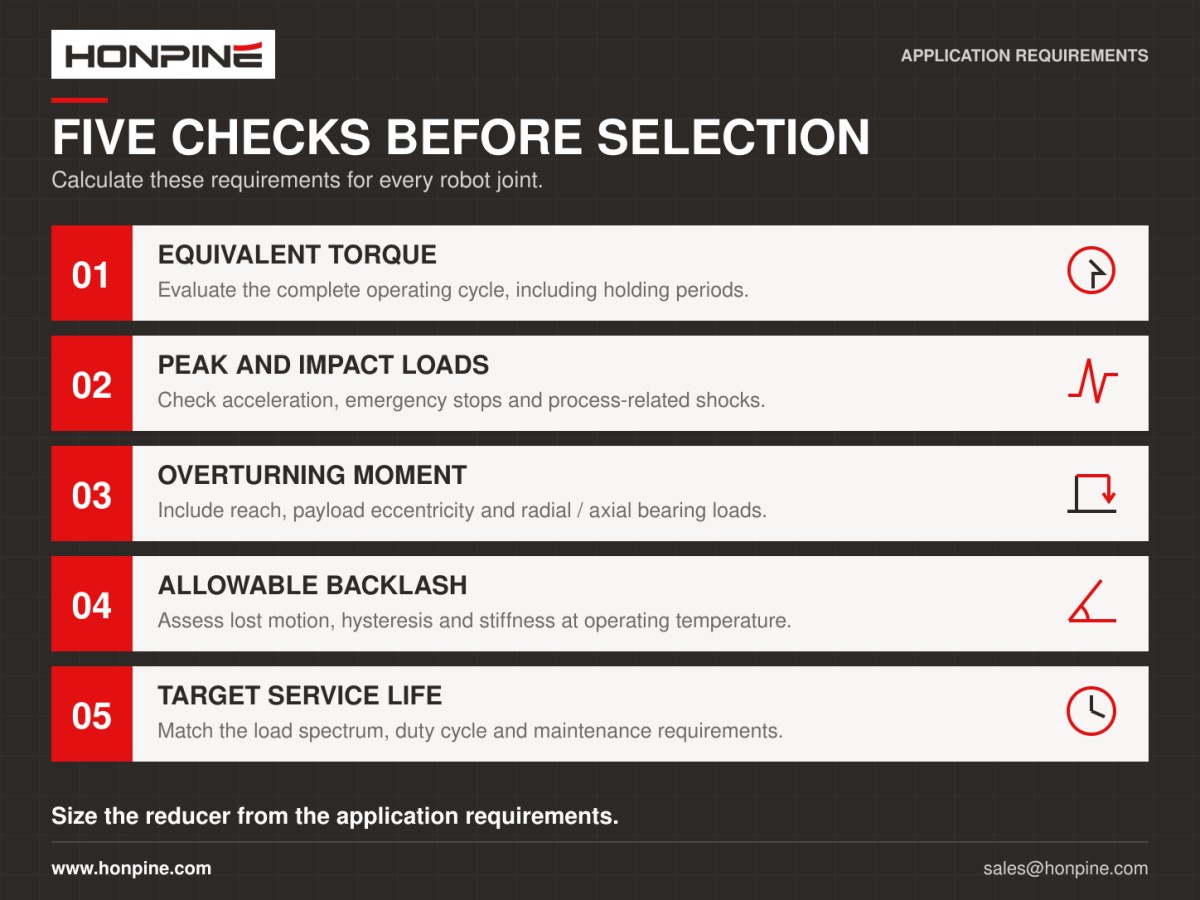
This matrix is illustrative. Actual selection should be based on five calculated requirements for each axis:
1. Equivalent torque
2. Peak and impact loads
3. Overturning moment
4. Allowable backlash
5. Target service life
7. What Should Be Considered Besides Reduction Ratio and Backlash?
1. Equivalent Output Torque
Evaluate torque over the complete operating cycle, accounting for the duration of each operating condition.
The maximum instantaneous value alone does not describe the reducer’s long-term loading.
2. Allowable Acceleration Torque and Maximum Instantaneous Torque
Check the allowable torque during acceleration and deceleration separately from the maximum instantaneous torque.
Spot welding and grinding applications require sufficient margin for process-related impacts.
3. Lost Motion, Backlash, Hysteresis, and Transmission Error
These parameters describe different aspects of transmission performance.
Request data for:
- Unloaded conditions
- Rated-load conditions
- Operating-temperature conditions
A single room-temperature or no-load specification does not provide a complete picture.
4. Torsional Stiffness and Moment Capacity
Torsional stiffness should be evaluated across the relevant load ranges.
Robot joints also require checks of bending and overturning stiffness, together with the allowable moment load.
5. Allowable Radial and Axial Loads
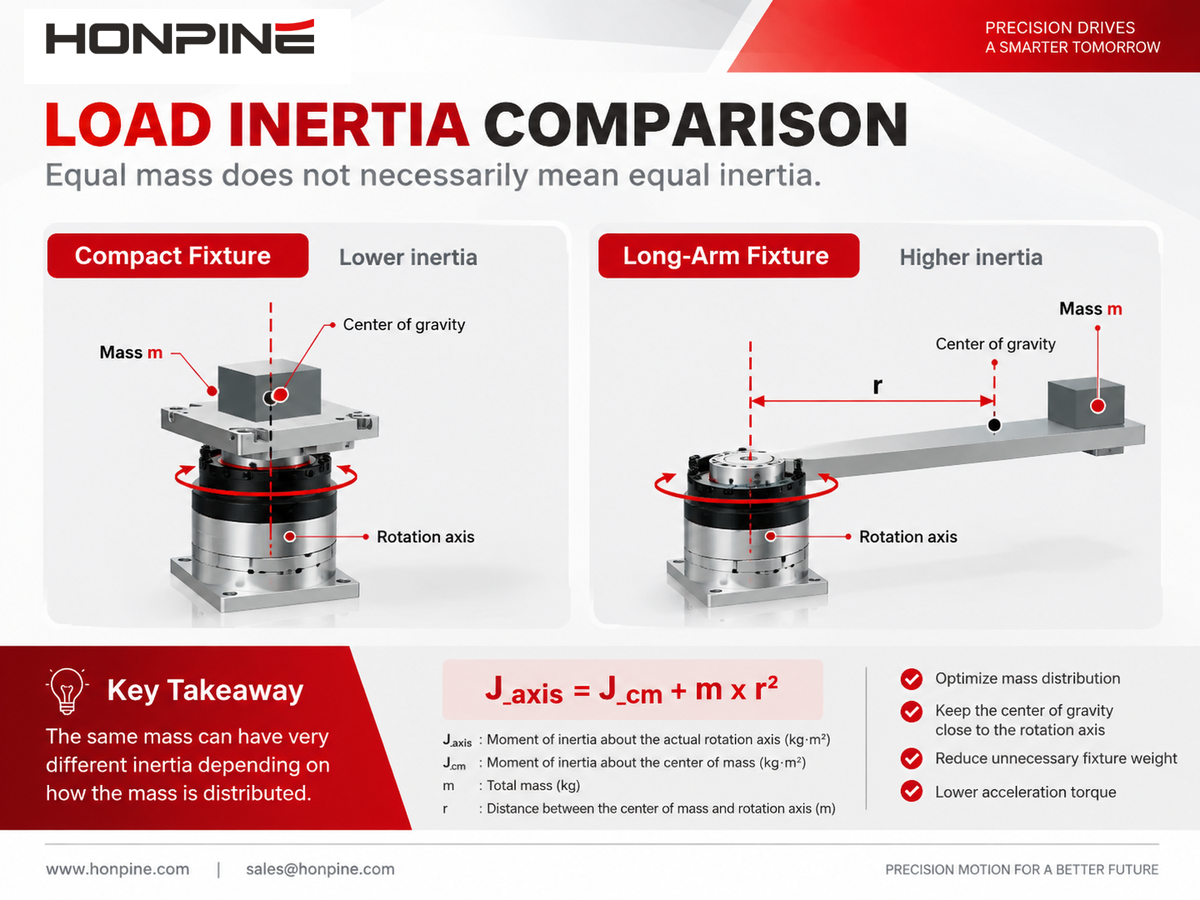
A long arm or eccentric payload can impose significant bearing loads even when output torque appears acceptable.
Radial and axial load limits must therefore be checked independently.
6. Efficiency and Temperature Rise
A catalog efficiency of ≥85% at the rated operating point may be used for preliminary transmission-loss estimates.
Continuous three-shift operation requires a check of housing temperature and the resulting thermal operating conditions.
7. Service Life and Maintenance Requirements
Request bench-test reports covering backlash, stiffness, transmission error, moment capacity, and rated service life under relevant GB/T 35089, GB/T 37718, GB/T 37165, or CR certification requirements.
Catalog service-life ratings are generally based on defined speed and load conditions. Some series, for example, specify a rated life of 6,000 hours under particular reference conditions.
Expected service life in the actual application must be assessed using the duty cycle and load spectrum.
Avoid describing the reducer as maintaining its performance indefinitely. A more meaningful specification states the catalog service-life target under defined operating conditions and a scheduled inspection program.
8. How to Select Harmonic and RV Reducers for a Specific Robot Project
There is no universal rule that the first three axes of a six-axis robot must use RV reducers and the last three must use harmonic reducers.
For the base and shoulder axes, an RV-based solution is usually the starting point.
For the elbow, the decision depends on forearm mass, payload distribution, and cycle rate.
For the wrist, harmonic reducers are a common starting point, while spot-welding guns, heavy fixtures, and severe impact loads justify evaluating compact RV reducers.
When preparing a customer proposal, calculate the following five groups of values for every axis:
- Equivalent torque over the operating cycle
- Peak torque and impact loads
- Overturning moment
- Allowable backlash
- Target service life
Use these results to determine the appropriate RV or harmonic reducer frame size.
This approach provides a clearer engineering basis than simply stating “use RV reducers for J1–J3.” It also makes the proposed configuration easier to justify against the robot’s actual operating requirements.
Read More
Learn more about the story of HONPINE and industry trends related to precision transmission.
 What is robot joint actuator?How to Choose the Best Robot Rotary Joint Actuator?In core robot joint transmission solutions, planetary and harmonic rotary actuators each have their own strengths. Choosing the right type based on application requirements is essential to achieve the optimal balance between performance and cost.
 DD Motors VS Harmonic Rotary ActuatorsThis article provides an in-depth comparison between Direct Drive (DD) motors and harmonic rotary actuators, covering their transmission principles, advantages and disadvantages, and typical application fields.
 OMG Ultra Compact Harmonic Drive Joint Module with Built-in Torque SensorHONPINE TCHL series harmonic drive joint module is a game-changing product that achieves disruptive improvements in multiple aspects such as lightweight design, integration level, and connection convenience. This article will analyze its revolutionary enhancements with you.
 The Role of Harmonic Drive Gears in Achieving 5–10 μm Accuracy in Dental Milling MachinesA dental milling machine is a CNC machining system used to directly process digital dental models into restorations such as crowns, bridges, veneers, inlays, and implant abutments. Dental milling machines require far higher operational accuracy and motion stability than ordinary equipment. This article explains how harmonic drive gear help dental milling machines achieve stable, continuous, and controllable operation.
 Why Are Harmonic Rotary Actuators Perfect for Medical Equipment?Harmonic rotary actuators (typically integrated systems consisting of a harmonic drive reducer, frameless torque motor, encoder, and optional brake) are regarded as key components in medical equipment. The core reason is that they simultaneously meet the most stringent medical requirements for precision, compact size, safety, and controllability. The following explanation is structured from three perspectives: technical characteristics, application scenarios, and medical value.
 High-Precision RV Reducers Perfectly Matched for Walking RobotsThe walking axis of a robot is a core component for power transmission and support. RV reducers provide extremely high rigidity, precision, and torque while maintaining a compact size and exceptional reliability, making them an ideal match for the demanding requirements of walking robot joints in terms of load capacity, impact resistance, and precision.
 How to Select Harmonic and RV Reducers for Each Axis of a Six-Axis Robot?What determines whether a six-axis robot joint needs a harmonic reducer or an RV reducer? The answer depends on torque, inertia, impact loads, bearing loads and installation space. This guide explains how to evaluate harmonic and RV reducers for the base, shoulder, elbow and wrist, with practical checks for stiffness, backlash and service life. Use the requirements of each axis to select a suitable reducer configuration.
 How to Calculate Torque for a Harmonic Rotary Actuator in a Flipping Mechanism?How much torque does a harmonic rotary actuator need to flip a 10 kg load through 180 degrees? The answer depends on more than weight. Center-of-gravity offset, load inertia, acceleration and operating frequency all affect actuator selection. In this guide, Theodore Li, Technical Director at HONPINE, explains the calculation process using a horizontal-axis flipping example and outlines the checks needed for peak torque, continuous operation, output speed and bearing loads.
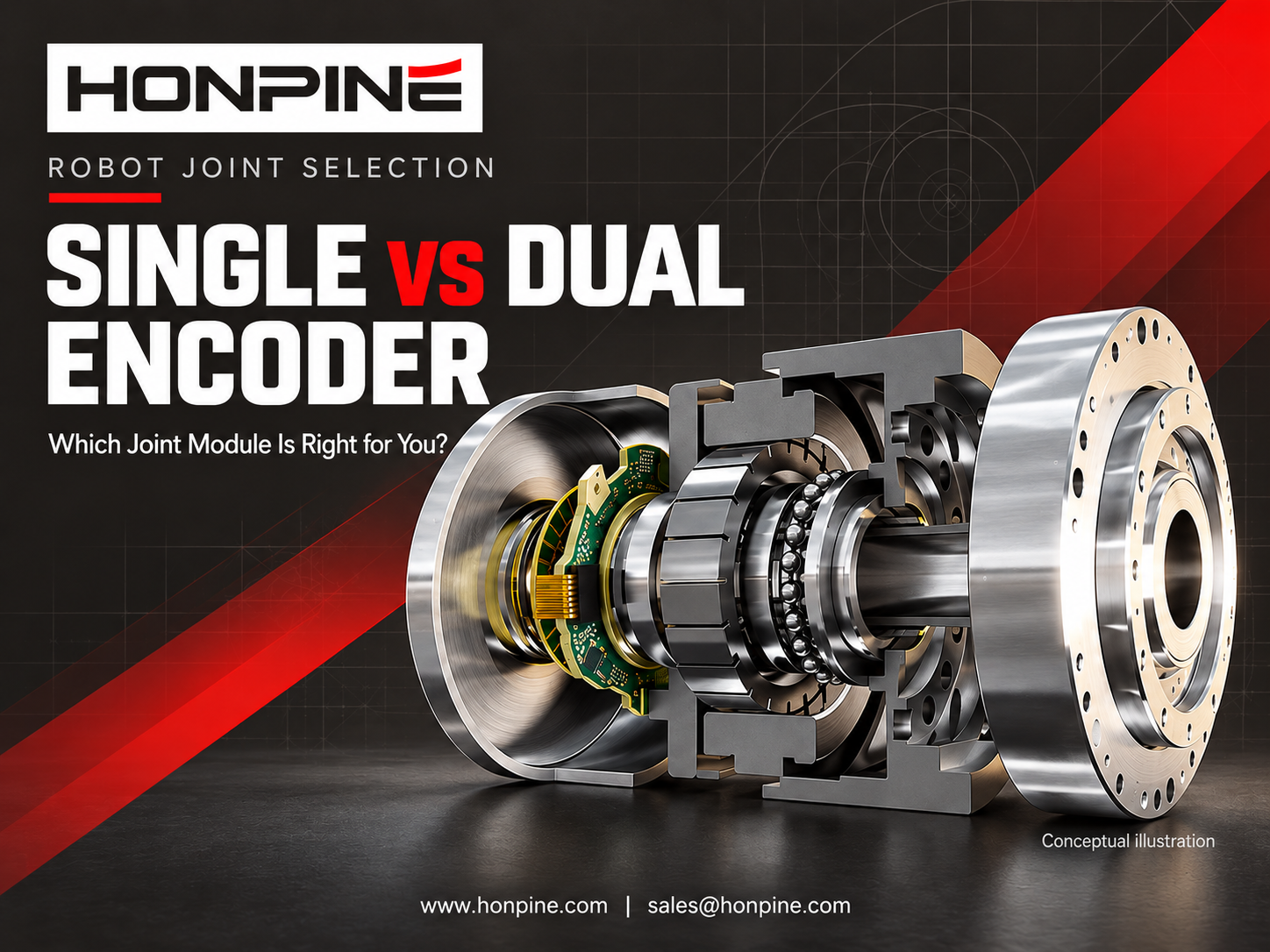
 What’s the Difference Between Single and Dual Encoder Robot Joint Modules?Does your robot need a dual encoder joint module, or is a single encoder enough? The answer depends on positioning requirements, transmission behavior, force control strategy and budget. This guide compares motor-side and output-side feedback, explains where dual encoders can improve control, and examines their costs and limitations. Learn when a single encoder can meet your needs and when additional output feedback is worth considering.
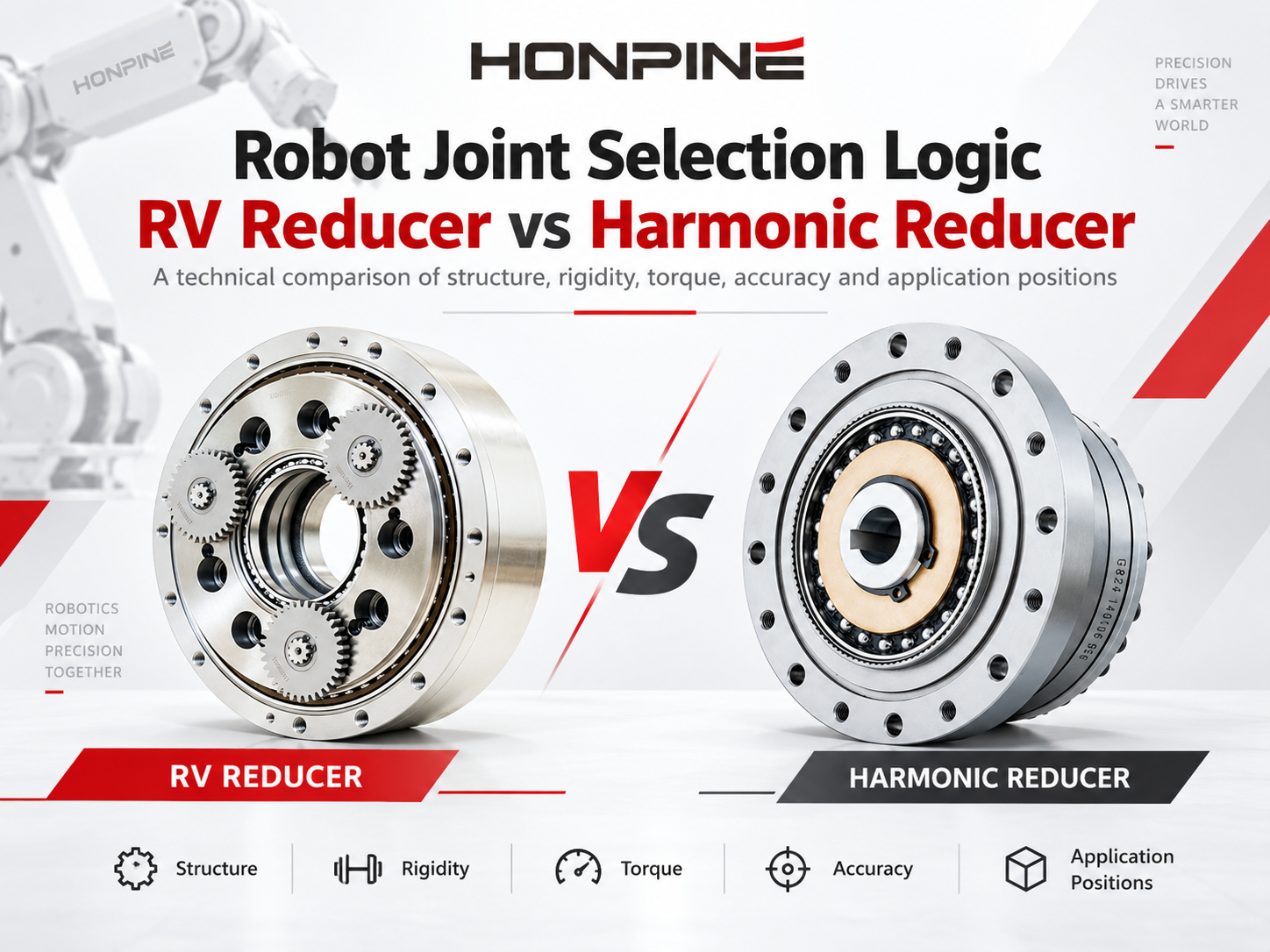
 RV vs Harmonic Reducer: How to Choose the Right Gearbox for Robot Joints?RV vs harmonic reducer: which gearbox is right for your robot joint? The answer depends on torque, rigidity, accuracy, installation space and operating conditions. This guide compares their working principles and five key performance factors, then explains how to evaluate joint loads, reducer life, temperature and lubrication. Whether you are designing a robot base, shoulder, elbow or wrist, use these considerations to match the reducer to the requirements of each joint.
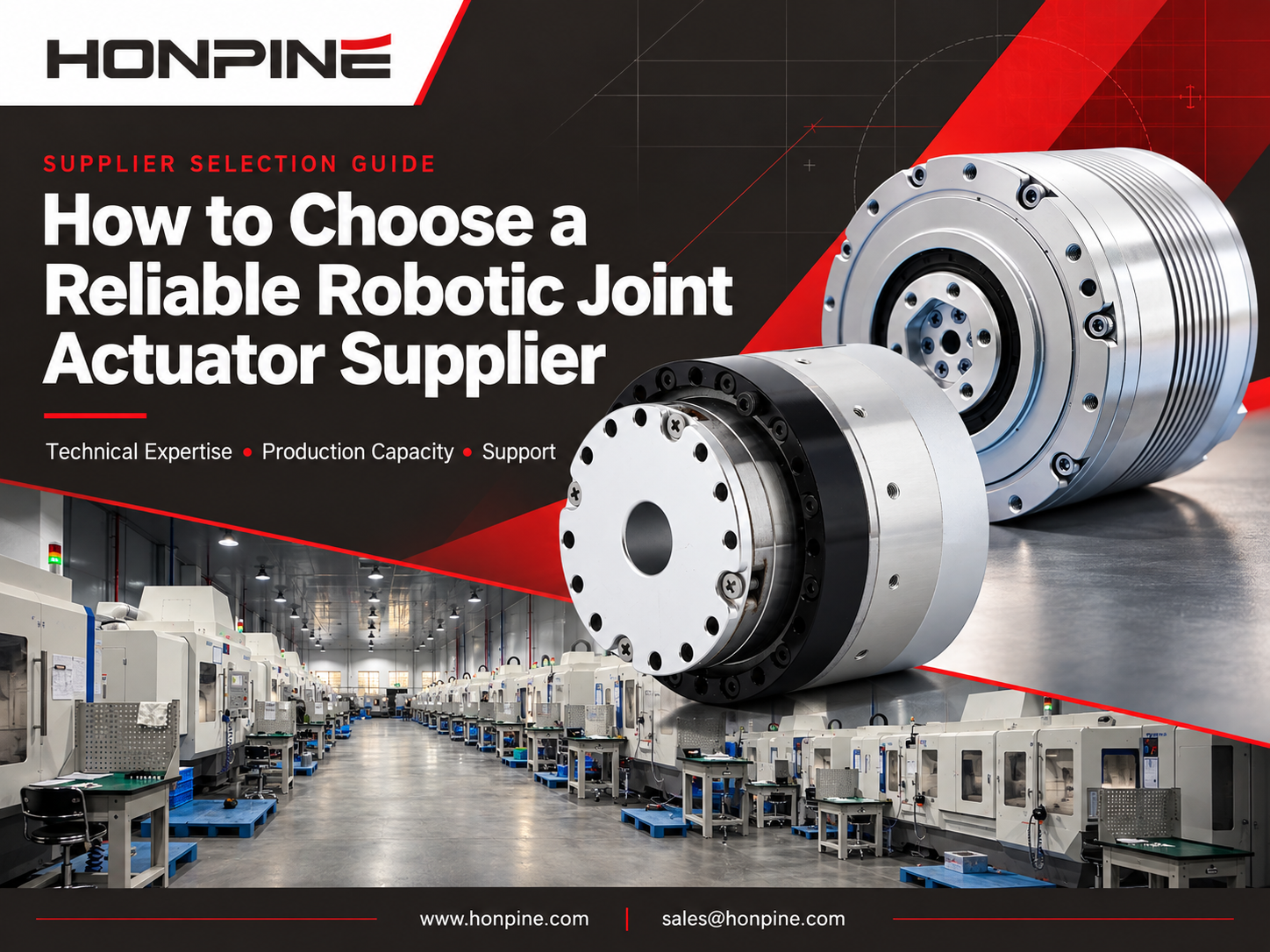
 How to Find a Reliable Robotic Joint Actuator Supplier?Choosing the right robotic joint actuator supplier is essential for reliable performance, smooth integration and long-term project success. Beyond product specifications, you need to understand a supplier’s technical expertise, production capacity and after-sales support. In this guide, Allen Li, Founder of HONPINE, explains how to assess these three factors when sourcing harmonic and planetary joint actuators for robotics and industrial automation.
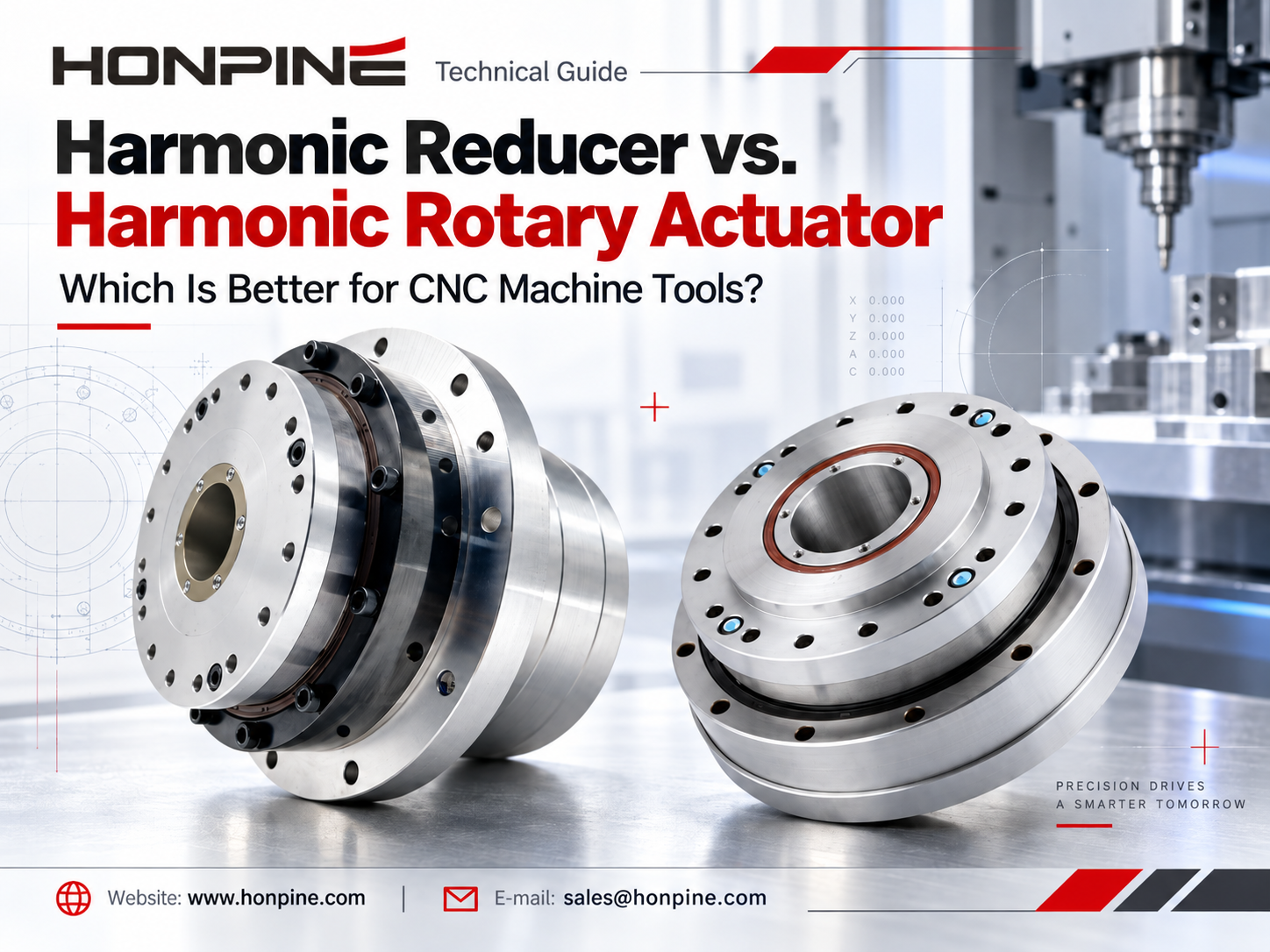
 Harmonic Reducer vs. Harmonic Rotary Actuator: Which Is Better for CNC Machine Tools?Choosing between a harmonic reducer and a harmonic rotary actuator is an important decision in CNC machine tool design. Both solutions offer high-precision motion control, but they differ in integration, installation requirements, rigidity, and system flexibility. For CNC fourth-axis rotary tables and compact five-axis machining systems, selecting the right harmonic drive can significantly influence machine performance. In this article, HONPINE Technical Director Theodore Li compares harmonic reducers and harmonic rotary actuators to help engineers identify the most suitable solution for their CNC applications.
Double Click
We provide harmonic drive reducer,planetary reducer,robot joint motor,robot rotary actuators,RV gear reducer,robot end effector,dexterous robot hand
 What is robot joint actuator?How to Choose the Best Robot Rotary Joint Actuator?In core robot joint transmission solutions, planetary and harmonic rotary actuators each have their own strengths. Choosing the right type based on application requirements is essential to achieve the optimal balance between performance and cost.
 DD Motors VS Harmonic Rotary ActuatorsThis article provides an in-depth comparison between Direct Drive (DD) motors and harmonic rotary actuators, covering their transmission principles, advantages and disadvantages, and typical application fields.
 OMG Ultra Compact Harmonic Drive Joint Module with Built-in Torque SensorHONPINE TCHL series harmonic drive joint module is a game-changing product that achieves disruptive improvements in multiple aspects such as lightweight design, integration level, and connection convenience. This article will analyze its revolutionary enhancements with you.
 How to Select Harmonic and RV Reducers for Each Axis of a Six-Axis Robot?What determines whether a six-axis robot joint needs a harmonic reducer or an RV reducer? The answer depends on torque, inertia, impact loads, bearing loads and installation space. This guide explains how to evaluate harmonic and RV reducers for the base, shoulder, elbow and wrist, with practical checks for stiffness, backlash and service life. Use the requirements of each axis to select a suitable reducer configuration.
 How to Calculate Torque for a Harmonic Rotary Actuator in a Flipping Mechanism?How much torque does a harmonic rotary actuator need to flip a 10 kg load through 180 degrees? The answer depends on more than weight. Center-of-gravity offset, load inertia, acceleration and operating frequency all affect actuator selection. In this guide, Theodore Li, Technical Director at HONPINE, explains the calculation process using a horizontal-axis flipping example and outlines the checks needed for peak torque, continuous operation, output speed and bearing loads.
 What’s the Difference Between Single and Dual Encoder Robot Joint Modules?Does your robot need a dual encoder joint module, or is a single encoder enough? The answer depends on positioning requirements, transmission behavior, force control strategy and budget. This guide compares motor-side and output-side feedback, explains where dual encoders can improve control, and examines their costs and limitations. Learn when a single encoder can meet your needs and when additional output feedback is worth considering.
 RV vs Harmonic Reducer: How to Choose the Right Gearbox for Robot Joints?RV vs harmonic reducer: which gearbox is right for your robot joint? The answer depends on torque, rigidity, accuracy, installation space and operating conditions. This guide compares their working principles and five key performance factors, then explains how to evaluate joint loads, reducer life, temperature and lubrication. Whether you are designing a robot base, shoulder, elbow or wrist, use these considerations to match the reducer to the requirements of each joint.
 How to Find a Reliable Robotic Joint Actuator Supplier?Choosing the right robotic joint actuator supplier is essential for reliable performance, smooth integration and long-term project success. Beyond product specifications, you need to understand a supplier’s technical expertise, production capacity and after-sales support. In this guide, Allen Li, Founder of HONPINE, explains how to assess these three factors when sourcing harmonic and planetary joint actuators for robotics and industrial automation.
 Harmonic Reducer vs. Harmonic Rotary Actuator: Which Is Better for CNC Machine Tools?Choosing between a harmonic reducer and a harmonic rotary actuator is an important decision in CNC machine tool design. Both solutions offer high-precision motion control, but they differ in integration, installation requirements, rigidity, and system flexibility. For CNC fourth-axis rotary tables and compact five-axis machining systems, selecting the right harmonic drive can significantly influence machine performance. In this article, HONPINE Technical Director Theodore Li compares harmonic reducers and harmonic rotary actuators to help engineers identify the most suitable solution for their CNC applications.
 How to Choose Harmonic Joint Actuators for a 7-DOF Robotic Arm?I'm Theodore Li, Technical Director at HONPINE. Choosing harmonic joint actuators for a 7-DOF robotic arm starts with the torque, weight, and installation needs of each joint. This guide uses a TCHL 20 shoulder and TCHL 14 wrist configuration as an example, then explores torque sensing, compliant control, and HAG Series considerations for demanding robotic applications.
 AGV Suspension: Should You Choose a Balance Beam or a Spring-Loaded Steering Drive Unit?Choosing an AGV suspension system starts with the vehicle’s load range and floor conditions. Balance beams and spring-loaded steering drive units offer different approaches to maintaining wheel contact and managing wheel loads. This HONPINE guide compares both options and explains how to evaluate traction, suspension travel, installation space, and maintenance before choosing a configuration.
 Hollow Rotary Platform Motor Matching: A Complete GuideSelecting the right motor for a hollow rotary platform is essential for achieving precise positioning, stable operation, and efficient automation. This guide explains how to match servo motors, stepper motors, and brushless DC motors with hollow rotary platforms based on torque, speed, inertia, accuracy, and installation requirements. Explore practical motor selection guidelines, typical application combinations, and space-saving mounting solutions to find the right configuration for your automation project.