








Harmonic Reducer vs. Harmonic Rotary Actuator: Which Is Better for CNC Machine Tools?
Hello everyone, I'm Theodore Li, Technical Director at HONPINE.
Many customers face a common question when selecting harmonic drive components for CNC machine tools: Should they choose a harmonic reducer or a harmonic rotary actuator?
In this article, I'll explain the differences between these two solutions and help you determine which one is better suited to your CNC application.
When choosing between a harmonic reducer and a harmonic rotary actuator for CNC machine tools, several key factors must be considered, including load capacity, rigidity, positioning accuracy, motor and control system compatibility, installation space, and specific application requirements.
Among these factors, load capacity and rigidity should be given the highest priority. Unlike conventional automation equipment, certain rotary axes in CNC machine tools must not only achieve precise positioning but also withstand external forces generated during machining operations.
Why Are Harmonic Reducers Well Suited for CNC Fourth-Axis Applications?
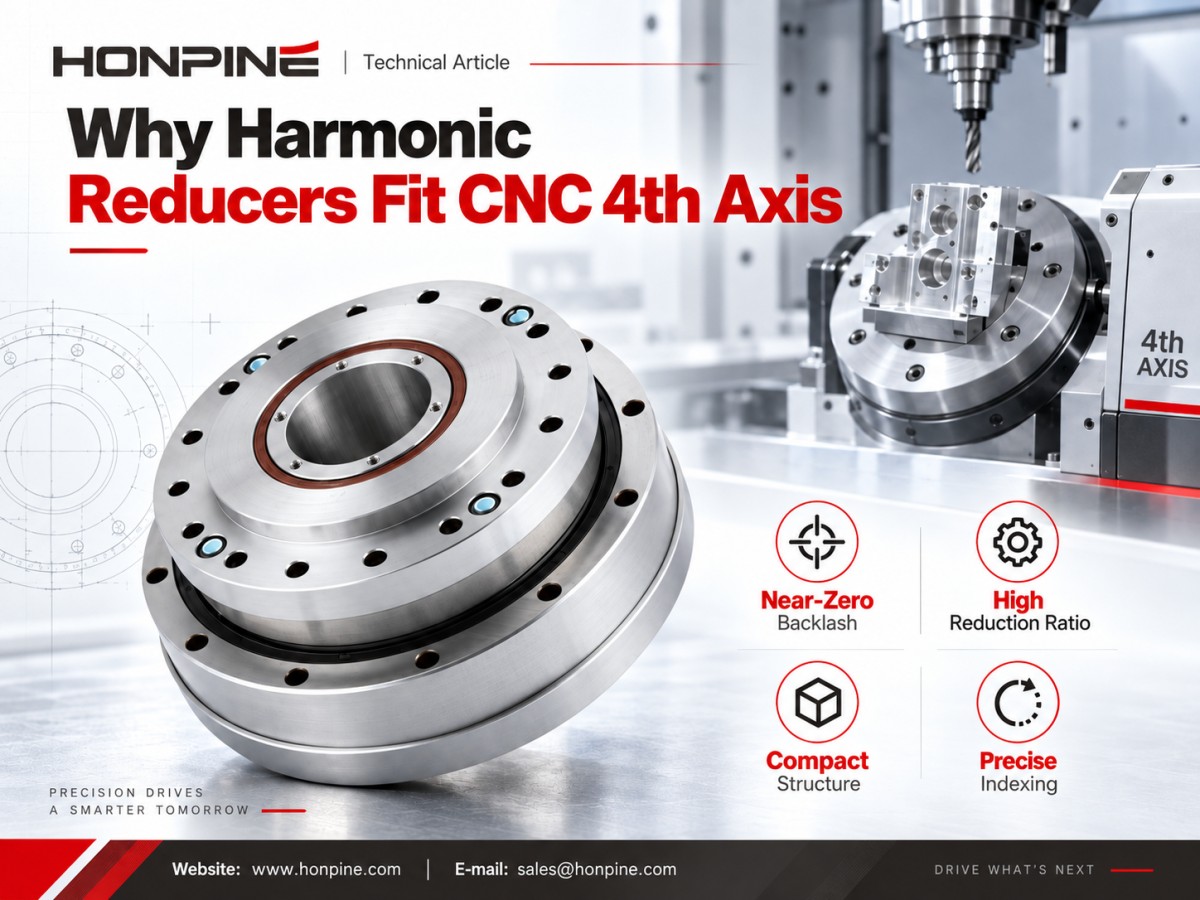
Harmonic reducers are particularly suitable for CNC fourth-axis applications, such as rotary tables, due to their key advantages: near-zero backlash, high positioning accuracy, high reduction ratios, and compact design.
These characteristics make harmonic reducers an attractive solution for CNC rotary tables that require precise indexing, efficient use of installation space, and responsive motion control.
Harmonic reducers operate through the elastic deformation of a flexible spline, allowing them to achieve high reduction ratios within a compact structure.
This unique transmission principle helps meet the requirements of CNC fourth-axis systems for high precision, high torque density, compact dimensions, and smooth motion.
However, the suitability of a harmonic reducer also depends on its torsional rigidity, load capacity, bearing arrangement, and resistance to machining forces. For heavy-duty cutting applications, these factors must be carefully evaluated.
Are Harmonic Rotary Actuators Better for CNC Fifth-Axis Applications?
Not necessarily. The most suitable solution still depends on the specific technical requirements of the CNC machine.
However, based on HONPINE's experience serving customers in recent years, we have observed a growing interest in integrated harmonic rotary actuators for compact CNC five-axis systems.
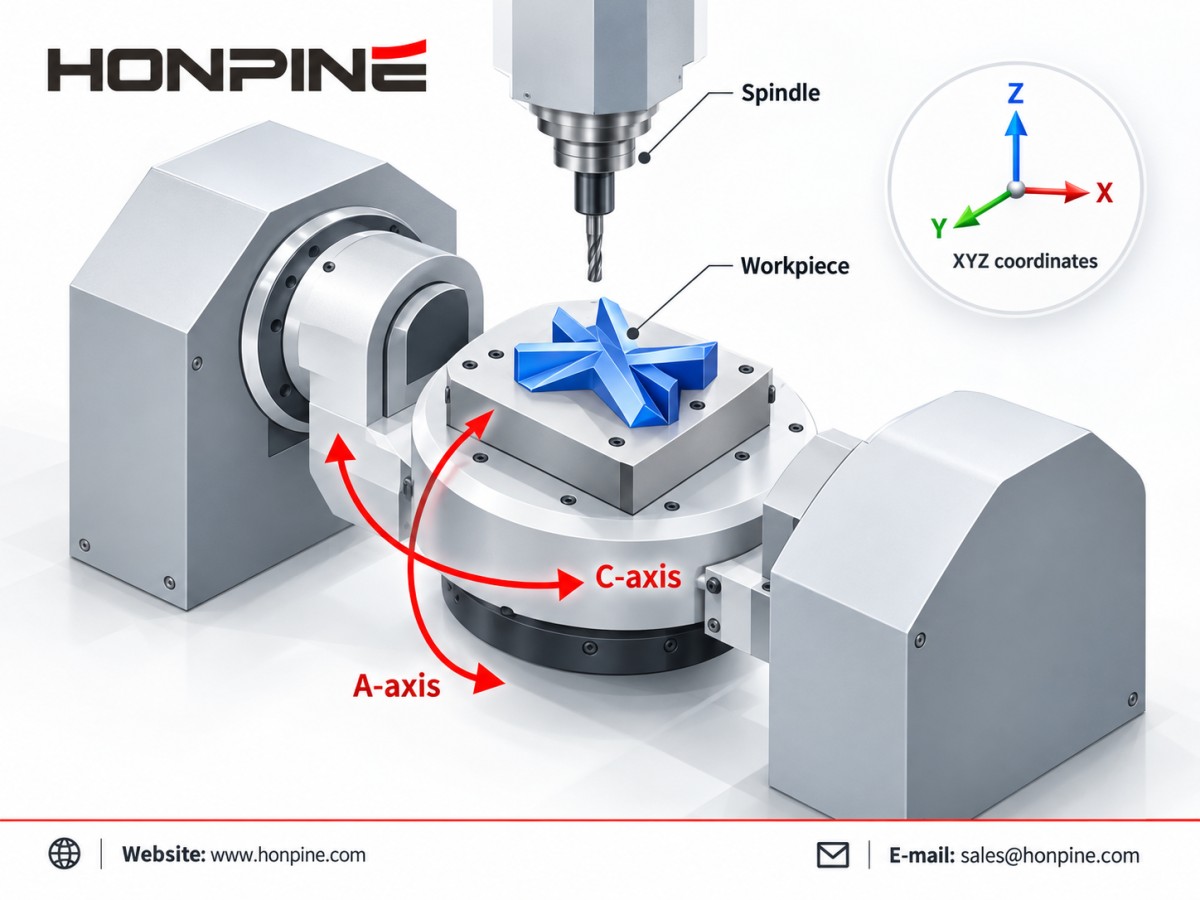
A five-axis CNC machine typically consists of three linear axes—X, Y, and Z—and two rotary axes, such as A/C or B/C.
Compared with a single rotary-axis mechanism, a five-axis system requires coordinated motion between two rotary axes. Certain complex surface machining operations also require simultaneous five-axis interpolation.
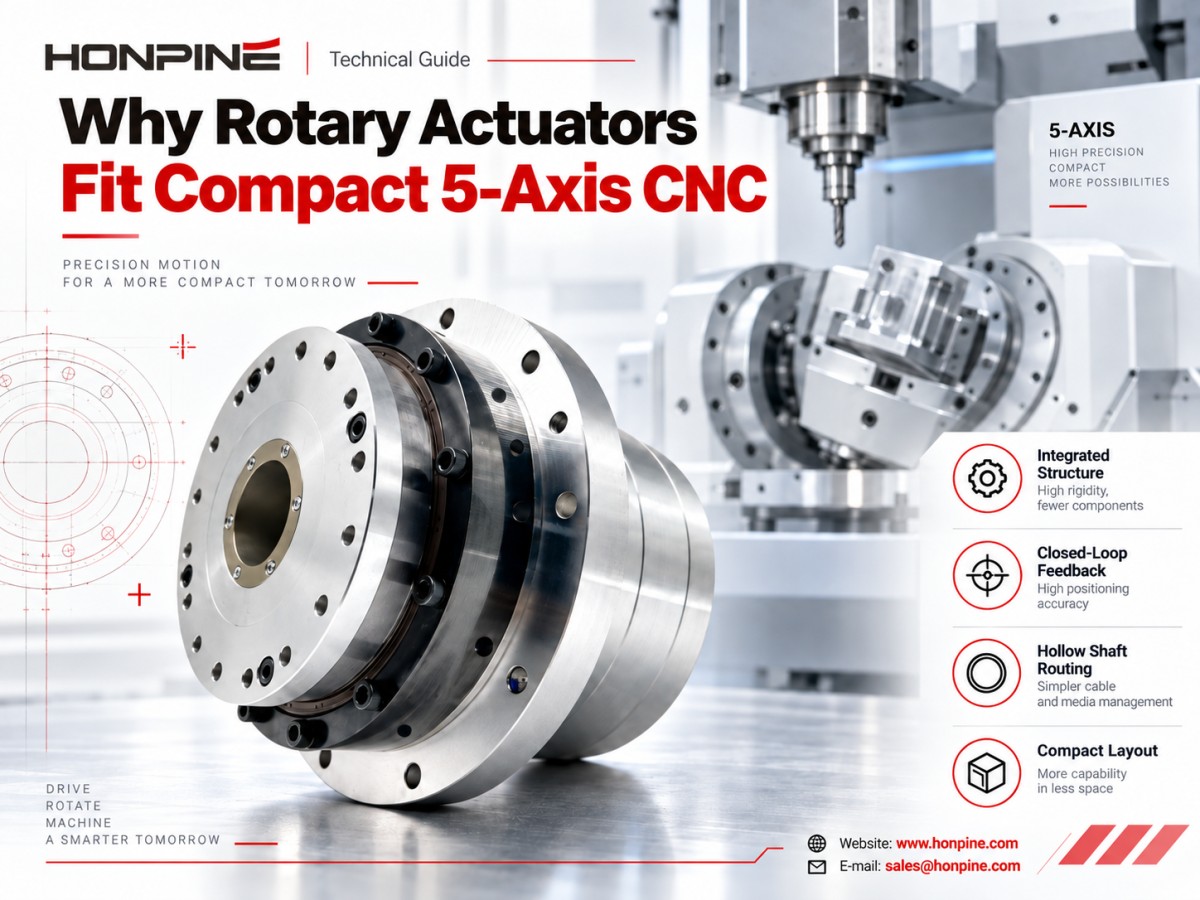
For compact five-axis mechanisms, harmonic rotary actuators offer four key advantages.
1. Integrated Design Helps Reduce Equipment Size
Five-axis rotary tables often need to accommodate two rotary axes, drive systems, bearings, and cables within limited installation space.
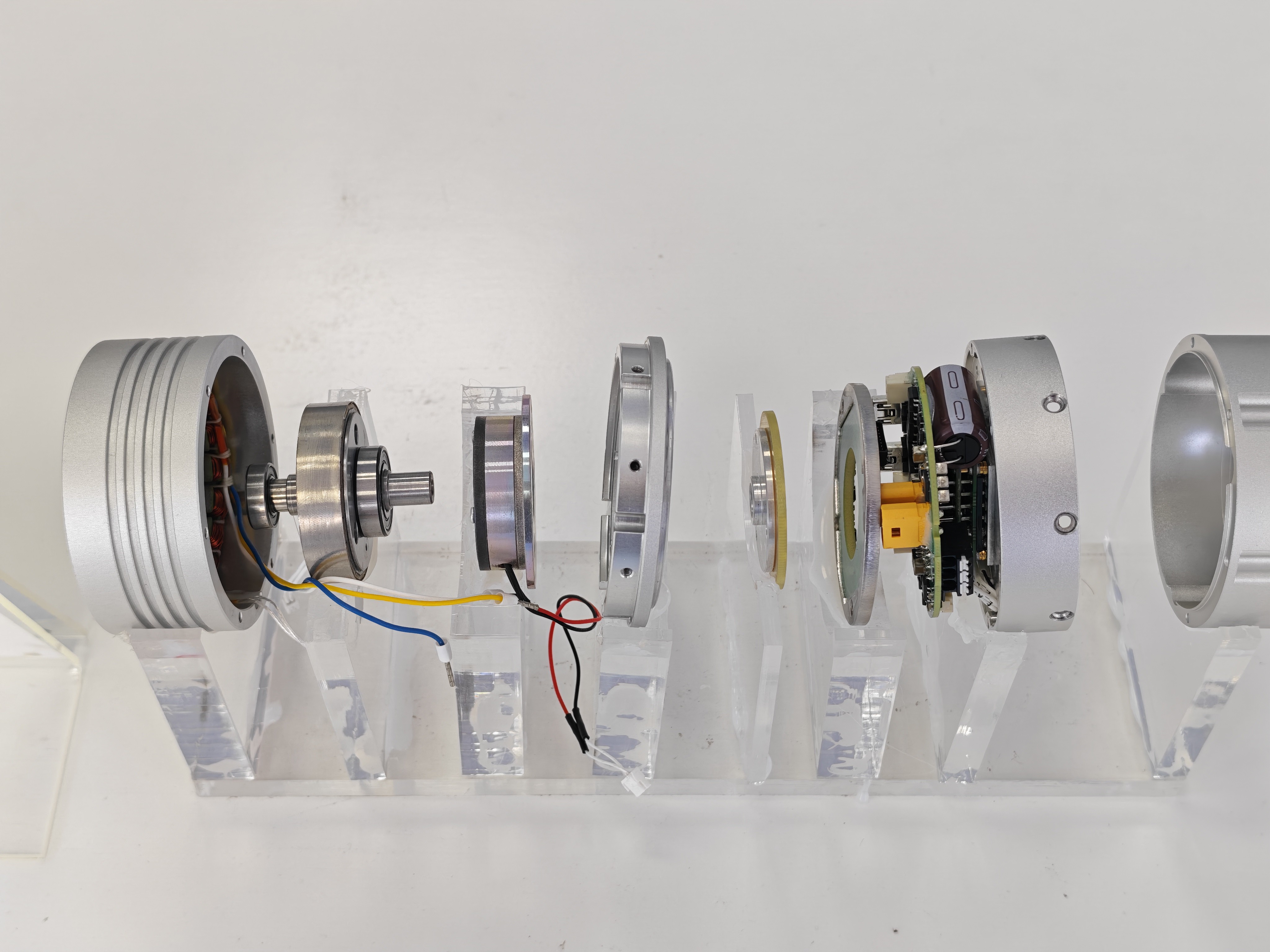
A harmonic rotary actuator integrates the motor, harmonic reducer, and encoder into a compact unit.
This integration reduces the number of separate transmission components and mechanical connections, allowing for a more compact A/C-axis or B/C-axis arrangement.
2. Integrated Feedback Supports Coordinated Multi-Axis Control
Five-axis machining requires precise rotary-axis positioning, smooth speed control, and responsive dynamic performance.
By combining a matched motor, reducer, and feedback system, an integrated servo actuator can simplify certain aspects of system integration while supporting closed-loop motion control.
However, this does not mean that an integrated actuator inherently provides higher control accuracy than a separate servo motor combined with a harmonic reducer.
Actual multi-axis machining performance still depends on the CNC controller, overall mechanical rigidity, feedback configuration, and machine calibration.
3. Hollow-Shaft Design Simplifies Cable Routing
Some harmonic rotary actuators feature a hollow-shaft design, allowing electrical cables, pneumatic tubes, and other connections to pass through the rotational center.
In five-axis tilting heads and rotary tables, this arrangement helps reduce external cable routing requirements and improves space utilization.
For continuous rotation applications, however, cable twisting and the possible need for rotary unions or slip rings must still be considered.
4. Simplified Mechanical Design and Assembly
Compared with independently selecting and assembling a motor, harmonic reducer, coupling, and encoder, an integrated harmonic rotary actuator can reduce the number of mechanical interfaces.
This can simplify equipment design, assembly, and commissioning, potentially shortening the overall machine development process.
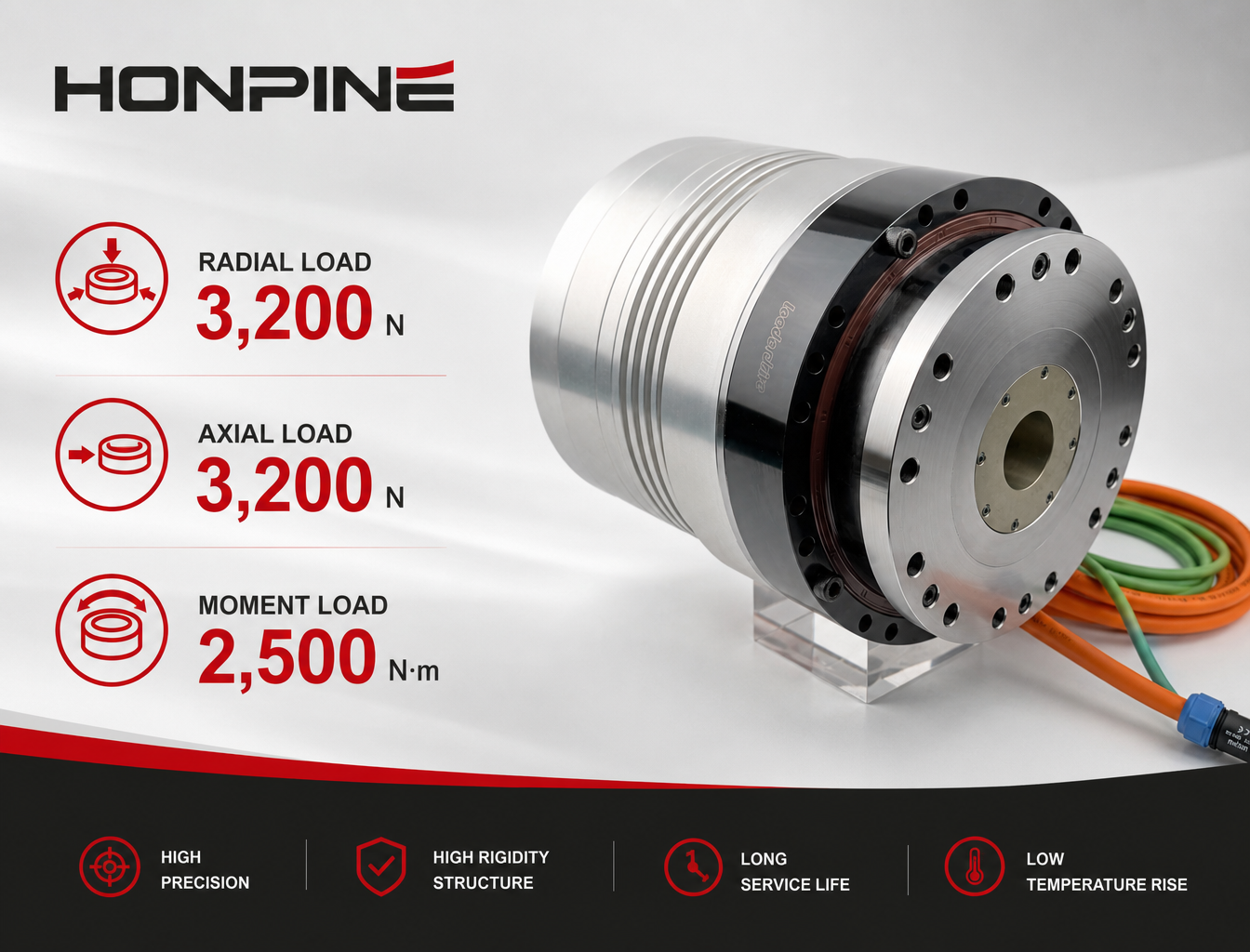
HONPINE 58 Series Harmonic Rotary Actuator for CNC Applications
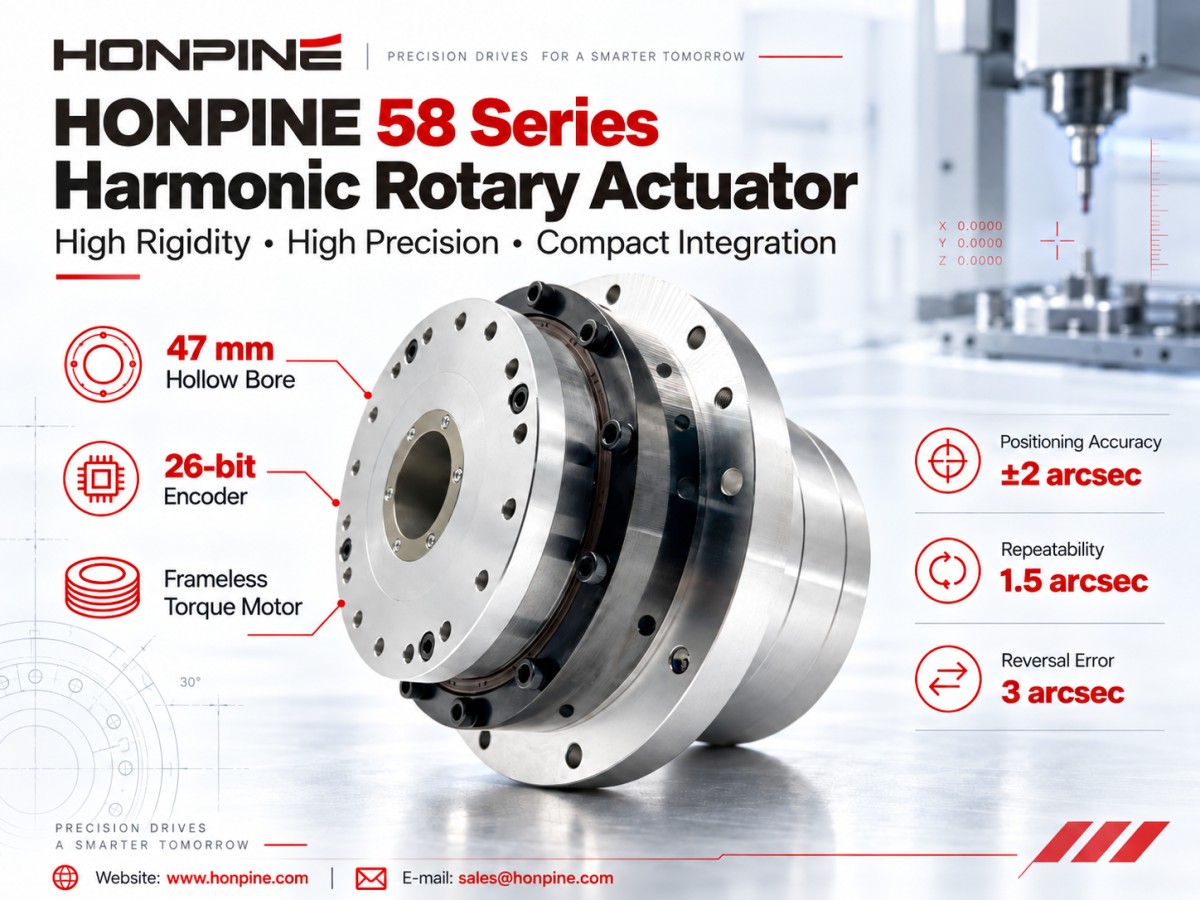
For customers looking for a compact, high-precision rotary drive solution, I would like to introduce the HONPINE 58 Series Harmonic Rotary Actuator.
The HONPINE 58 Series is designed to deliver exceptional rigidity and positioning accuracy.
It integrates three key components into a single compact unit:
- A high-precision harmonic reducer
- A high-resolution 26-bit encoder
The actuator also features a 47 mm hollow bore, providing convenient routing space for cables and other connections.
Exceptional Rigidity Demonstrated Through Laboratory Testing
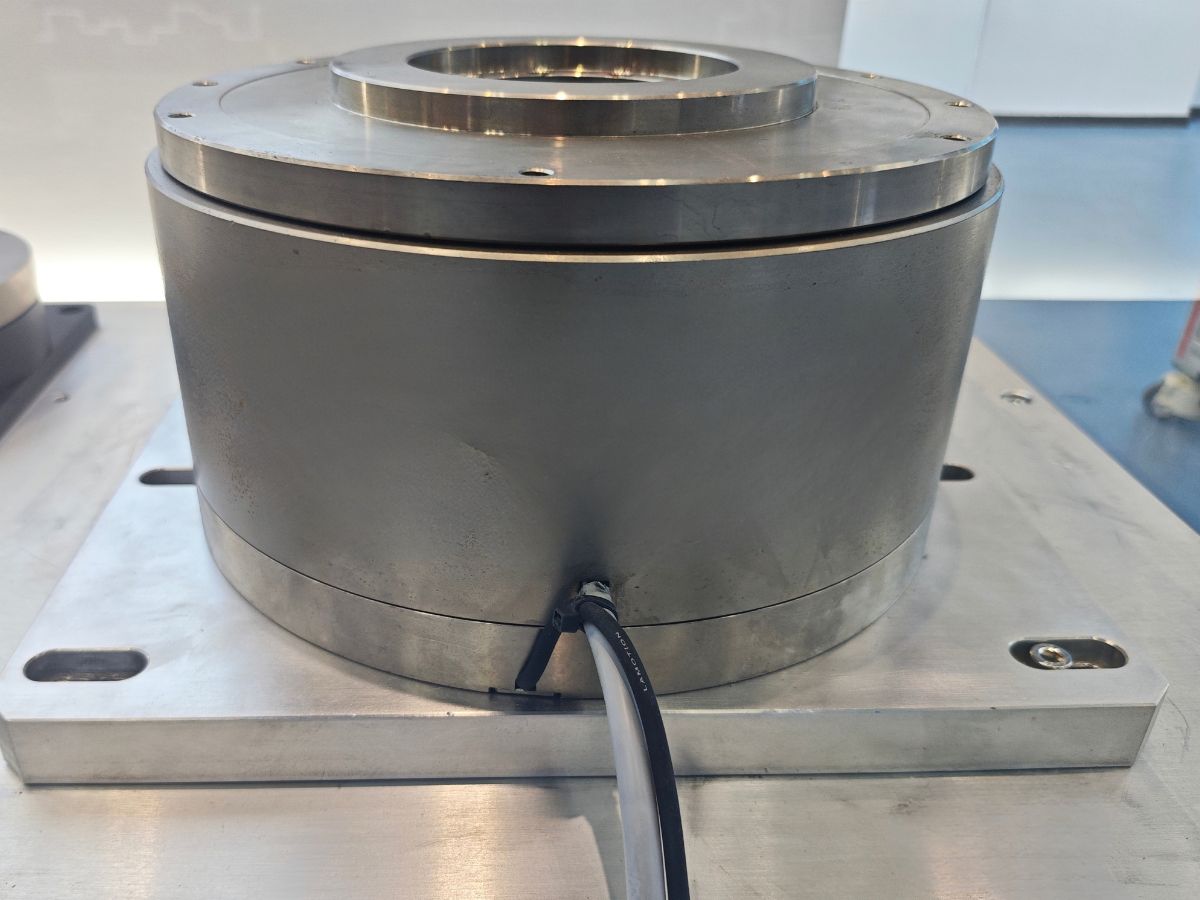
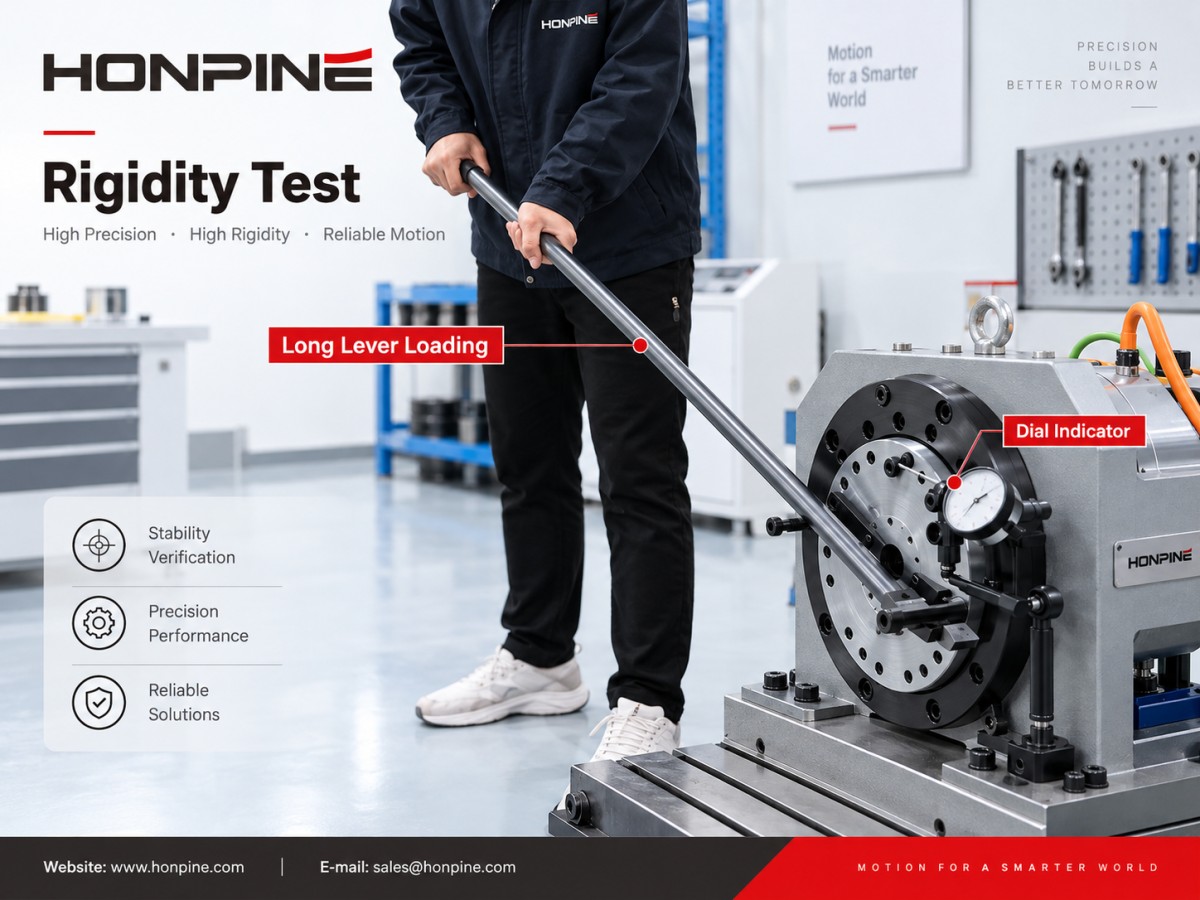
At the HONPINE laboratory, we conducted a rigidity demonstration using a lever nearly two meters long.
During the test, we applied force to the actuator's output end through the lever and monitored its displacement using a dial indicator.
Even under this lever-induced load, the dial indicator showed almost no visible movement.
More importantly, the harmonic rotary actuator used in this experiment was not equipped with a braking mechanism.
The test was intended to demonstrate the actuator's inherent resistance to deflection under the tested conditions, rather than relying on an additional mechanical brake.
This result highlights the impressive rigidity of the HONPINE 58 Series harmonic rotary actuator.
High Positioning Accuracy Without Compromising Rigidity
In addition to its high rigidity, the HONPINE 58 Series harmonic rotary actuator achieves excellent positioning performance.
According to HONPINE's laboratory test results, its key accuracy specifications include:
These results demonstrate the actuator's ability to combine high rigidity with precise motion control.
Below is the accuracy test report generated using our laser measurement system.
[Insert Image: HONPINE 58 Series Harmonic Rotary Actuator Accuracy Test Report]
It is important to note that the final performance of any actuator in a CNC machine tool also depends on the installation structure, applied loads, control configuration, and overall machine design.
Contact HONPINE for CNC Harmonic Drive Solutions
Whether you are developing a CNC fourth-axis rotary table, a compact five-axis machining system, or a customized rotary positioning mechanism, selecting the right harmonic drive solution is essential for achieving reliable performance.
HONPINE provides harmonic reducers and integrated harmonic rotary actuators for a wide range of precision motion applications.
Contact HONPINE today to learn more about our harmonic reducers and rotary actuators for CNC machine tools, and obtain additional technical specifications, product documentation, and application support.

About Author
Theodore Li serves as the Technical Director at HONPINE, overseeing the R&D strategy for replication products, guiding team selection, and managing both pre-sales and after-sales operations.

Read More
Learn more about the story of HONPINE and industry trends related to precision transmission.
 What is robot joint actuator?How to Choose the Best Robot Rotary Joint Actuator?In core robot joint transmission solutions, planetary and harmonic rotary actuators each have their own strengths. Choosing the right type based on application requirements is essential to achieve the optimal balance between performance and cost.
 DD Motors VS Harmonic Rotary ActuatorsThis article provides an in-depth comparison between Direct Drive (DD) motors and harmonic rotary actuators, covering their transmission principles, advantages and disadvantages, and typical application fields.
 OMG Ultra Compact Harmonic Drive Joint Module with Built-in Torque SensorHONPINE TCHL series harmonic drive joint module is a game-changing product that achieves disruptive improvements in multiple aspects such as lightweight design, integration level, and connection convenience. This article will analyze its revolutionary enhancements with you.
 The Role of Harmonic Drive Gears in Achieving 5–10 μm Accuracy in Dental Milling MachinesA dental milling machine is a CNC machining system used to directly process digital dental models into restorations such as crowns, bridges, veneers, inlays, and implant abutments. Dental milling machines require far higher operational accuracy and motion stability than ordinary equipment. This article explains how harmonic drive gear help dental milling machines achieve stable, continuous, and controllable operation.
 Why Are Harmonic Rotary Actuators Perfect for Medical Equipment?Harmonic rotary actuators (typically integrated systems consisting of a harmonic drive reducer, frameless torque motor, encoder, and optional brake) are regarded as key components in medical equipment. The core reason is that they simultaneously meet the most stringent medical requirements for precision, compact size, safety, and controllability. The following explanation is structured from three perspectives: technical characteristics, application scenarios, and medical value.
 High-Precision RV Reducers Perfectly Matched for Walking RobotsThe walking axis of a robot is a core component for power transmission and support. RV reducers provide extremely high rigidity, precision, and torque while maintaining a compact size and exceptional reliability, making them an ideal match for the demanding requirements of walking robot joints in terms of load capacity, impact resistance, and precision.
 Harmonic Reducer vs. Harmonic Rotary Actuator: Which Is Better for CNC Machine Tools?Choosing between a harmonic reducer and a harmonic rotary actuator is an important decision in CNC machine tool design. Both solutions offer high-precision motion control, but they differ in integration, installation requirements, rigidity, and system flexibility. For CNC fourth-axis rotary tables and compact five-axis machining systems, selecting the right harmonic drive can significantly influence machine performance. In this article, HONPINE Technical Director Theodore Li compares harmonic reducers and harmonic rotary actuators to help engineers identify the most suitable solution for their CNC applications.
 How to Choose Harmonic Joint Actuators for a 7-DOF Robotic Arm?I'm Theodore Li, Technical Director at HONPINE. Choosing harmonic joint actuators for a 7-DOF robotic arm starts with the torque, weight, and installation needs of each joint. This guide uses a TCHL 20 shoulder and TCHL 14 wrist configuration as an example, then explores torque sensing, compliant control, and HAG Series considerations for demanding robotic applications.
 AGV Suspension: Should You Choose a Balance Beam or a Spring-Loaded Steering Drive Unit?Choosing an AGV suspension system starts with the vehicle’s load range and floor conditions. Balance beams and spring-loaded steering drive units offer different approaches to maintaining wheel contact and managing wheel loads. This HONPINE guide compares both options and explains how to evaluate traction, suspension travel, installation space, and maintenance before choosing a configuration.
 Hollow Rotary Platform Motor Matching: A Complete GuideSelecting the right motor for a hollow rotary platform is essential for achieving precise positioning, stable operation, and efficient automation. This guide explains how to match servo motors, stepper motors, and brushless DC motors with hollow rotary platforms based on torque, speed, inertia, accuracy, and installation requirements. Explore practical motor selection guidelines, typical application combinations, and space-saving mounting solutions to find the right configuration for your automation project.
 Can Robots Feel Touch? HONPINE HAG Force-Controlled Harmonic Robot Joint MotorsCan robots respond to a gentle touch? The HONPINE HAG robot joint motor with torque sensor combines a harmonic reducer, integrated torque sensing, and closed-loop control to detect external forces and support smooth, compliant motion. In this article, HONPINE founder Allen Li demonstrates the module's response to light contact and hand-guided movement, explains its key force-control technologies, and shares the vision behind joint modules designed for practical industrial robotics.
 Does a Higher Gearbox Ratio Mean More Torque? Planetary, Harmonic, and RV Gearboxes ExplainedDoes a higher gearbox ratio mean more torque? This engineering guide explains the relationship between gearbox ratio, output torque, and output speed, and compares planetary gearboxes, harmonic gearboxes, and RV gearboxes. Learn why reduction ratio alone cannot determine gearbox torque capacity, efficiency, dynamic response, precision, or service life, and what engineers should consider when selecting a gearbox for robotics, CNC machines, servo systems, and industrial motion control.
Double Click
We provide harmonic drive reducer,planetary reducer,robot joint motor,robot rotary actuators,RV gear reducer,robot end effector,dexterous robot hand
 What is robot joint actuator?How to Choose the Best Robot Rotary Joint Actuator?In core robot joint transmission solutions, planetary and harmonic rotary actuators each have their own strengths. Choosing the right type based on application requirements is essential to achieve the optimal balance between performance and cost.
 DD Motors VS Harmonic Rotary ActuatorsThis article provides an in-depth comparison between Direct Drive (DD) motors and harmonic rotary actuators, covering their transmission principles, advantages and disadvantages, and typical application fields.
 OMG Ultra Compact Harmonic Drive Joint Module with Built-in Torque SensorHONPINE TCHL series harmonic drive joint module is a game-changing product that achieves disruptive improvements in multiple aspects such as lightweight design, integration level, and connection convenience. This article will analyze its revolutionary enhancements with you.
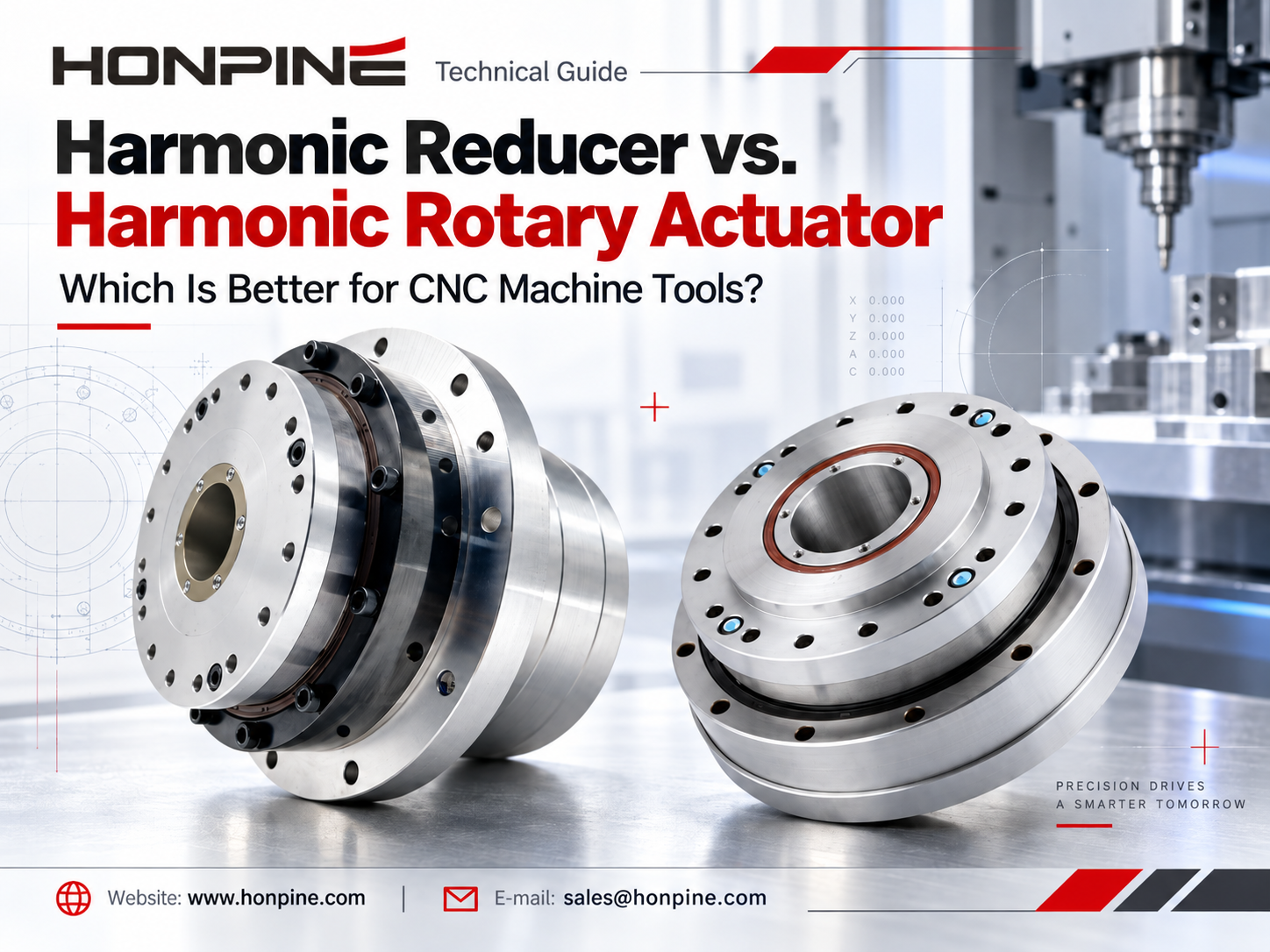
 Harmonic Reducer vs. Harmonic Rotary Actuator: Which Is Better for CNC Machine Tools?Choosing between a harmonic reducer and a harmonic rotary actuator is an important decision in CNC machine tool design. Both solutions offer high-precision motion control, but they differ in integration, installation requirements, rigidity, and system flexibility. For CNC fourth-axis rotary tables and compact five-axis machining systems, selecting the right harmonic drive can significantly influence machine performance. In this article, HONPINE Technical Director Theodore Li compares harmonic reducers and harmonic rotary actuators to help engineers identify the most suitable solution for their CNC applications.
 How to Choose Harmonic Joint Actuators for a 7-DOF Robotic Arm?I'm Theodore Li, Technical Director at HONPINE. Choosing harmonic joint actuators for a 7-DOF robotic arm starts with the torque, weight, and installation needs of each joint. This guide uses a TCHL 20 shoulder and TCHL 14 wrist configuration as an example, then explores torque sensing, compliant control, and HAG Series considerations for demanding robotic applications.
 AGV Suspension: Should You Choose a Balance Beam or a Spring-Loaded Steering Drive Unit?Choosing an AGV suspension system starts with the vehicle’s load range and floor conditions. Balance beams and spring-loaded steering drive units offer different approaches to maintaining wheel contact and managing wheel loads. This HONPINE guide compares both options and explains how to evaluate traction, suspension travel, installation space, and maintenance before choosing a configuration.
 Hollow Rotary Platform Motor Matching: A Complete GuideSelecting the right motor for a hollow rotary platform is essential for achieving precise positioning, stable operation, and efficient automation. This guide explains how to match servo motors, stepper motors, and brushless DC motors with hollow rotary platforms based on torque, speed, inertia, accuracy, and installation requirements. Explore practical motor selection guidelines, typical application combinations, and space-saving mounting solutions to find the right configuration for your automation project.
 Can Robots Feel Touch? HONPINE HAG Force-Controlled Harmonic Robot Joint MotorsCan robots respond to a gentle touch? The HONPINE HAG robot joint motor with torque sensor combines a harmonic reducer, integrated torque sensing, and closed-loop control to detect external forces and support smooth, compliant motion. In this article, HONPINE founder Allen Li demonstrates the module's response to light contact and hand-guided movement, explains its key force-control technologies, and shares the vision behind joint modules designed for practical industrial robotics.
 Does a Higher Gearbox Ratio Mean More Torque? Planetary, Harmonic, and RV Gearboxes ExplainedDoes a higher gearbox ratio mean more torque? This engineering guide explains the relationship between gearbox ratio, output torque, and output speed, and compares planetary gearboxes, harmonic gearboxes, and RV gearboxes. Learn why reduction ratio alone cannot determine gearbox torque capacity, efficiency, dynamic response, precision, or service life, and what engineers should consider when selecting a gearbox for robotics, CNC machines, servo systems, and industrial motion control.
 High-Precision Hollow Harmonic Rotary Actuator for CNC Machines and Heavy-Duty Rotary AxesHONPINE 58 Series Hollow Harmonic Rotary Actuator is designed for CNC rotary tables, precision rotary axes, laser processing equipment, and heavy-duty rotary positioning applications. With a 50 mm hollow bore, up to 2,722 N·m peak torque, integrated crossed roller bearing, multi-turn absolute encoder options, positioning accuracy below 30 arcsec, and repeat positioning accuracy below 5 arcsec, it combines high torque capacity with precision rotary motion and flexible mechanical integration.
 How Does the HONPINE JRM Planetary Robot Joint Module Address Temperature Rise in Continuous Operation?HONPINE JRM planetary robot joint modules are designed for long-duration and high-load robotic operation. This article examines how motor electromagnetic optimization, high-efficiency planetary transmission, GaN-based drive technology, and system-level low-loss design help control temperature rise. Using the C6345 planetary robot joint module as a test example, HONPINE also presents full-load thermal validation under continuous operation, including motor efficiency up to 92%, planetary gearbox efficiency up to 97%, and a final equilibrium temperature of 61.42°C at a 25°C ambient temperature.
 Direct Drive Motor Sizing: A Complete Guide to Torque Calculation and SelectionSelecting a direct drive motor for a precision rotary system requires more than matching motor torque to the equipment weight. Engineers need to evaluate gravity torque, inertial torque, wind torque, friction, rotational inertia, speed, acceleration, duty cycle, and positioning requirements. In this guide, Theodore Li, Technical Director at HONPINE, explains a practical approach to direct drive motor sizing and torque calculation using an azimuth and elevation turntable as an engineering example. The article covers continuous and peak torque calculation, motor selection criteria, and the application of frameless direct drive motors in integrated rotary systems.