

How to Select a Servo Drive for HONPINE Harmonic Rotary Actuators with External Drives?
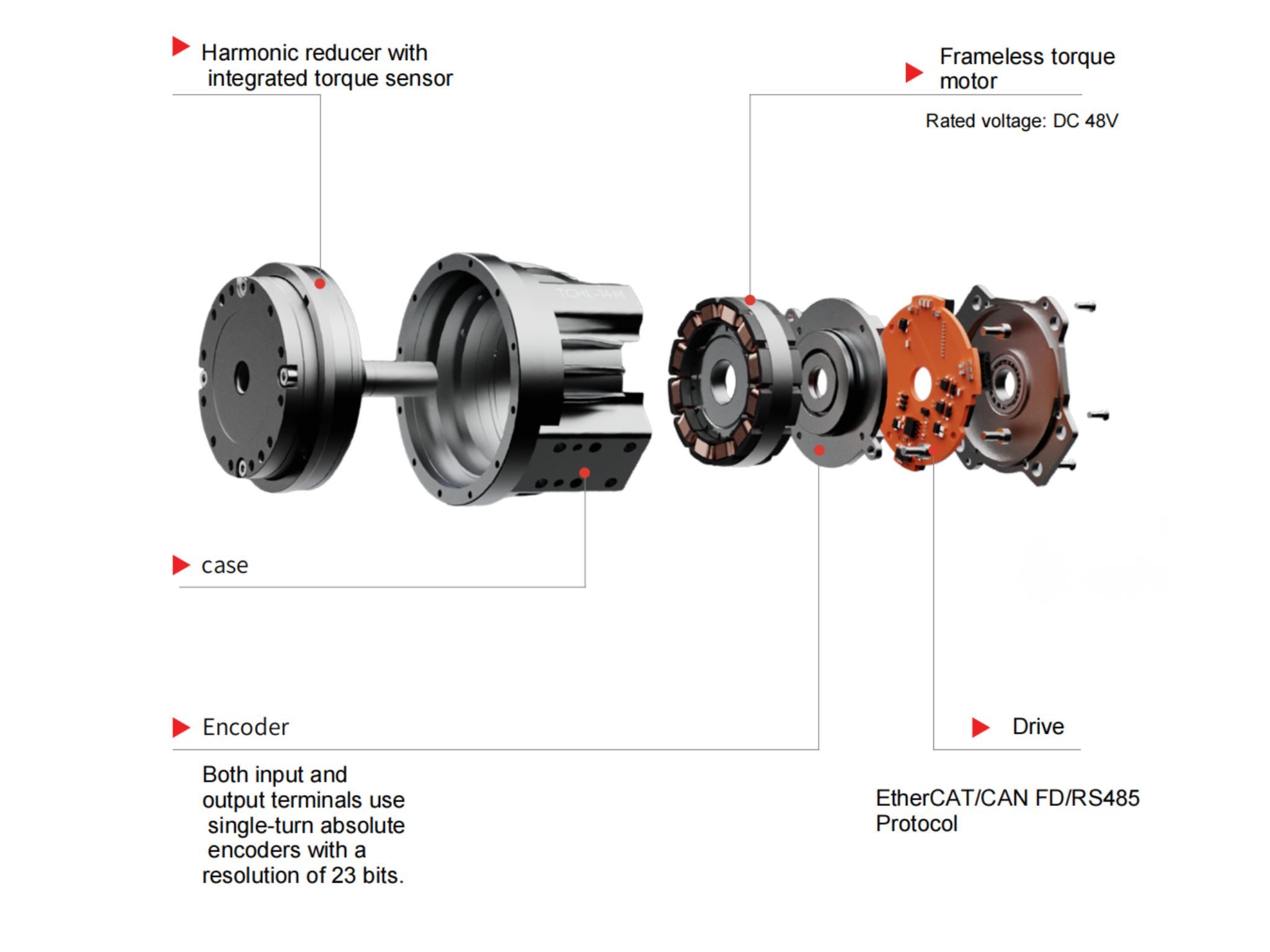
HONPINE integrated harmonic rotary actuators with external servo drives combine a frameless torque motor, harmonic reducer, and absolute encoder into a compact motion unit. They are widely used in precision rotary tables, automated workstations, robotic joints, and other precision motion control applications. As the core control component of the entire system, the servo drive directly affects positioning accuracy, operational stability, and equipment service life.
Hello everyone, I'm Theodore Li, Technical Director at HONPINE. In this article, based on our product selection catalog, I will explain the key considerations when selecting an external servo drive for HONPINE harmonic rotary actuators. We will cover power supply compatibility, electrical parameters, encoder protocols, brake functions, communication buses, hardware interfaces, operating condition derating, and system integration to provide practical guidance for real-world applications.
1. Match the Power Supply Voltage
Power supply compatibility is the first requirement when selecting a servo drive.
HONPINE harmonic rotary actuators with external drives are available in two power supply configurations: AC 220V and DC 48V. These two versions are not interchangeable.
The DC 48V configuration is available for actuator sizes HAT11 to HAT40, while the high-torque HAT50 and HAT58 configurations are available exclusively with AC 220V power supply.
When selecting a servo drive, its input power specifications must match the actuator. For AC-powered models, the drive must support single-phase 220VAC input. For DC-powered models, the DC bus voltage must be compatible with a stable 48VDC supply.
An incorrect voltage rating can cause serious hardware damage to both the motor and the servo drive.
2. Match the Rated and Peak Output Current
Current matching is one of the most important factors in servo drive selection. During this process, it is essential to distinguish between RMS current (Arms) and peak current to avoid confusion between different current ratings.
Both the continuous output current and peak output current of the servo drive should include an appropriate design margin.
Continuous Current and Peak Current Margins
Under normal operating conditions, the recommended selection criteria are:
Peak output current: At least 1.2–1.5 times the maximum motor current specified in the product catalog. This margin helps accommodate current surges during acceleration, deceleration, startup, and direction changes.
Continuous output current: At least 1.1–1.2 times the motor's rated current to prevent overheating and power derating during prolonged operation under load.
For applications involving high-frequency reciprocating motion or frequent acceleration and deceleration, a current margin of approximately 1.5 times is recommended. The peak current duration supported by the drive must also be checked to ensure compatibility with the actual operating cycle.
Special Considerations for High-Torque Harmonic Rotary Actuators
For high-torque harmonic rotary actuator configurations, such as the HAT50 and HAT58 sizes, the motor operating current can reach approximately 20–30 A or even higher, depending on the operating conditions.
In these cases, particular attention should be paid to the servo drive's power rating and control cabinet cooling capacity. Insufficient thermal management may trigger overtemperature protection and cause unexpected system shutdowns.
3. Verify Absolute Encoder Communication Compatibility
The encoder communication protocol determines whether the servo drive can correctly read the actuator's position feedback signals.
HONPINE harmonic rotary actuators are equipped with Tamagawa absolute encoders as standard. In the encoder model designation, code 31 indicates a single-turn resolution of 17-bit (23-bit optional) combined with 16-bit multi-turn counting.
Therefore, the selected servo drive must natively support the corresponding Tamagawa absolute encoder protocol. A drive that supports only incremental encoders is not suitable.
Check Multi-Turn Position Retention
Multi-turn absolute encoders use a battery to retain position information when the system is powered off.
During selection, confirm whether the servo drive supports a compatible encoder battery pack or has an integrated battery power supply solution.
Without the required backup power, the encoder may lose its multi-turn position information after a power interruption, potentially affecting the machine's positioning reliability and homing requirements.
4. Check Brake Control Compatibility
If the selected harmonic rotary actuator is equipped with an electromagnetic brake, the servo drive must provide compatible brake control functionality.
For HONPINE actuators with brakes, the electromagnetic brake generally operates at DC 24V.
The servo drive should therefore provide an independent brake control output, with an output voltage and current rating compatible with the brake specifications.
Verify Brake Release and Engagement Logic
The internal brake control sequence is equally important.
Under normal operating conditions:
When the servo is enabled, the brake should be released.
When a servo fault occurs or the servo is disabled, the brake should engage promptly to hold the load.
This function is particularly important for vertical-axis applications, where an unexpected loss of motor torque could cause the mechanical structure to move downward under gravity.
The brake control logic should be verified to ensure reliable load holding and operational safety.
5. Select the Appropriate Control Mode and Communication Bus
The control mode and communication interface should be compatible with the overall machine control architecture.
HONPINE harmonic rotary actuators are commonly used for angular positioning applications. Therefore, the servo drive's position-loop control performance should be a primary consideration.
Depending on the system requirements, the drive may support pulse-and-direction control or industrial communication interfaces such as EtherCAT and RS485. The reference configuration in the HONPINE catalog uses EtherCAT communication.
Before purchasing, verify that the selected drive's communication protocol is compatible with the upper-level controller, PLC, or motion control system.
For applications requiring additional functional safety, a servo drive equipped with Safe Torque Off (STO) terminals is also recommended. These terminals can be integrated into the machine's safety circuit to meet the applicable equipment safety requirements.
6. Verify Hardware Interfaces and Cable Compatibility
Hardware interface compatibility is another detail that should not be overlooked.
The servo drive must match the pin assignments of the actuator's motor power cable and encoder cable.
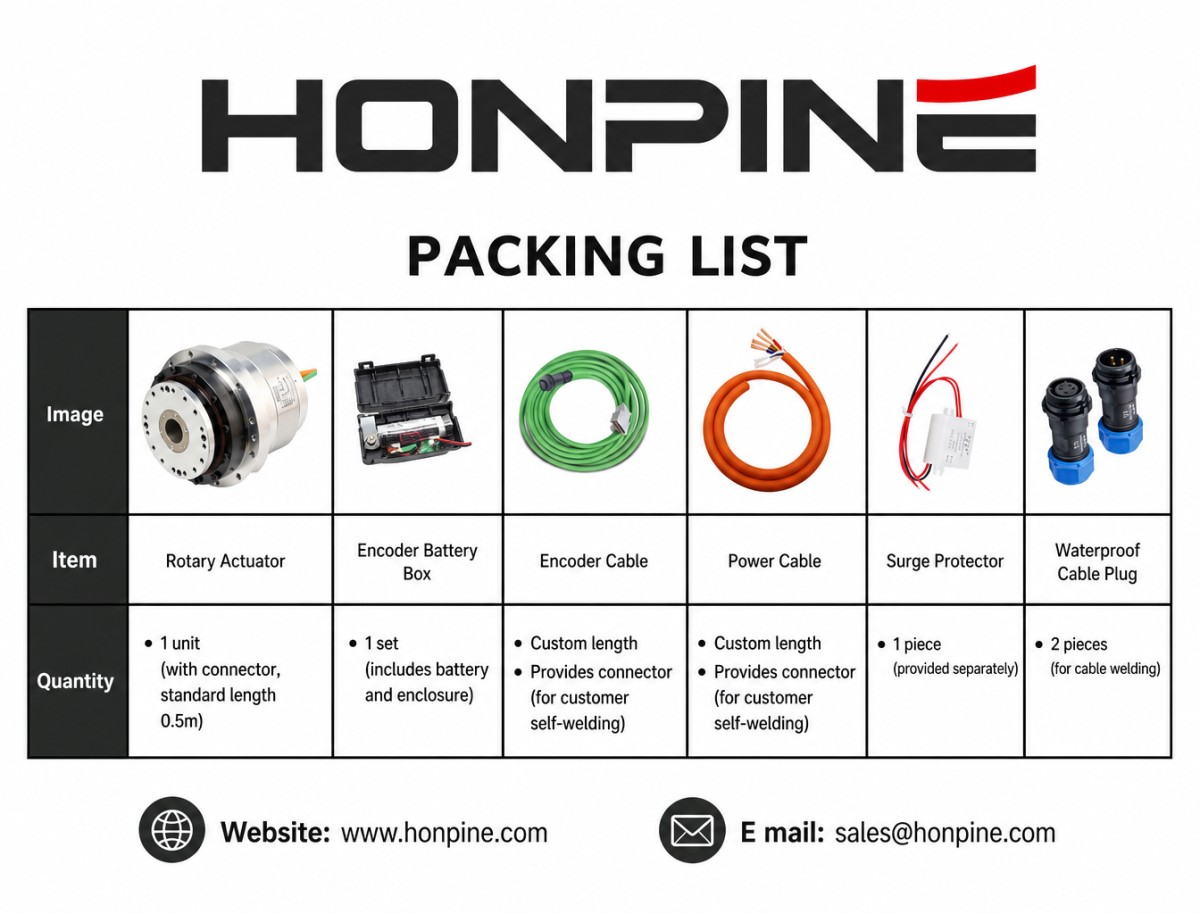
HONPINE harmonic rotary actuators use the following standard connector configurations:
7-pin or 4-pin aviation connectors for motor power connections, depending on the actuator configuration.
9-pin connectors for Tamagawa encoder connections.
The connectors on the servo drive side and the corresponding cables must match the actuator's actual interface specifications and pin definitions.
The standard cable length is 0.5 m. For installations requiring longer cable runs, customized cables may be necessary to reduce signal attenuation and electromagnetic interference.
For AC 220V power supply systems, installing an appropriate power line filter is recommended to suppress electromagnetic interference from the power grid and improve overall system stability.
7. Evaluate Operating Conditions and Apply Appropriate Derating
Servo drive selection should not rely entirely on catalog specifications. Actual operating conditions must also be considered when verifying the drive capacity.
Consider Load Inertia
In addition to the motor's electrical parameters, the actual load inertia must be evaluated.
The HONPINE catalog provides rotor inertia specifications for harmonic rotary actuator configurations both with and without electromagnetic brakes. The servo drive's tuning capability and inertia matching range should be suitable for the combined motor and mechanical load inertia.
Verify Low-Speed Torque Performance
For applications requiring high torque at low speeds, verify that the servo drive can maintain sufficient torque output throughout the low-speed operating range.
This helps prevent torque reduction or unstable operation under demanding low-speed conditions.
Consider Ambient Temperature and Thermal Derating
When the servo drive is installed in a control cabinet with a relatively high ambient temperature, its available output capacity may decrease due to thermal limitations.
In such cases, a higher-rated drive may be required to compensate for derating and maintain sufficient performance margins.
Proper thermal management and adequate ventilation should also be considered during system design.
8. Servo Drive Selection Checklist
After checking all the technical parameters, the following checklist can be used for final verification:
Confirm that the drive's input voltage matches the actuator's AC 220V or DC 48V configuration.
Ensure that both peak and continuous output current ratings provide sufficient margins.
Verify compatibility with the Tamagawa single-turn and multi-turn absolute encoder.
For brake-equipped actuator models, confirm the brake output voltage, current capacity, and control logic.
Ensure that the communication bus or pulse interface is compatible with the motion controller.
Verify that motor power and encoder connector pin assignments match the actuator.
Check whether the servo drive provides STO safety terminals when required by the machine safety design.
Increase current and thermal margins for high-frequency motion and demanding operating conditions.
Conclusion: Servo Drive Selection Requires Complete System Matching
Selecting an external servo drive for a harmonic rotary actuator is a system-level matching process, not simply a matter of choosing a drive based on motor power.
Power supply voltage, output current, encoder compatibility, brake control, communication protocols, hardware interfaces, and actual operating conditions must all be carefully evaluated.
Only when these factors are properly matched can HONPINE harmonic rotary actuators deliver their intended high positioning accuracy, high torsional rigidity, and reliable operating performance.
For engineers designing precision rotary tables, automated production equipment, or robotic joints, a properly matched external servo drive is essential for achieving stable motion control and long-term system reliability.

About Author
Theodore Li serves as the Technical Director at HONPINE, overseeing the R&D strategy for replication products, guiding team selection, and managing both pre-sales and after-sales operations.

Read More
Learn more about the story of HONPINE and industry trends related to precision transmission.
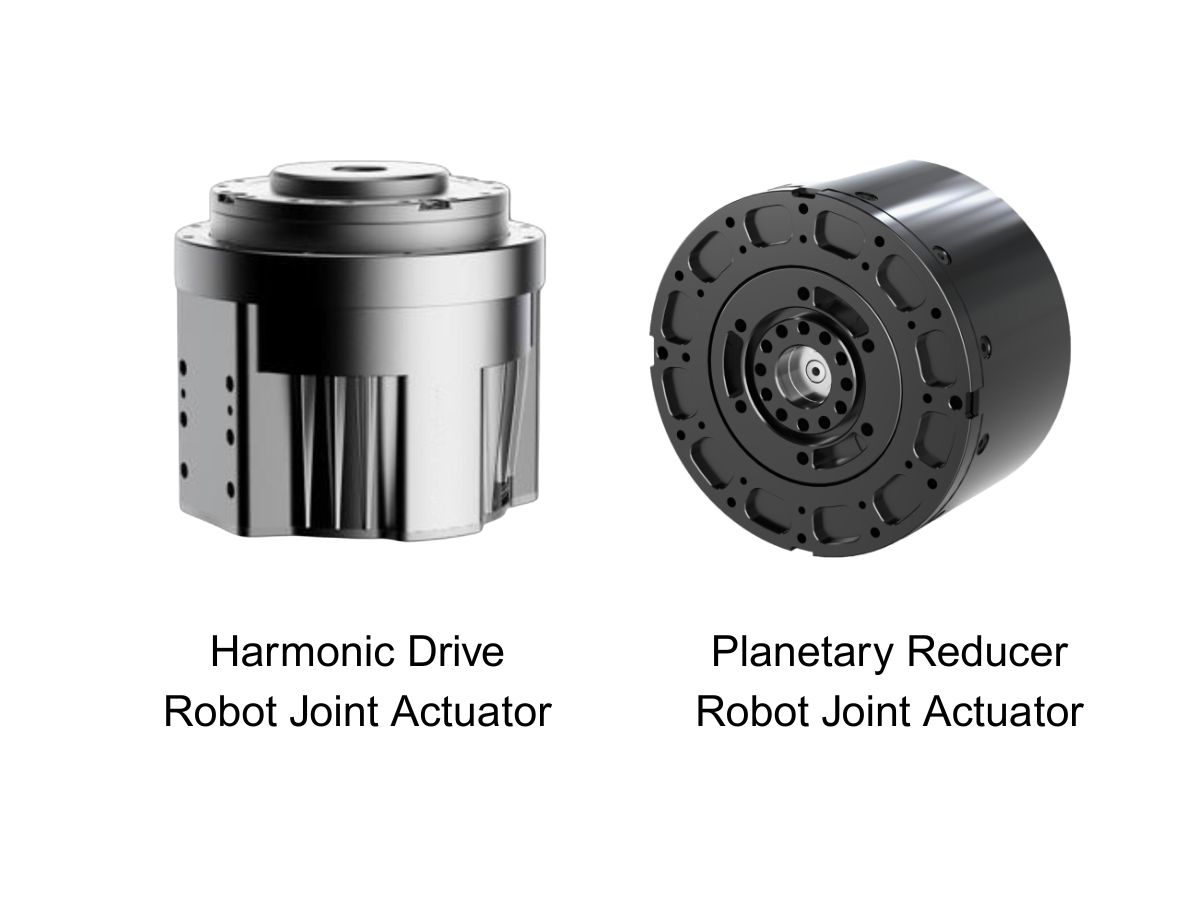
 What is robot joint actuator?How to Choose the Best Robot Rotary Joint Actuator?In core robot joint transmission solutions, planetary and harmonic rotary actuators each have their own strengths. Choosing the right type based on application requirements is essential to achieve the optimal balance between performance and cost.
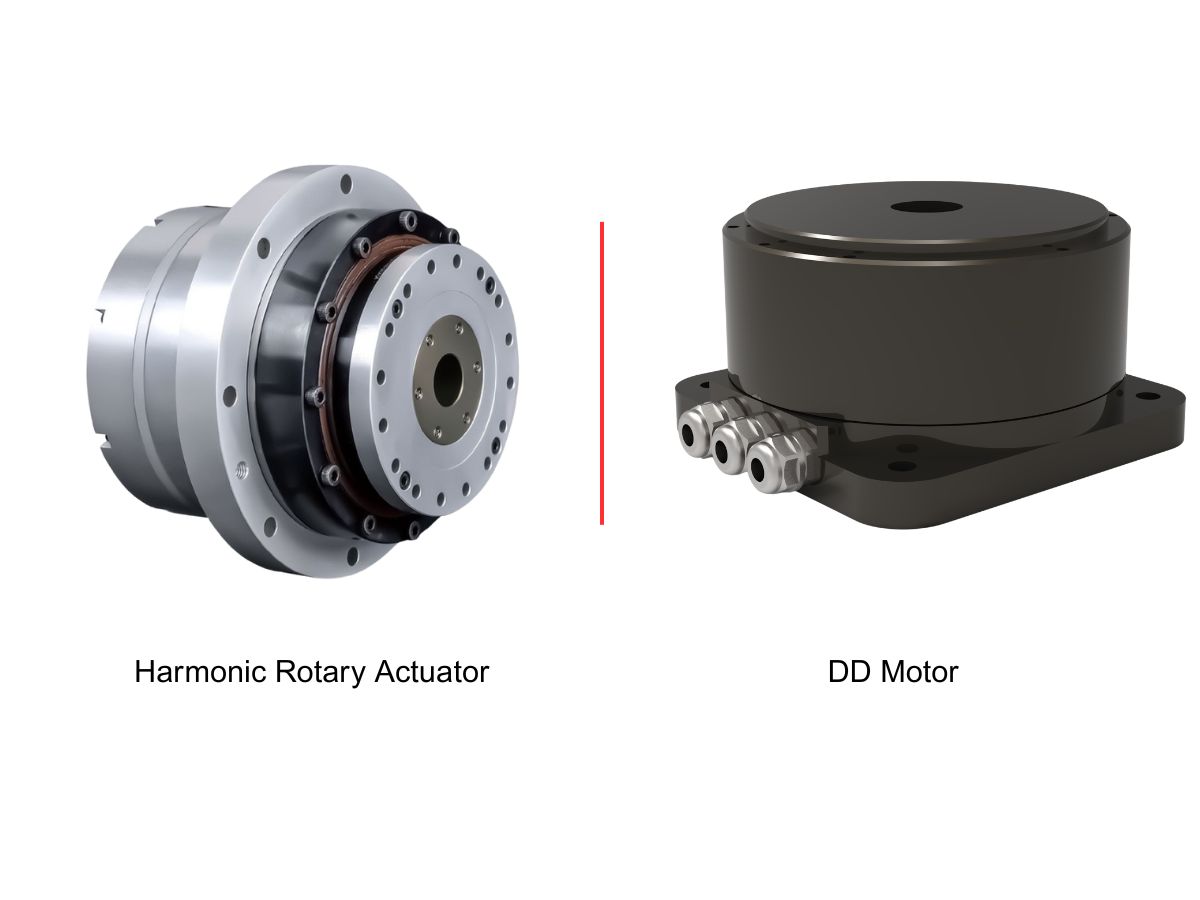
 DD Motors VS Harmonic Rotary ActuatorsThis article provides an in-depth comparison between Direct Drive (DD) motors and harmonic rotary actuators, covering their transmission principles, advantages and disadvantages, and typical application fields.
 OMG Ultra Compact Harmonic Drive Joint Module with Built-in Torque SensorHONPINE TCHL series harmonic drive joint module is a game-changing product that achieves disruptive improvements in multiple aspects such as lightweight design, integration level, and connection convenience. This article will analyze its revolutionary enhancements with you.
 The Role of Harmonic Drive Gears in Achieving 5–10 μm Accuracy in Dental Milling MachinesA dental milling machine is a CNC machining system used to directly process digital dental models into restorations such as crowns, bridges, veneers, inlays, and implant abutments. Dental milling machines require far higher operational accuracy and motion stability than ordinary equipment. This article explains how harmonic drive gear help dental milling machines achieve stable, continuous, and controllable operation.
 Why Are Harmonic Rotary Actuators Perfect for Medical Equipment?Harmonic rotary actuators (typically integrated systems consisting of a harmonic drive reducer, frameless torque motor, encoder, and optional brake) are regarded as key components in medical equipment. The core reason is that they simultaneously meet the most stringent medical requirements for precision, compact size, safety, and controllability. The following explanation is structured from three perspectives: technical characteristics, application scenarios, and medical value.
 High-Precision RV Reducers Perfectly Matched for Walking RobotsThe walking axis of a robot is a core component for power transmission and support. RV reducers provide extremely high rigidity, precision, and torque while maintaining a compact size and exceptional reliability, making them an ideal match for the demanding requirements of walking robot joints in terms of load capacity, impact resistance, and precision.
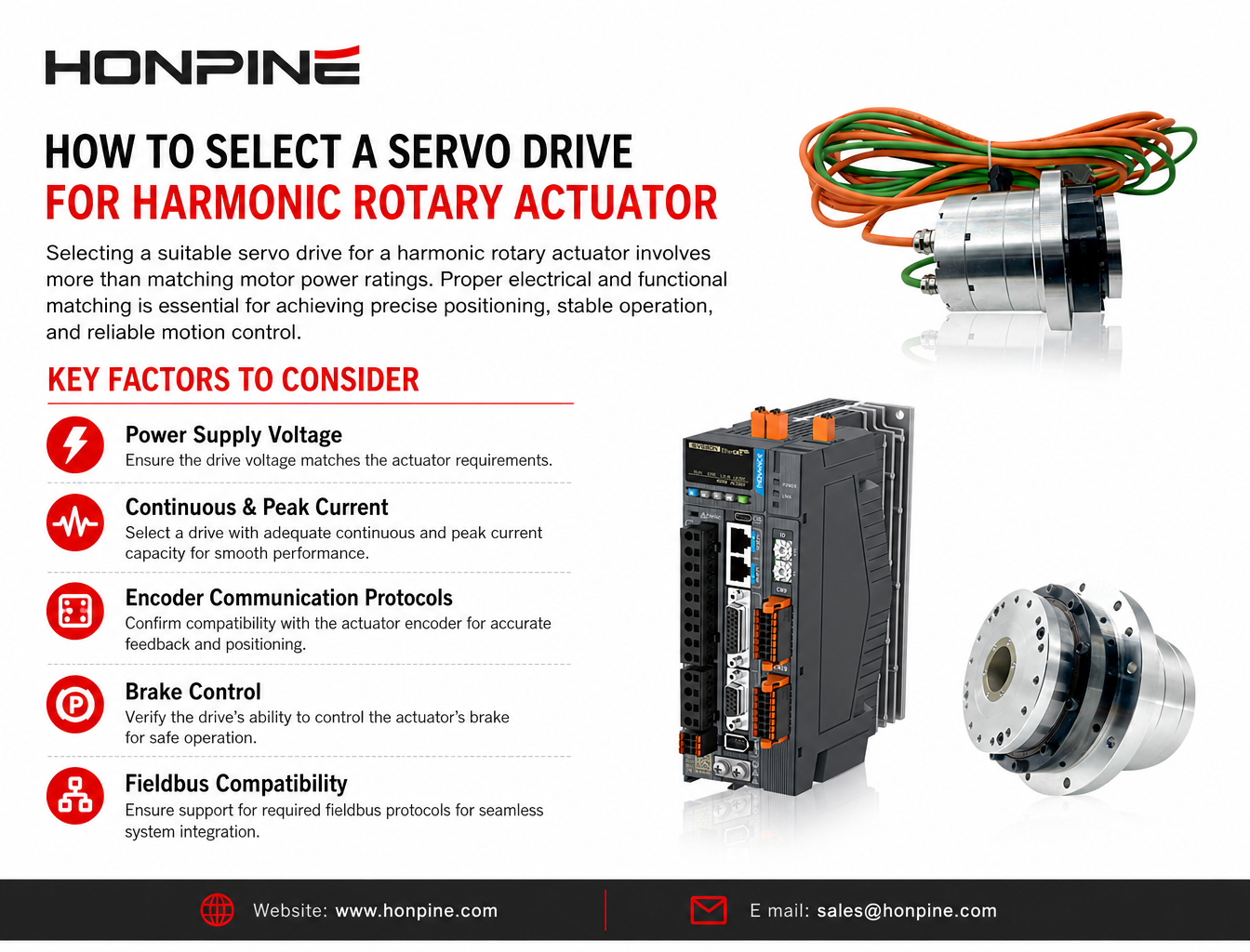
 How to Select a Servo Drive for HONPINE Harmonic Rotary Actuators with External Drives?Selecting a suitable servo drive for a harmonic rotary actuator involves more than matching motor power ratings. Power supply voltage, continuous and peak current, encoder communication protocols, brake control, and fieldbus compatibility all affect system performance. For HONPINE harmonic rotary actuators with external servo drives, proper electrical and functional matching is essential for achieving precise positioning, stable operation, and reliable motion control. In this guide, Theodore Li, Technical Director at HONPINE, explains the key factors engineers should consider when selecting and integrating an external servo drive.
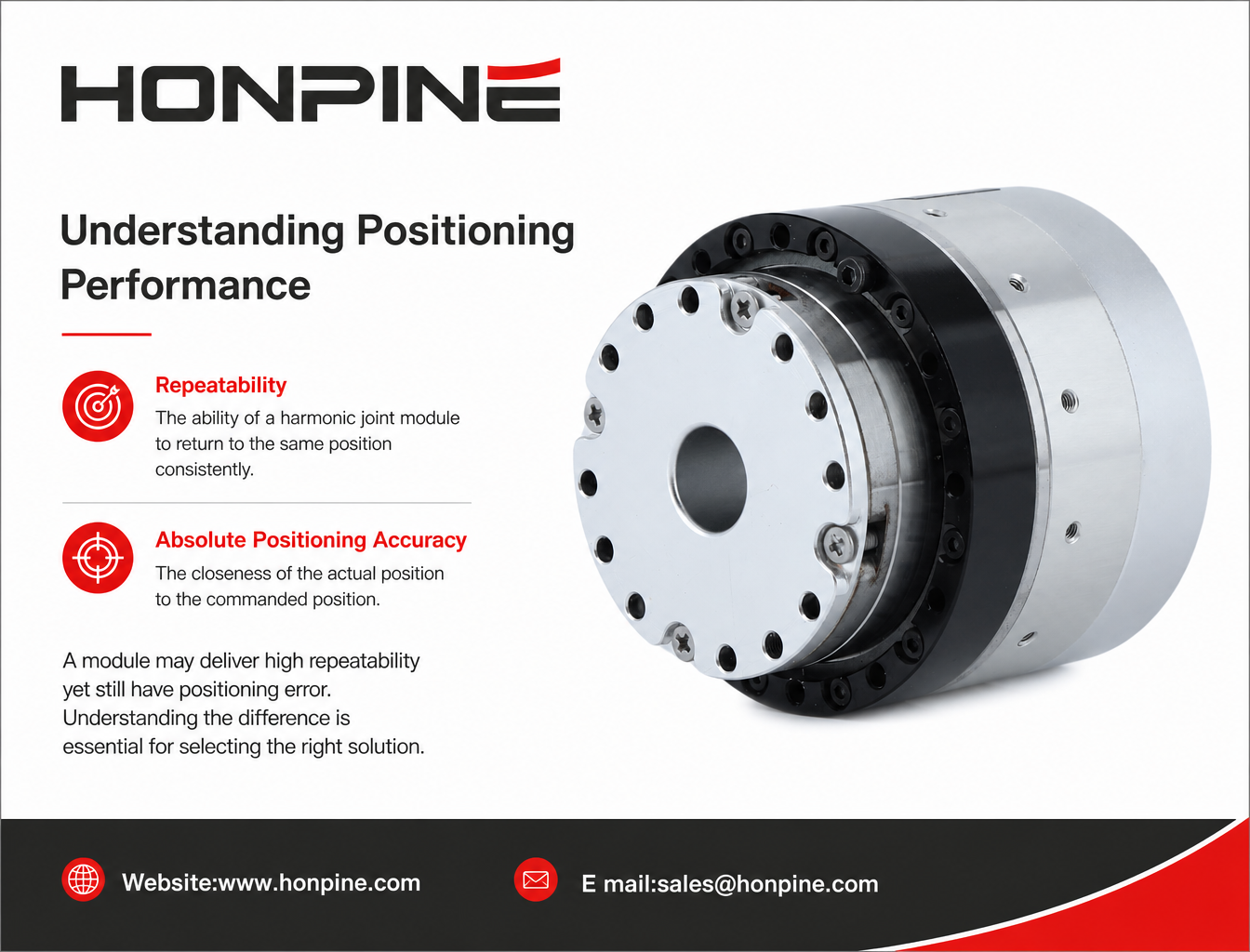
 Repeatability vs. Absolute Positioning Accuracy in Harmonic Joint Modules: Differences and Industrial ApplicationsWhen evaluating the positioning performance of a harmonic joint module, repeatability and absolute positioning accuracy are two important but often misunderstood specifications. A module may repeatedly reach the same position with high consistency while still having a noticeable deviation from the commanded position. Understanding this distinction is essential when selecting motion components for robotics, semiconductor equipment, precision machining, and medical devices. This article explains how the two specifications differ, what factors affect them, and which positioning performance should take priority in different industrial applications.
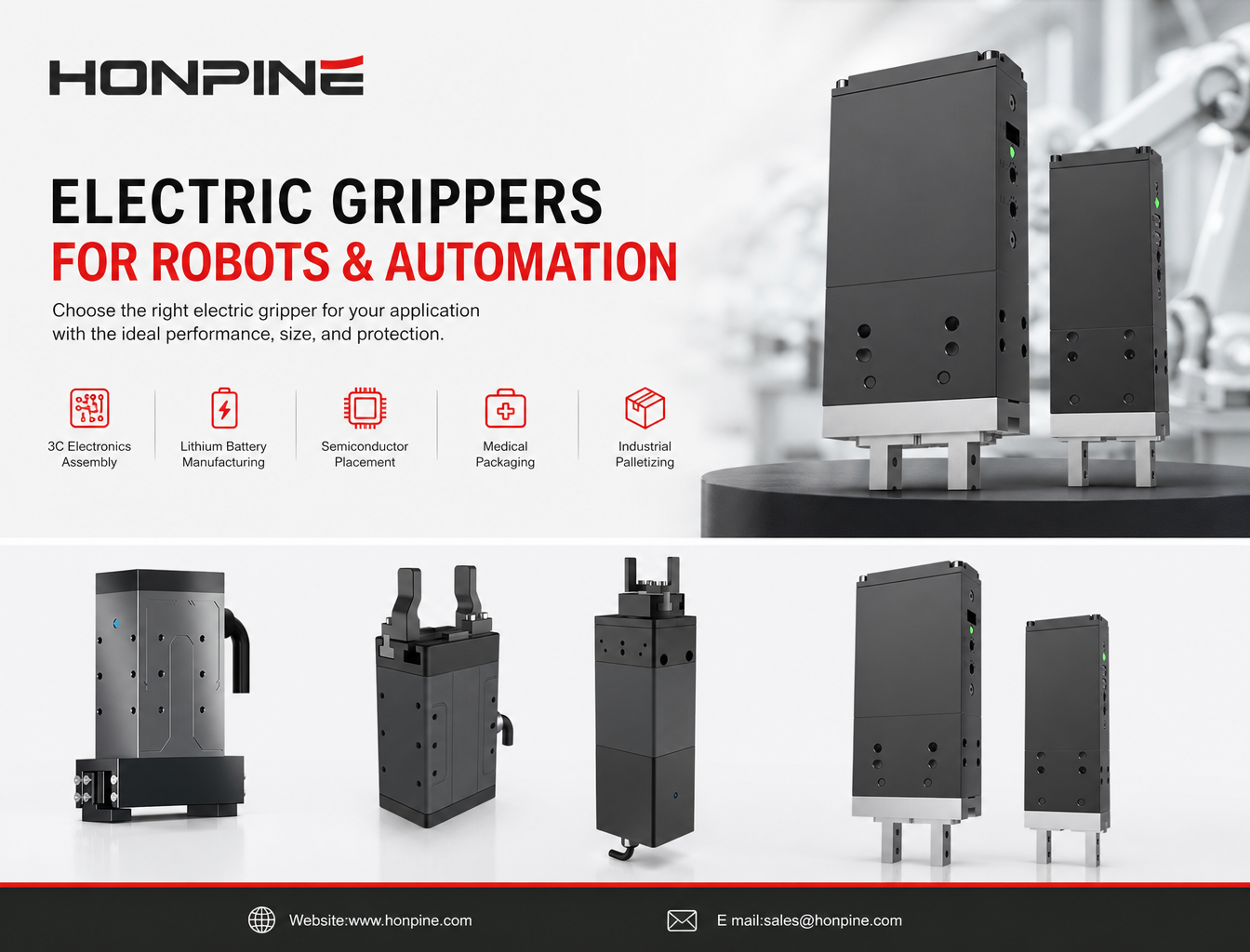
 How to Select Electric Grippers for Robots and Industrial Automation Production Lines?Electric grippers are essential robot end-effectors in modern industrial automation, enabling precise workpiece handling, assembly, positioning, and packaging. However, different applications require different gripping forces, stroke lengths, payload capacities, force control accuracy, and protection ratings. How should engineers select the right electric gripper for delicate 3C components, heavy lithium battery modules, semiconductor placement, medical packaging, or general industrial handling? In this article, Theodore Li, Technical Director at HONPINE, explains how to choose suitable electric grippers and linear rotary actuators based on actual application requirements.
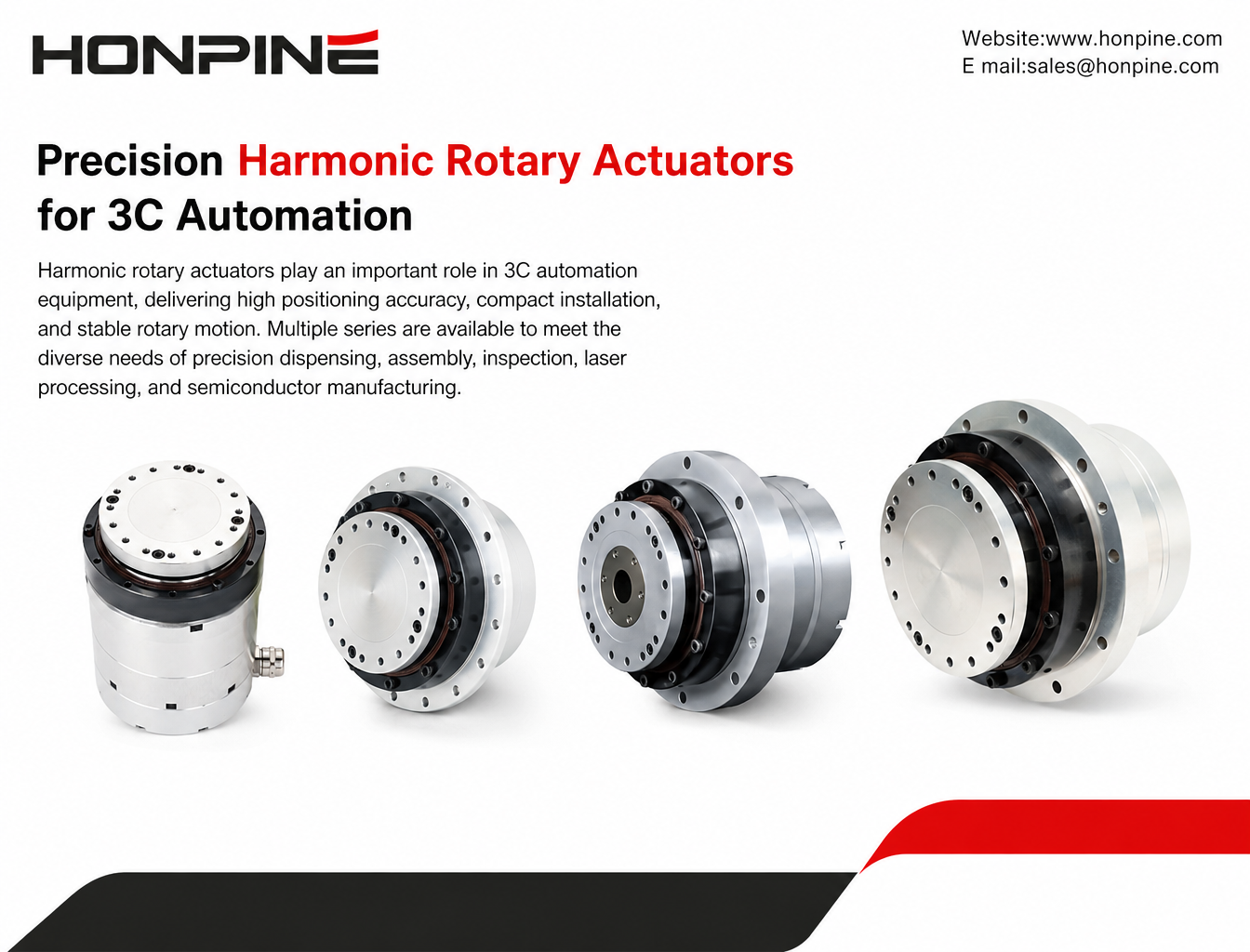
 How to Select Harmonic Rotary Actuators for Precision Assembly, Dispensing, and Inspection in 3C Automation Equipment?Harmonic rotary actuators play an important role in modern 3C automation equipment, particularly in applications requiring high positioning accuracy, compact installation, and stable rotary motion. From precision dispensing machines and smartphone assembly lines to machine vision inspection, laser processing, and semiconductor manufacturing equipment, different applications have different requirements for torque, rigidity, rotational speed, and shaft configuration. In this article, Theodore Li, Technical Director at HONPINE, introduces the HAT, HAS, HATF, and HAM series harmonic rotary actuators and explains how to select suitable models for different 3C automation applications.
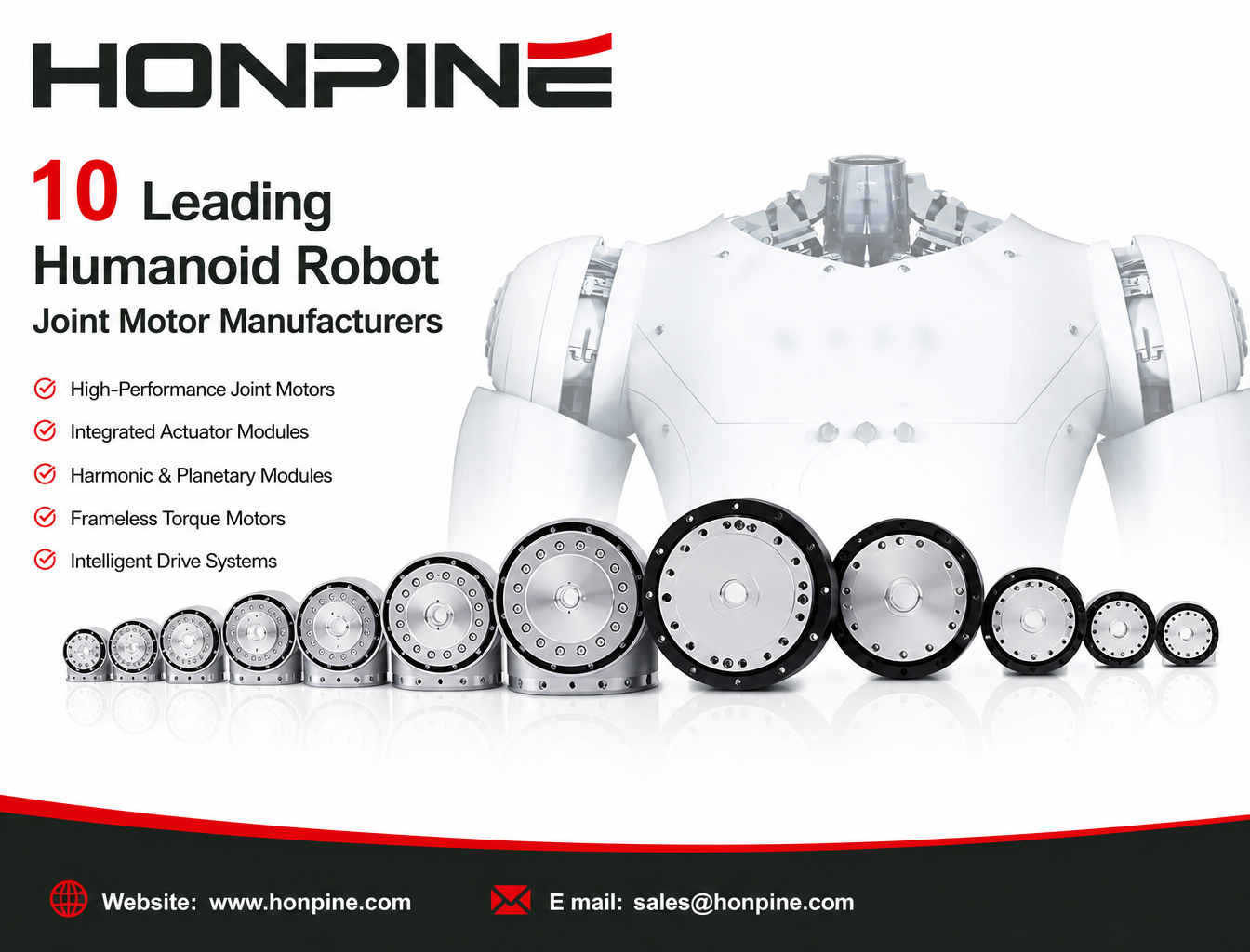
 Top 10 Humanoid Robot Joint Motor ManufacturersThe rapid development of humanoid robotics is driving demand for high-performance joint motors and integrated actuator modules. From harmonic and planetary joint modules to frameless torque motors and intelligent drive systems, manufacturers are developing different solutions to meet the requirements of humanoid robot joints. But which supplier should you choose? In this article, we introduce 10 humanoid robot joint motor manufacturers from China and Japan, comparing their product portfolios, technical features, torque capabilities, and application areas to help robotics developers and manufacturers make more informed sourcing decisions.
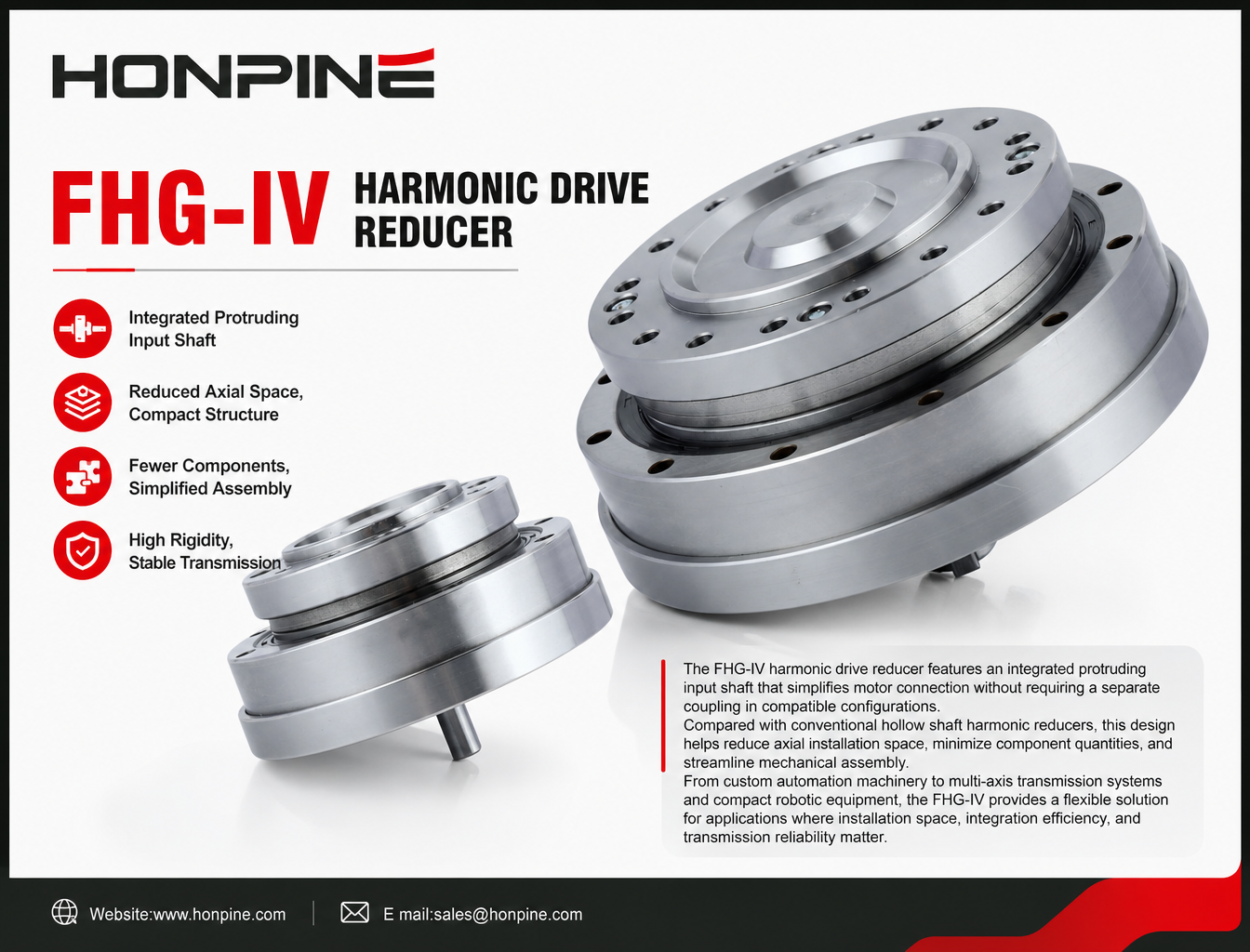
 FHG-IV Harmonic Drive Reducer: Eliminate the Coupling for a More Compact DesignThe FHG-IV harmonic drive reducer features an integrated protruding input shaft that simplifies motor connection without requiring a separate coupling in compatible configurations. Compared with conventional hollow shaft harmonic reducers, this design helps reduce axial installation space, minimize component quantities, and streamline mechanical assembly. From custom automation machinery to multi-axis transmission systems and compact robotic equipment, the FHG-IV provides a flexible solution for applications where installation space, integration efficiency, and transmission reliability matter.
Double Click
We provide harmonic drive reducer,planetary reducer,robot joint motor,robot rotary actuators,RV gear reducer,robot end effector,dexterous robot hand
 What is robot joint actuator?How to Choose the Best Robot Rotary Joint Actuator?In core robot joint transmission solutions, planetary and harmonic rotary actuators each have their own strengths. Choosing the right type based on application requirements is essential to achieve the optimal balance between performance and cost.
 DD Motors VS Harmonic Rotary ActuatorsThis article provides an in-depth comparison between Direct Drive (DD) motors and harmonic rotary actuators, covering their transmission principles, advantages and disadvantages, and typical application fields.
 OMG Ultra Compact Harmonic Drive Joint Module with Built-in Torque SensorHONPINE TCHL series harmonic drive joint module is a game-changing product that achieves disruptive improvements in multiple aspects such as lightweight design, integration level, and connection convenience. This article will analyze its revolutionary enhancements with you.
 How to Select a Servo Drive for HONPINE Harmonic Rotary Actuators with External Drives?Selecting a suitable servo drive for a harmonic rotary actuator involves more than matching motor power ratings. Power supply voltage, continuous and peak current, encoder communication protocols, brake control, and fieldbus compatibility all affect system performance. For HONPINE harmonic rotary actuators with external servo drives, proper electrical and functional matching is essential for achieving precise positioning, stable operation, and reliable motion control. In this guide, Theodore Li, Technical Director at HONPINE, explains the key factors engineers should consider when selecting and integrating an external servo drive.
 Repeatability vs. Absolute Positioning Accuracy in Harmonic Joint Modules: Differences and Industrial ApplicationsWhen evaluating the positioning performance of a harmonic joint module, repeatability and absolute positioning accuracy are two important but often misunderstood specifications. A module may repeatedly reach the same position with high consistency while still having a noticeable deviation from the commanded position. Understanding this distinction is essential when selecting motion components for robotics, semiconductor equipment, precision machining, and medical devices. This article explains how the two specifications differ, what factors affect them, and which positioning performance should take priority in different industrial applications.
 How to Select Electric Grippers for Robots and Industrial Automation Production Lines?Electric grippers are essential robot end-effectors in modern industrial automation, enabling precise workpiece handling, assembly, positioning, and packaging. However, different applications require different gripping forces, stroke lengths, payload capacities, force control accuracy, and protection ratings. How should engineers select the right electric gripper for delicate 3C components, heavy lithium battery modules, semiconductor placement, medical packaging, or general industrial handling? In this article, Theodore Li, Technical Director at HONPINE, explains how to choose suitable electric grippers and linear rotary actuators based on actual application requirements.
 How to Select Harmonic Rotary Actuators for Precision Assembly, Dispensing, and Inspection in 3C Automation Equipment?Harmonic rotary actuators play an important role in modern 3C automation equipment, particularly in applications requiring high positioning accuracy, compact installation, and stable rotary motion. From precision dispensing machines and smartphone assembly lines to machine vision inspection, laser processing, and semiconductor manufacturing equipment, different applications have different requirements for torque, rigidity, rotational speed, and shaft configuration. In this article, Theodore Li, Technical Director at HONPINE, introduces the HAT, HAS, HATF, and HAM series harmonic rotary actuators and explains how to select suitable models for different 3C automation applications.
 Top 10 Humanoid Robot Joint Motor ManufacturersThe rapid development of humanoid robotics is driving demand for high-performance joint motors and integrated actuator modules. From harmonic and planetary joint modules to frameless torque motors and intelligent drive systems, manufacturers are developing different solutions to meet the requirements of humanoid robot joints. But which supplier should you choose? In this article, we introduce 10 humanoid robot joint motor manufacturers from China and Japan, comparing their product portfolios, technical features, torque capabilities, and application areas to help robotics developers and manufacturers make more informed sourcing decisions.
 FHG-IV Harmonic Drive Reducer: Eliminate the Coupling for a More Compact DesignThe FHG-IV harmonic drive reducer features an integrated protruding input shaft that simplifies motor connection without requiring a separate coupling in compatible configurations. Compared with conventional hollow shaft harmonic reducers, this design helps reduce axial installation space, minimize component quantities, and streamline mechanical assembly. From custom automation machinery to multi-axis transmission systems and compact robotic equipment, the FHG-IV provides a flexible solution for applications where installation space, integration efficiency, and transmission reliability matter.
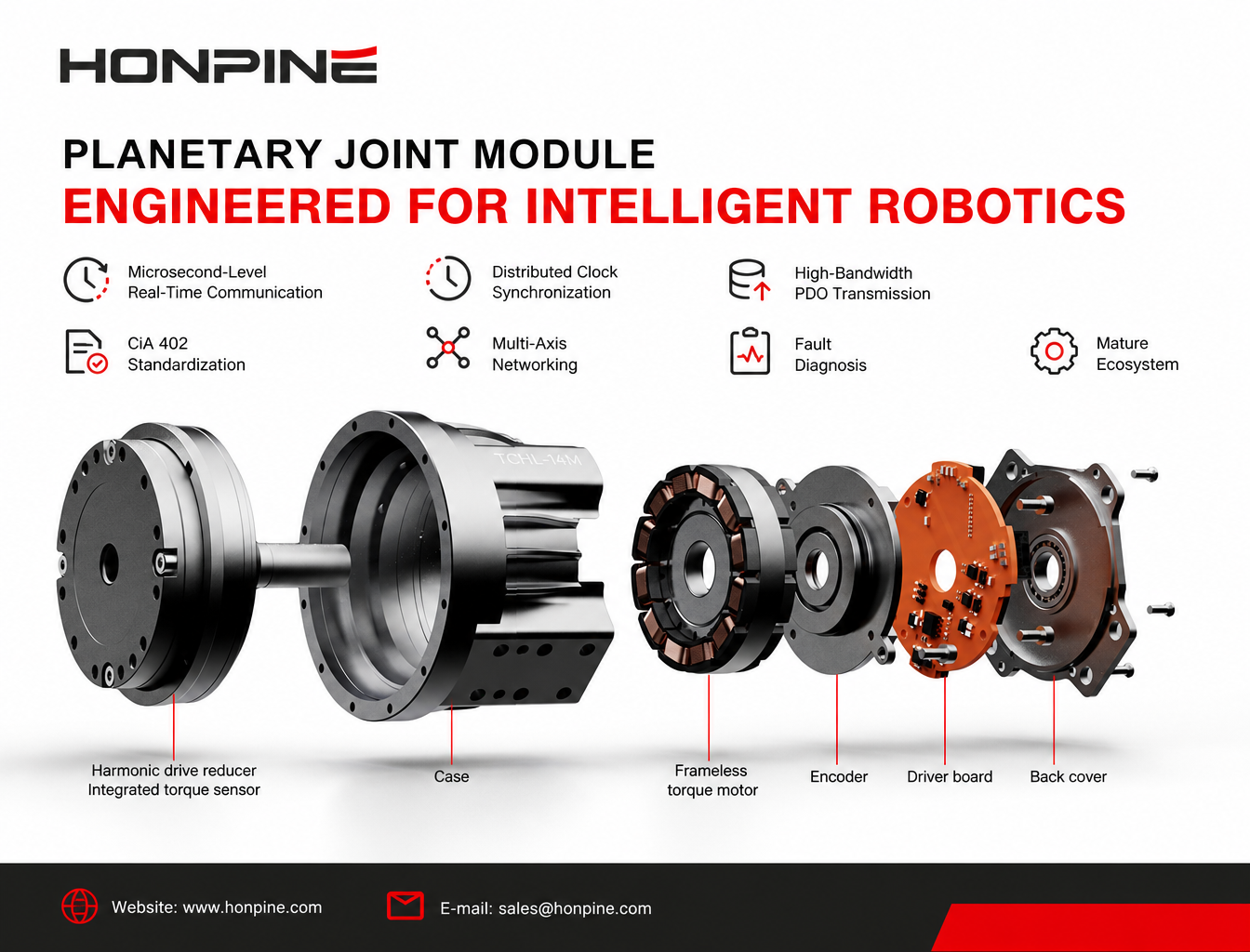
 Why Is EtherCAT Becoming the Mainstream Communication Bus for Robotic Joint Modules?Why is EtherCAT becoming the mainstream communication solution for intelligent robotic joint modules? This article explores seven key advantages, including microsecond-level real-time communication, Distributed Clock synchronization, CiA 402 standardization, high-bandwidth PDO transmission, multi-axis networking, fault diagnosis, and a mature development ecosystem. Learn how EtherCAT supports the advanced control requirements of humanoid robots, collaborative robots, and high-precision automation equipment.
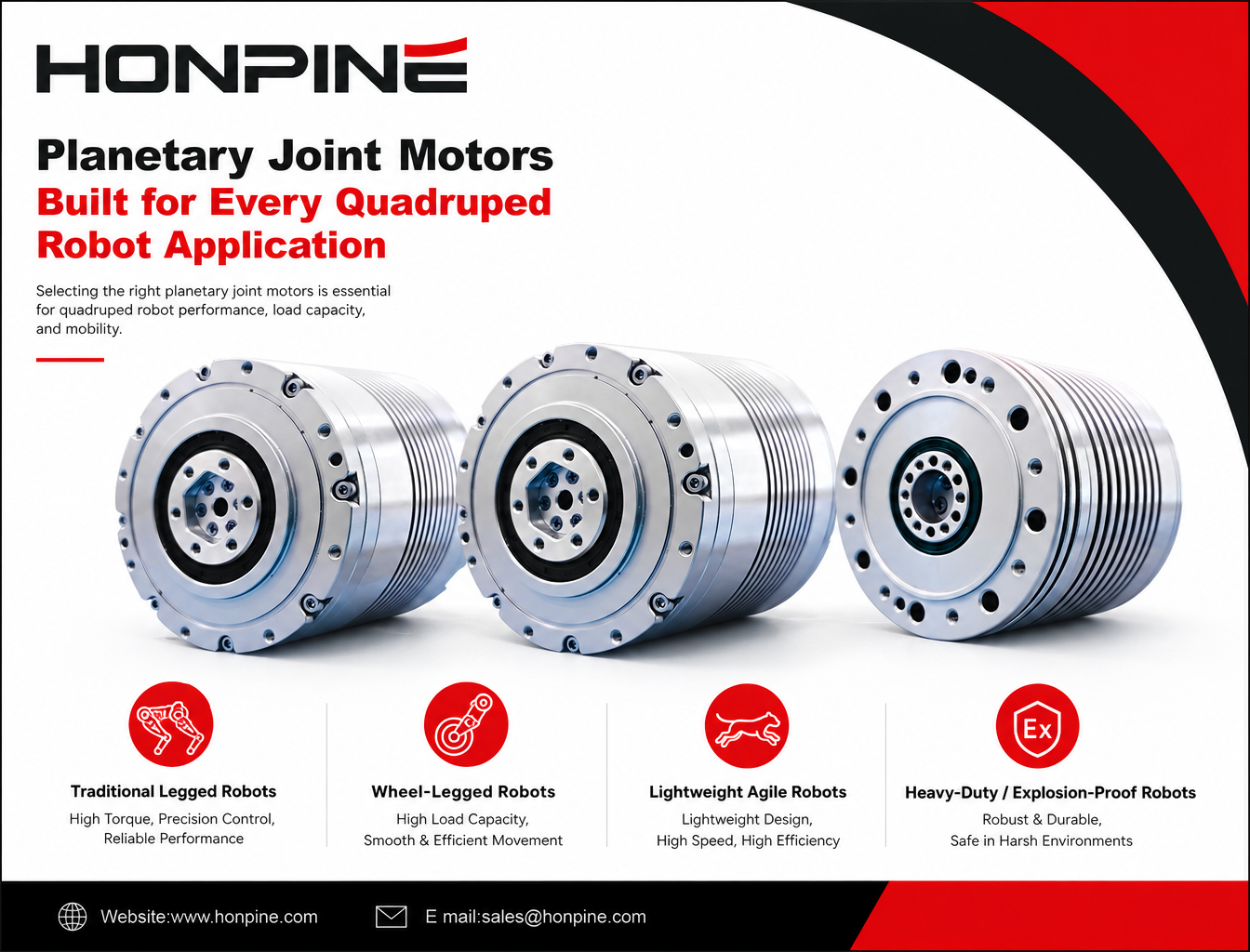
 How to Select Planetary Joint Motors for Quadruped Robots?Selecting the right planetary joint motors is essential for quadruped robot performance, load capacity, and mobility. This guide explores motor selection for traditional legged robots, wheel-legged robots, lightweight agile robots, and heavy-duty or explosion-proof quadruped robots. Learn how to match HONPINE JRM planetary joint modules to different joint positions based on rated torque, peak torque, rotational speed, voltage, and weight requirements.
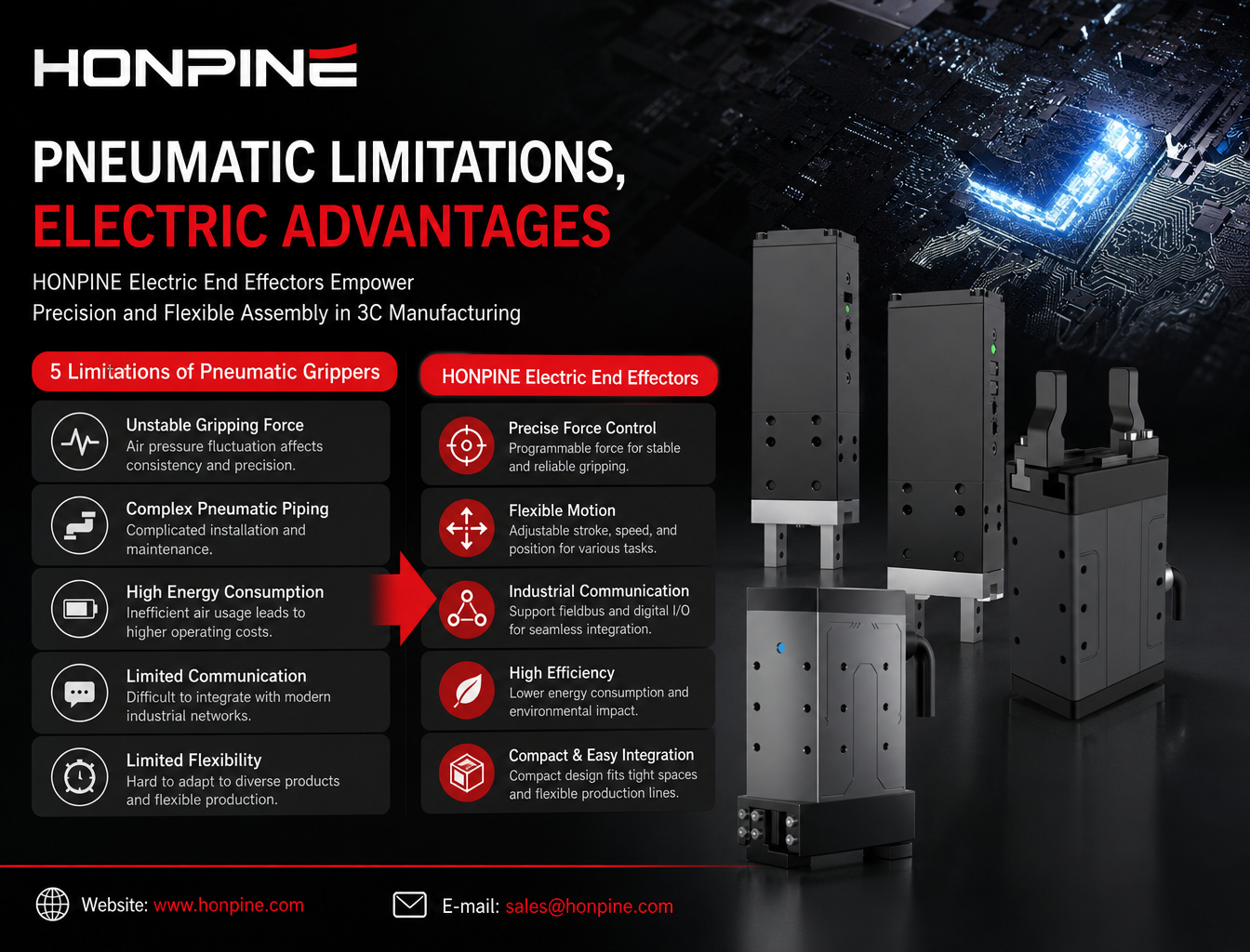
 Why Are End Effectors in 3C Automation Shifting from Pneumatic Grippers to Electric Grippers?As 3C manufacturing evolves toward thinner components, higher assembly precision, and more flexible production lines, traditional pneumatic grippers are facing increasing limitations. Fluctuating gripping force, complex pneumatic piping, high energy consumption, and limited communication capabilities make them less suitable for modern precision assembly. Electric grippers offer programmable force control, flexible motion, and industrial communication capabilities, making them an increasingly attractive alternative. In this article, we explore five major limitations of pneumatic grippers and explain how HONPINE electric end effectors support precision assembly, flexible automation, and digital manufacturing in the 3C industry.