








Hollow Rotary Platform vs. Harmonic Rotary Actuator: Application Comparison and Interchangeability
Hello everyone, I’m Theodore Li, Technical Director at HONPINE.
For engineers designing precision rotary stations for industrial automation, there is one question that often causes confusion: when a machine requires high-precision rotation, indexing, or rotary positioning, should you use a hollow rotary platform or a harmonic rotary actuator?
Can the two be used interchangeably? Which applications can use either solution? And in which applications should they not be directly substituted?
Many people simply think that both are precision rotary transmission products with high accuracy, so they should be interchangeable. However, problems often appear after the machine is actually put into operation: insufficient load capacity, inadequate rigidity, vibration, limited speed, or reduced service life.
So, let's take a closer look at the application boundaries between hollow rotary platforms and harmonic rotary actuators. Once you understand the differences, you can make a more appropriate choice during the initial design stage instead of finding problems after the equipment is built.
1. The Fundamental Difference: Their Structural Roles Are Different
Although both can be used for high-precision rotary motion, their structural characteristics and application priorities are different.
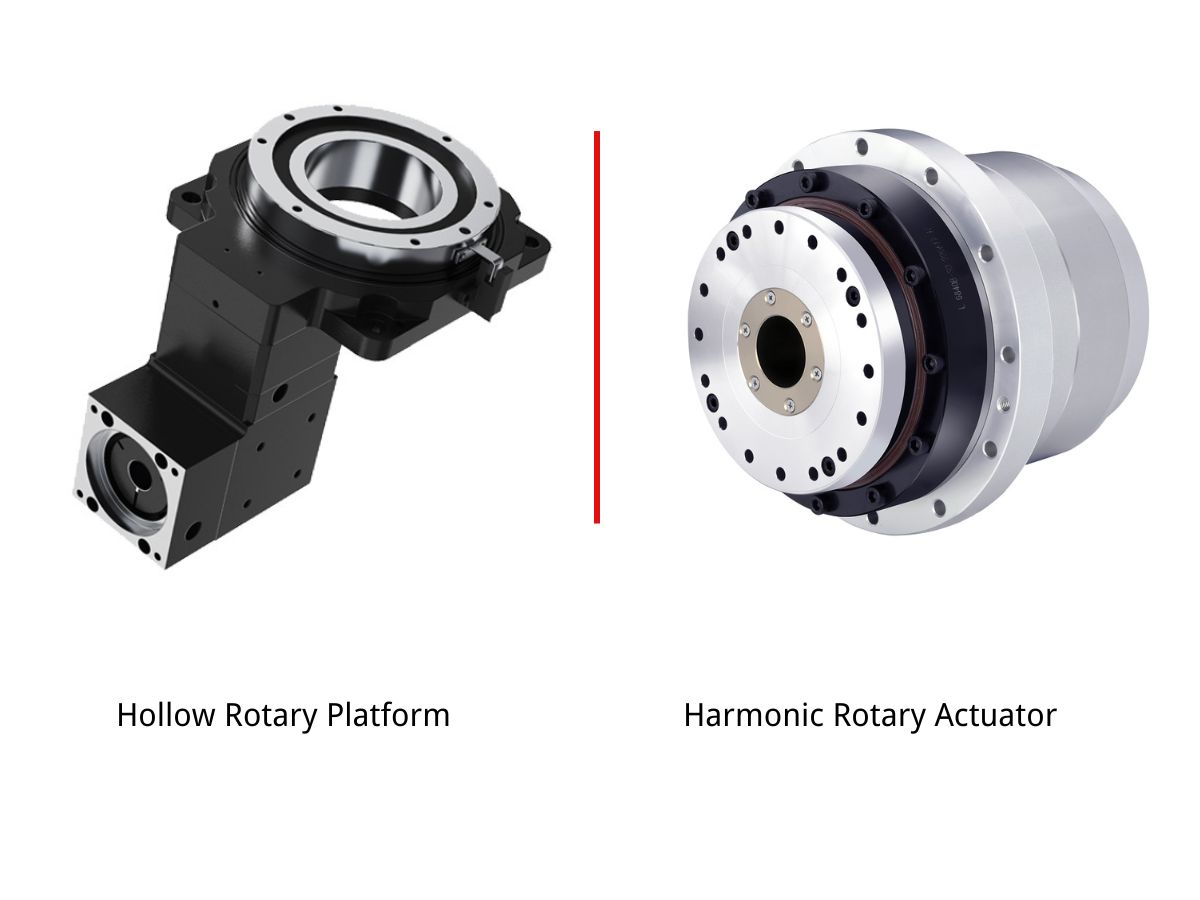
A hollow rotary platform focuses on high rigidity, load capacity, and stable rotary motion. It generally uses a gear transmission structure together with a rigid housing and load-bearing structure. It is well suited to rotary stations that need to carry workpieces, fixtures, tooling, or other external loads.
The hollow structure also allows cables, pneumatic tubes, and other utilities to pass through the center, which can simplify machine layout and reduce cable interference during rotary motion.
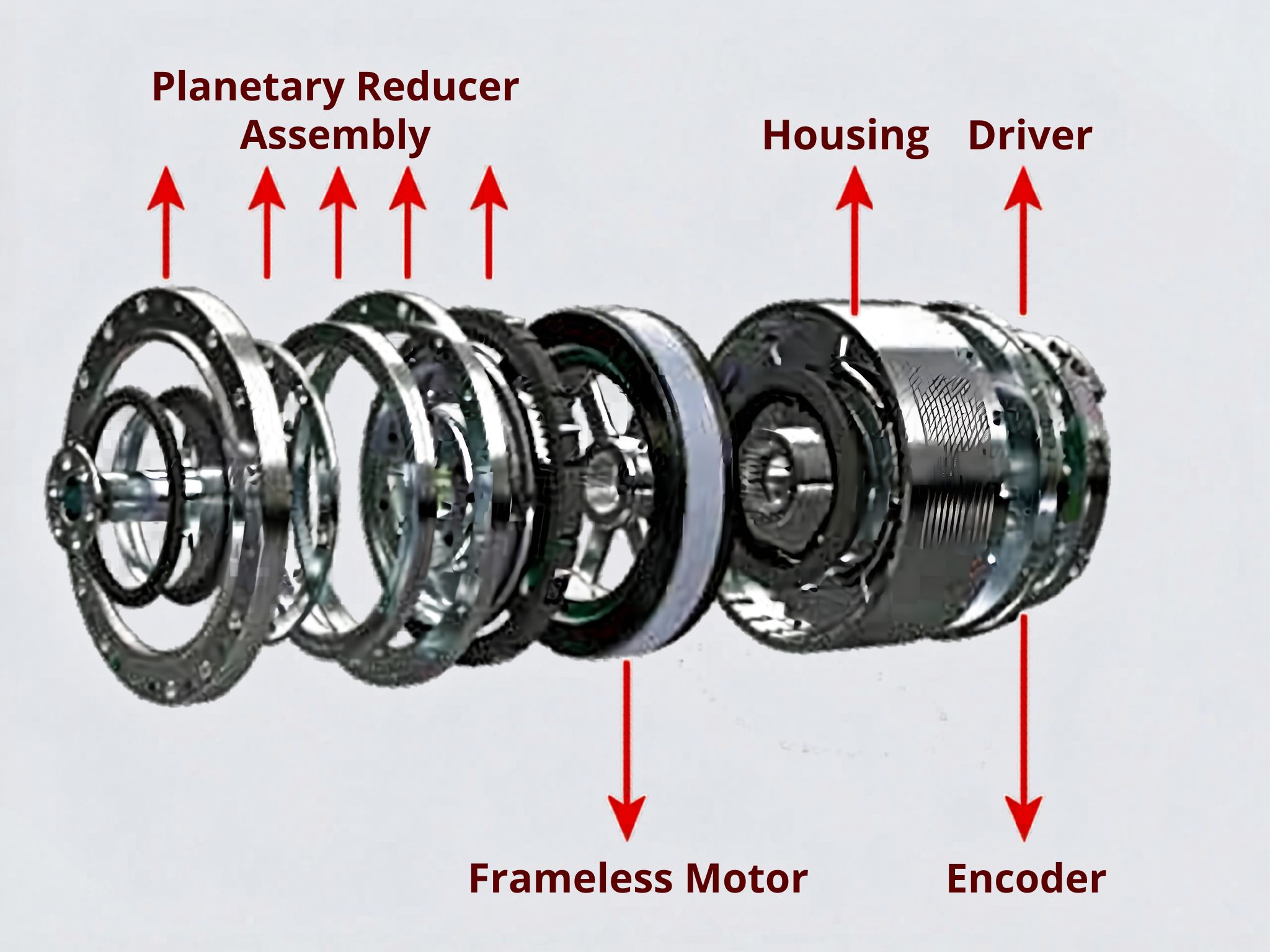
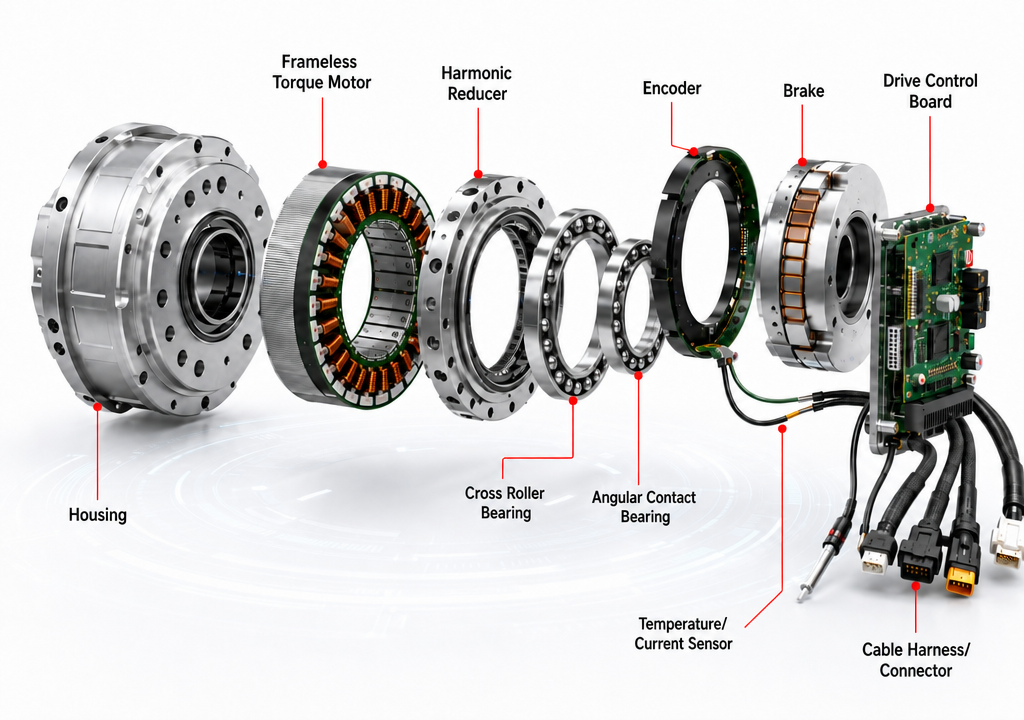
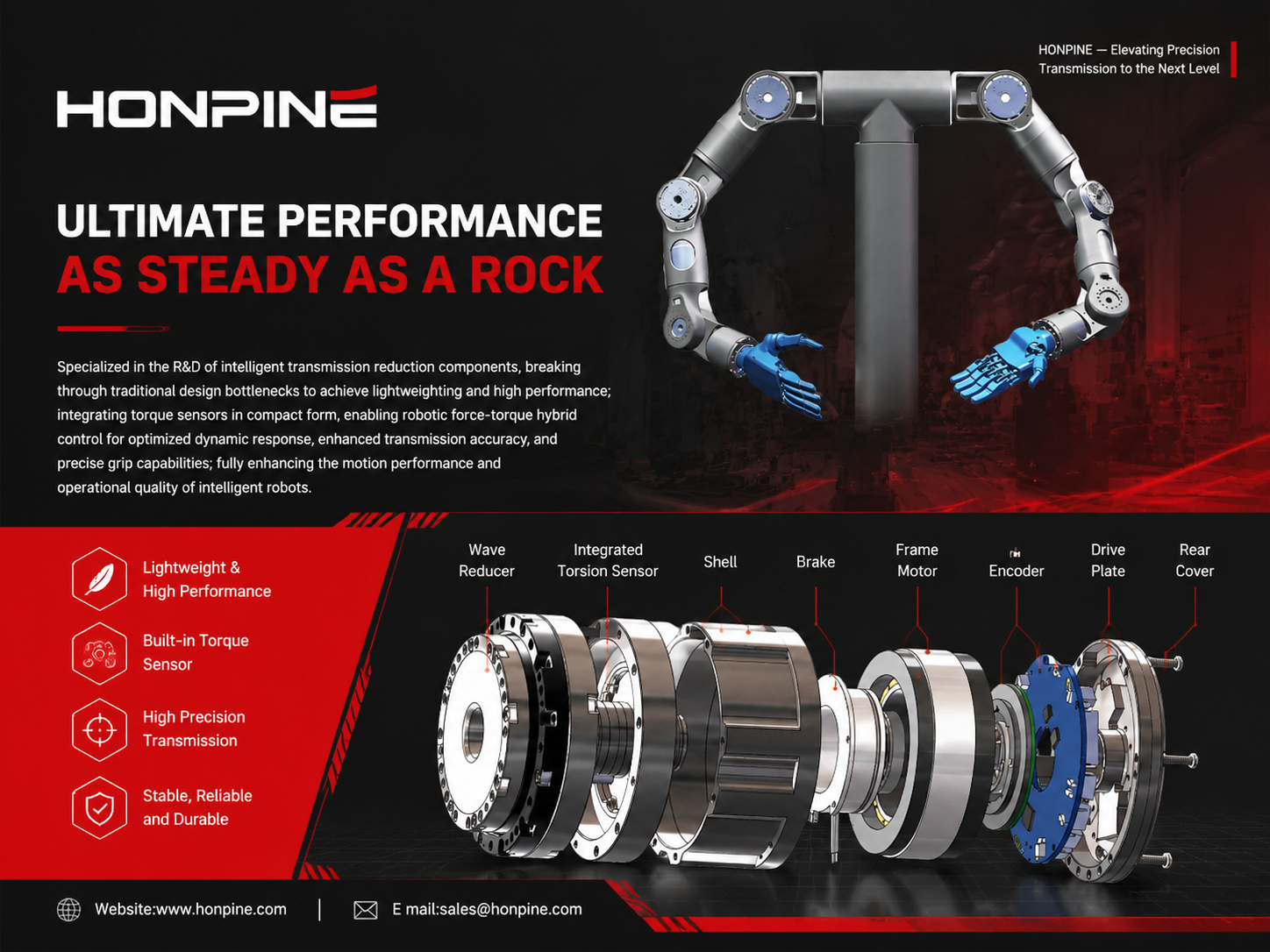
A harmonic rotary actuator, on the other hand, focuses more on compact size, high reduction ratio, low backlash, high positioning accuracy, and high torque density. It integrates a harmonic transmission mechanism with a motor and other components to provide a compact rotary drive solution.
This makes harmonic rotary actuators particularly suitable for robot joints, compact precision mechanisms, and applications where installation space and weight are important.
The key difference is therefore not simply which product has higher accuracy.
It is about the mechanical architecture, load conditions, rigidity, installation space, and motion requirements of the complete system.
Understanding this basic difference is important when determining whether the two solutions can actually replace each other.
2. Applications Where Both Can Be Used
First, let's look at the applications that are relatively easy to interchange.
2.1 Light-Load Precision Angular Positioning
Examples include small inspection rotary tables, lens calibration mechanisms, precision angular adjustment mechanisms, and other small rotary positioning systems.
When the load is light, external forces are limited, and there is little impact or eccentric loading, both a hollow rotary platform and a harmonic rotary actuator may be suitable.
In this type of application, the final choice can mainly depend on installation space, required rigidity, hollow diameter, positioning accuracy, motor configuration, and cost.
2.2 Low-Speed, Intermittent Indexing and Rotary Motion
When the rotational speed is relatively low, acceleration and deceleration are controlled, and there is no frequent high-speed reversing or significant impact, both solutions can provide stable rotary motion when properly selected.
In simple terms:
Light load, low speed, limited impact, and limited eccentric loading are conditions where a hollow rotary platform and harmonic rotary actuator may both be considered.
However, even in these applications, the actual torque, radial load, axial load, overturning moment, duty cycle, and positioning requirements should still be checked before making a final selection.
3. Applications Where a Hollow Rotary Platform Is Usually More Suitable
This is one of the areas where engineers can easily make the wrong selection.
3.1 Heavy Loads, Fixtures, and Workpiece Rotation
When the rotary station needs to carry a relatively heavy workpiece, fixture, tooling system, or eccentric load, structural rigidity and load-bearing capability become very important.
A hollow rotary platform normally integrates the transmission system with a rigid load-bearing structure. Depending on its design, it can directly support radial loads, axial loads, and overturning moments.
For this type of application, a harmonic rotary actuator should not be selected only by looking at its output torque. The output bearing capacity, allowable radial and axial loads, torsional stiffness, external moment, duty cycle, and service life all need to be considered.
For heavy-duty rotary stations, a properly sized hollow rotary platform may therefore be a more suitable solution.
3.2 Frequent Start-Stop, Forward and Reverse Rotation, and Impact
Some automated rotary stations need to accelerate and decelerate frequently, repeatedly change rotation direction, or operate under external impact loads.
These conditions place additional demands on the transmission system.
Cyclic loading, torsional stiffness, bearing loads, thermal conditions, and fatigue life all need to be considered.
A rigid hollow rotary platform can be advantageous when the rotary station itself needs to directly support substantial external loads and repeated dynamic forces.
A harmonic rotary actuator can also be used in dynamic applications when properly selected and operated within its specified conditions. However, low backlash alone should never be the only reason for selecting it.
3.3 Applications Requiring High-Speed Continuous Rotation
For applications requiring continuous rotation or relatively high rotational speed, the designer needs to consider more than the nominal speed.
Thermal management, bearing speed, transmission efficiency, lubrication, motor speed, and long-term operating temperature all affect the final performance.
A harmonic rotary actuator can operate at relatively high speeds in suitable applications, but its rated speed, thermal behavior, lubrication, and duty cycle need to be evaluated carefully.
A hollow rotary platform may be more suitable when the application requires stable continuous rotation together with a rigid load-bearing structure.
Therefore, the important question is not simply which product is faster. The real question is whether the complete rotary system can maintain the required accuracy, temperature, durability, and stability under the target operating conditions.
4. Applications Where a Harmonic Rotary Actuator Is More Suitable
There are also applications where the compact structure of a harmonic rotary actuator provides clear advantages.
4.1 Extremely Compact and Lightweight Equipment
When installation space is very limited, the size and weight of the rotary mechanism can become major design constraints.
A harmonic rotary actuator integrates the harmonic transmission mechanism with a motor and other components, providing a compact solution with a high reduction ratio and high torque density.
This makes it suitable for robotic joints, precision mechanisms, compact automation modules, and other applications with strict space requirements.
Compared with a larger rotary platform structure, a harmonic rotary actuator can make it easier to achieve a compact mechanical layout.
4.2 High-Precision Positioning and Low Backlash
Harmonic rotary actuators are widely used in applications where low backlash, high positioning accuracy, and compact transmission are important.
Typical applications include precision assembly, optical equipment, robot joints, semiconductor equipment, inspection systems, and other precision motion mechanisms.
However, it is important to understand that backlash and overall positioning accuracy are not exactly the same thing.
The final positioning accuracy of a machine is also affected by encoder resolution, structural deformation, bearing characteristics, assembly tolerances, servo control, thermal effects, and overall machine rigidity.
Therefore, the harmonic rotary actuator should be selected based on the requirements of the complete motion system, rather than simply comparing one catalog specification.
5. Hollow Rotary Platform vs. Harmonic Rotary Actuator: Key Selection Factors
When selecting between the two, do not simply compare the product names or one individual specification.
The actual application conditions should be considered.
This table is only a preliminary guide.
For a real machine design, engineers should also check output torque, rotational speed, acceleration, payload, radial load, axial load, overturning moment, duty cycle, required service life, installation dimensions, hollow diameter, and control requirements.
6. Hollow Rotary Platform or Harmonic Rotary Actuator: How to Choose?
For the initial design stage, you can use a simple rule of thumb.
Heavy load, direct workpiece support, high rigidity, large external moments, and demanding rotary-station structures: consider a hollow rotary platform first.
Lightweight design, compact installation, high reduction ratio, low backlash, and high torque density: consider a harmonic rotary actuator first.
However, these categories are not absolute.
A high-performance hollow rotary platform can also provide high positioning accuracy, while a properly designed harmonic rotary actuator can be used in demanding industrial applications.
The important point is not to select a rotary solution based on only one parameter such as backlash, torque, or overall size.
Instead, evaluate the complete mechanical system and find the best balance between:
Load Capacity, Rigidity, Precision, Speed, Durability, Installation Space, and Cost.
7. Hollow Rotary Platforms and Harmonic Rotary Actuators in Precision Automation
Both technologies can be used in precision automation, but their ideal applications are different.
7.1 Industrial Automation
Hollow rotary platforms are suitable for automated rotary stations that need to support workpieces, fixtures, tooling, or inspection equipment while maintaining stable rotary positioning.
Harmonic rotary actuators can be used for compact rotary mechanisms, robotic systems, and applications where integrated motor and transmission design helps reduce the overall size of the machine.
7.2 Semiconductor and 3C Automation
Semiconductor manufacturing and 3C automation equipment often require high positioning accuracy, compact machine layouts, low vibration, and reliable cable routing.
A hollow rotary platform can be a good choice when the rotary mechanism needs to directly support a relatively large fixture or inspection assembly.
A harmonic rotary actuator may be more suitable when installation space is limited and low backlash, compactness, and integrated motion are important.
7.3 Robotics
Robot joints often require compact dimensions, high torque density, low backlash, and precise motion control.
For these applications, harmonic rotary actuators are widely used because their compact transmission structure can be integrated into robot joints.
Hollow rotary platforms can also be used in robotic positioning mechanisms, rotary workstations, and other applications where the output structure needs to directly support external loads.
7.4 CNC and Precision Rotary Axes
CNC rotary axes require a combination of positioning accuracy, rigidity, load capacity, speed, and thermal stability.
A hollow rotary platform can be suitable for rotary tables and positioning stations that need to directly support workpieces and fixtures.
A harmonic rotary actuator can be considered for compact rotary axes and mechanisms where low backlash, high reduction ratio, and compact integration are important.
8. What Should Engineers Check Before Replacing One with the Other?
Before replacing a hollow rotary platform with a harmonic rotary actuator, or replacing a harmonic rotary actuator with a hollow rotary platform, engineers should evaluate the complete mechanical load.
The key parameters include:
Payload and fixture weight
Required output torque
Radial load
Axial load
Overturning moment
Maximum rotational speed
Continuous rotational speed
Acceleration and deceleration
Frequency of forward and reverse rotation
Duty cycle
Positioning accuracy and repeatability
Torsional stiffness
Backlash
Installation space
Hollow diameter and cable-routing requirements
Required service life
Operating temperature and thermal conditions
These parameters determine whether the alternative solution can actually meet the requirements of the machine.
For example, a rotary mechanism carrying an eccentric fixture may generate a significant overturning moment even when the required rotational torque itself is not particularly high.
In this case, output bearing capacity and structural rigidity may become more important than simply looking at the nominal torque rating.
9. Conclusion
Hollow rotary platforms and harmonic rotary actuators are both high-precision rotary motion solutions, but they are not automatically interchangeable in every application.
For heavy loads, direct workpiece support, high rigidity, large external moments, and demanding rotary stations, a hollow rotary platform is often the more suitable choice.
For compact installation, lightweight mechanical design, high reduction ratio, low backlash, high torque density, and integrated rotary motion, a harmonic rotary actuator may be the better option.
The right choice ultimately depends on the actual operating conditions of the machine.
Before replacing one technology with another, engineers should evaluate payload, torque, speed, acceleration, radial and axial loads, overturning moment, duty cycle, positioning accuracy, rigidity, service life, installation constraints, and control requirements.
Understanding these interchangeability boundaries helps equipment designers avoid both over-engineering and under-sizing, while achieving a more reliable and cost-effective precision rotary motion system.
If you have a specific rotary station or automation application and are not sure whether a hollow rotary platform or harmonic rotary actuator is the better choice, you can contact HONPINE and provide the basic load, speed, accuracy, and installation requirements. Our engineering team can help evaluate the appropriate rotary transmission solution.
Read More
Learn more about the story of HONPINE and industry trends related to precision transmission.
 What is robot joint actuator?How to Choose the Best Robot Rotary Joint Actuator?In core robot joint transmission solutions, planetary and harmonic rotary actuators each have their own strengths. Choosing the right type based on application requirements is essential to achieve the optimal balance between performance and cost.
 DD Motors VS Harmonic Rotary ActuatorsThis article provides an in-depth comparison between Direct Drive (DD) motors and harmonic rotary actuators, covering their transmission principles, advantages and disadvantages, and typical application fields.
 OMG Ultra Compact Harmonic Drive Joint Module with Built-in Torque SensorHONPINE TCHL series harmonic drive joint module is a game-changing product that achieves disruptive improvements in multiple aspects such as lightweight design, integration level, and connection convenience. This article will analyze its revolutionary enhancements with you.
 The Role of Harmonic Drive Gears in Achieving 5–10 μm Accuracy in Dental Milling MachinesA dental milling machine is a CNC machining system used to directly process digital dental models into restorations such as crowns, bridges, veneers, inlays, and implant abutments. Dental milling machines require far higher operational accuracy and motion stability than ordinary equipment. This article explains how harmonic drive gear help dental milling machines achieve stable, continuous, and controllable operation.
 Why Are Harmonic Rotary Actuators Perfect for Medical Equipment?Harmonic rotary actuators (typically integrated systems consisting of a harmonic drive reducer, frameless torque motor, encoder, and optional brake) are regarded as key components in medical equipment. The core reason is that they simultaneously meet the most stringent medical requirements for precision, compact size, safety, and controllability. The following explanation is structured from three perspectives: technical characteristics, application scenarios, and medical value.
 High-Precision RV Reducers Perfectly Matched for Walking RobotsThe walking axis of a robot is a core component for power transmission and support. RV reducers provide extremely high rigidity, precision, and torque while maintaining a compact size and exceptional reliability, making them an ideal match for the demanding requirements of walking robot joints in terms of load capacity, impact resistance, and precision.
 Outdoor Robot Joint Solution: Harmonic Joint Module with Built-in Torque SensorHello everyone, I’m Theodore Li, Technical Director at HONPINE. As robots move beyond controlled factory environments, outdoor robotic applications are creating new requirements for robot joint design. Rain, dust, humidity, temperature fluctuations, low-temperature conditions, and unpredictable external loads can all affect how a robotic joint performs in the field. In these environments, a joint needs to provide more than precise rotation. It also needs reliable torque feedback, suitable environmental protection, stable operation under changing temperatures, and practical mechanical integration. In this article, I will explain the key engineering considerations behind our outdoor robot joint solution, including the harmonic joint module, built-in torque sensor, IP65 protection, low-temperature lubrication, cable outlet protection, and mechanical integration, based on our experience with outdoor robotic applications such as solar panel installation, construction, and cleaning robots.
 Multi-Robot Collaboration: From Single-Robot Intelligence to System IntelligenceHello, I’m Allen Li, Founder of HONPINE. As robotics continues to evolve, I believe the next major step will not come only from making individual robots more intelligent, but from enabling multiple robots to work together as coordinated systems. Multi-robot collaboration introduces new requirements for communication, task allocation, motion coordination, state awareness, and safety. This evolution also changes the role of the robot joint. A future intelligent robot joint will need to do more than generate precise motion. With technologies such as dual encoders, torque sensing, integrated drives, real-time communication, and safety functions, the robot joint can become an intelligent motion node connecting robot intelligence with physical movement. In this article, I would like to share how I see the relationship between multi-robot collaboration, system intelligence, and the next generation of HONPINE robot joint modules.
 RV Reducer for Welding Positioners: Selection and Torque Calculation for Heavy-Duty Welding ApplicationsSelecting the right RV reducer for a welding positioner requires more than simply matching the reducer to the workpiece weight. A heavy-duty welding positioner must provide sufficient output torque, high torsional rigidity, stable low-speed rotation, accurate positioning, and reliable performance during acceleration, deceleration, and reversing. In this article, we explain how to select an RV reducer and servo motor for a welding positioner by calculating output speed, reduction ratio, workpiece inertia, gravity load torque, acceleration torque, motor torque, and peak torque. A practical 500 kg welding positioner example is also used to show how these parameters affect RV reducer selection.
 Types of Robot Joint Motors: Model Selection, Advantages and DisadvantagesRobot joint motors are one of the key components that determine the performance, precision, efficiency, and load capacity of a robot. Depending on the application, robot joints can use electric, hydraulic, pneumatic, or other drive technologies. Among them, electric-drive solutions have become the mainstream choice for modern robots, especially humanoid robots, industrial robots, collaborative robots, and mobile robots. Electric robot joint motors can be further divided according to their transmission methods, including harmonic drive, planetary reducer, cycloidal reducer, ball screw, and direct drive solutions. Each type has its own advantages and disadvantages in terms of precision, torque density, efficiency, impact resistance, size, cost, and backdrivability. Understanding these differences is essential for selecting the right robot joint motor for a specific application.
 Hollow Rotary Platform vs. Harmonic Rotary Actuator: Application Comparison and InterchangeabilityHello everyone, I’m Theodore Li, Technical Director at HONPINE. For engineers designing precision rotary stations for industrial automation, one question often comes up: when a machine requires high-precision rotation, indexing, or rotary positioning, should you choose a hollow rotary platform or a harmonic rotary actuator? Can they be used interchangeably? Although both are precision rotary motion solutions, their mechanical structures and application characteristics are quite different. In actual equipment, choosing the wrong solution can lead to insufficient load capacity, inadequate rigidity, vibration, speed limitations, or reduced service life. In this article, I’ll compare their application characteristics and explain where they can be used interchangeably, where one is more suitable than the other, and what engineers should check before making a replacement.
 How HONPINE Manufactures Precision Harmonic Reducers: Technology, Quality and Manufacturing Challenges?A precision harmonic reducer is more than a compact high-ratio transmission component. Its actual performance depends on how accurately every critical component is designed, manufactured, assembled, and tested. Tooth profile accuracy, flexspline material, heat treatment, machining tolerances, wave generator geometry, assembly precision, and production consistency can all influence backlash, torsional stiffness, efficiency, durability, and positioning accuracy. For robotics, CNC equipment, semiconductor manufacturing, optical inspection, and other precision automation applications, these factors become even more important. This article explores how HONPINE manufactures precision harmonic reducers, the key technologies and manufacturing challenges involved, and why stable production capability is essential for achieving reliable transmission performance at scale.
Double Click
We provide harmonic drive reducer,planetary reducer,robot joint motor,robot rotary actuators,RV gear reducer,robot end effector,dexterous robot hand
 What is robot joint actuator?How to Choose the Best Robot Rotary Joint Actuator?In core robot joint transmission solutions, planetary and harmonic rotary actuators each have their own strengths. Choosing the right type based on application requirements is essential to achieve the optimal balance between performance and cost.
 Hollow Rotary Platform vs. Harmonic Rotary Actuator: Application Comparison and InterchangeabilityHello everyone, I’m Theodore Li, Technical Director at HONPINE. For engineers designing precision rotary stations for industrial automation, one question often comes up: when a machine requires high-precision rotation, indexing, or rotary positioning, should you choose a hollow rotary platform or a harmonic rotary actuator? Can they be used interchangeably? Although both are precision rotary motion solutions, their mechanical structures and application characteristics are quite different. In actual equipment, choosing the wrong solution can lead to insufficient load capacity, inadequate rigidity, vibration, speed limitations, or reduced service life. In this article, I’ll compare their application characteristics and explain where they can be used interchangeably, where one is more suitable than the other, and what engineers should check before making a replacement.
 Humanoid Robot Joint Module Selection Guide: Choosing the Right Harmonic Joint Module for Every Robot JointSelecting the right joint module is one of the most important decisions in humanoid robot design.
Different robot joints require different levels of torque, speed, stiffness, and payload capacity. Using the same actuator throughout the robot often increases weight, reduces efficiency, and limits motion performance.
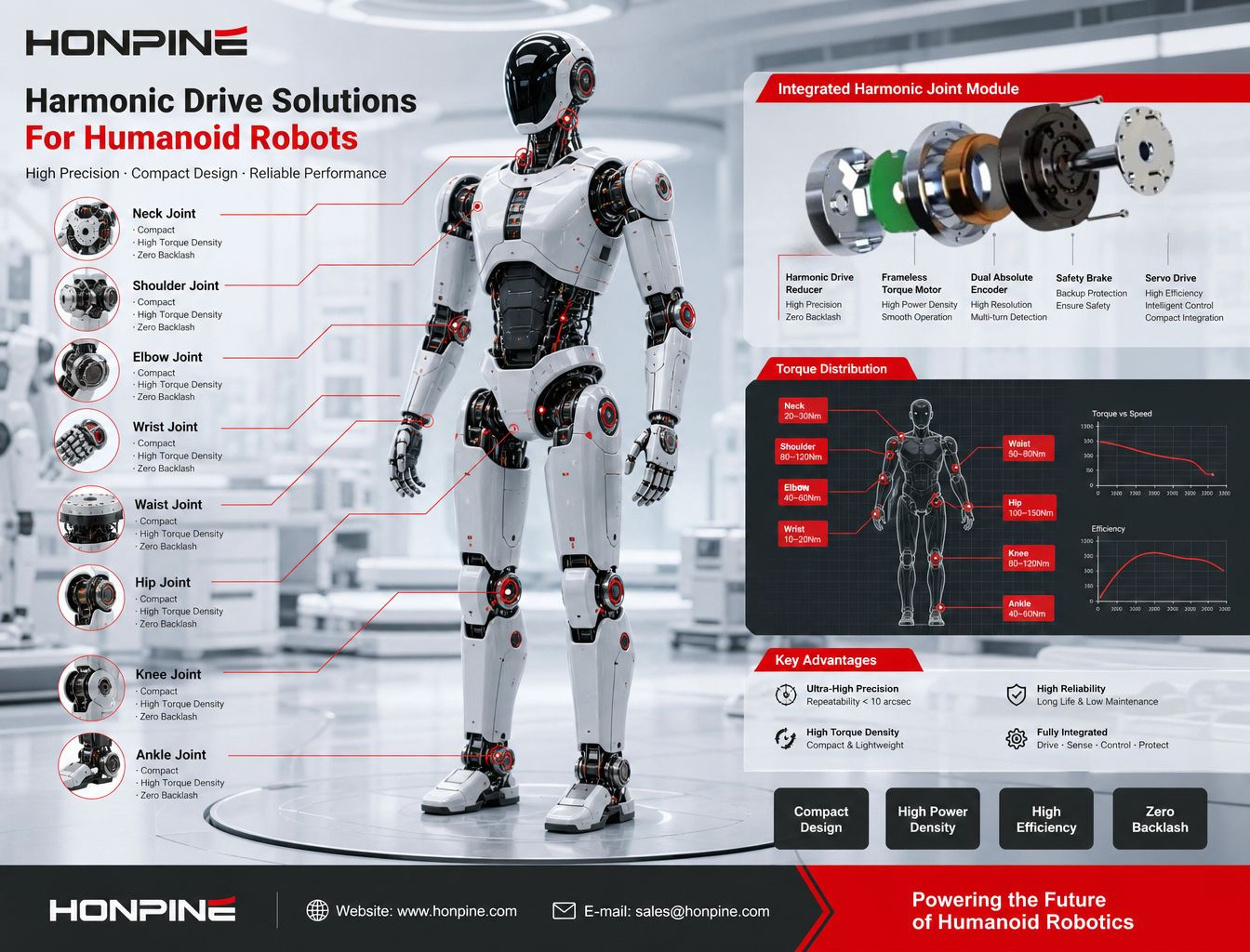
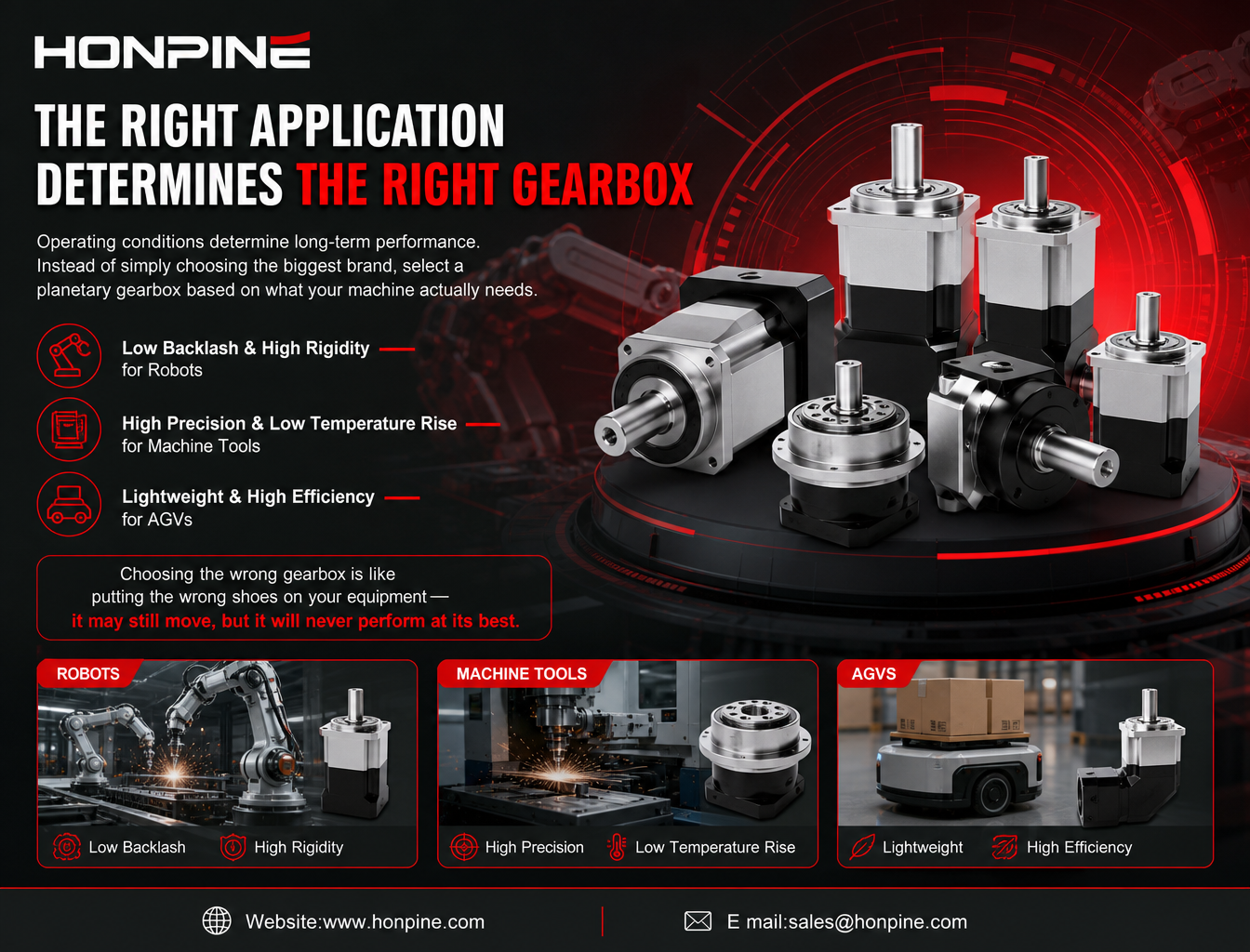
The Honpine HPJM-PRO Series Harmonic Joint Modules provide a complete range of integrated joint actuators for humanoid robots, enabling engineers to optimize every joint from the head to the lower body. Honpine Planetary Gearbox Selection Guide: How to Choose the Right Gearbox for Robots, CNC Machines, and AGVsThe right application determines the right gearbox. Operating conditions determine long-term performance. Instead of simply choosing the biggest brand, select a planetary gearbox based on what your machine actually needs: low backlash and high rigidity for robots, high precision and low temperature rise for machine tools, and lightweight, high-efficiency designs for AGVs. Choosing the wrong gearbox is like putting the wrong shoes on your equipment—it may still move, but it will never perform at its best.
 How the HONPINE JRM Planetary Joint Module Improves Robot Motion Performance?The JRM-C Planetary Joint Module is a lightweight, high-torque actuator module specially designed for humanoid robots, wheeled robots, quadruped robots, and other intelligent robotic systems.
 Why Do Most People Choose Nabtesco as Their RV Reducer Gearbox Supplier?The article explains Nabtesco’s dominance in RV reducers due to its high precision and reliability, while noting that the industry has few suppliers because of extreme manufacturing difficulty. It also briefly mentions competitors like Sumitomo, Spinea, and HONPINE offering cost and delivery advantages.
 What Is the Revolving Joint of a Robot?Structure, Components, and Working Principles Explained?This article will provide you with a comprehensive analysis of a robot's rotary joint, including its integrated components, the role of each component, and how precise control is achieved.
 Which Manufacturers Are Capable of Providing Integrated Frameless Torque Motor and Hollow Rotary Servo Actuator Solutions?A traditional servo rotary actuator consists of a rotor, stator, housing, bearings, end caps, and feedback components. A frameless motor removes all redundant mechanical structures and retains only the electromagnetic conversion core. The rotor becomes a direct part of the load shaft, while the stator is integrated into the machine structure through bonding, locking, or potting.
 Why Are Crossed Roller Bearing Harmonic Reducers Ideal for Robot Joints?In robotic harmonic reducers, crossed roller bearings are the key components that ensure motion accuracy and structural rigidity. Their performance directly affects the robot’s repeat positioning accuracy, load capacity, and service life.
 How HONPINE HAG Harmonic Drive Robot Joint Modules Improve Precision, Torque Control, and ReliabilityHONPINE HAG robot joint module is a game-changing innovation developed to meet the emerging demands of the robotics industry. It is a fully closed-loop harmonic robotic joint module.
 Comprehensive Analysis of Braking Dissipation Modules for Robotic Harmonic Joint ActuatorsIn discussions about robotic joint actuator modules, the motor, gearbox, encoder, brake, and driver usually receive the most attention, while the braking dissipation module is often underestimated. In real engineering projects, many 48V joint systems operate normally during no-load commissioning. However, once they enter conditions involving large inertia, rapid acceleration and deceleration, gravity-axis lowering, or frequent backdriving, issues such as DC bus overvoltage, driver alarms, unexpected shutdowns, and even thermal failures of power devices begin to appear.
 Comprehensive Guide to the HONPINE HAG Harmonic Drive Robotic Actuator Unit with Torque SensorThis article provides a comprehensive overview of the HONPINE HAG harmonic drive robotic actuator unit with torque sensor, including its functions, advantages, disadvantages, and application value.