







Multi-Robot Collaboration: From Single-Robot Intelligence to System Intelligence
Hello, I’m Allen Li, Founder of HONPINE.
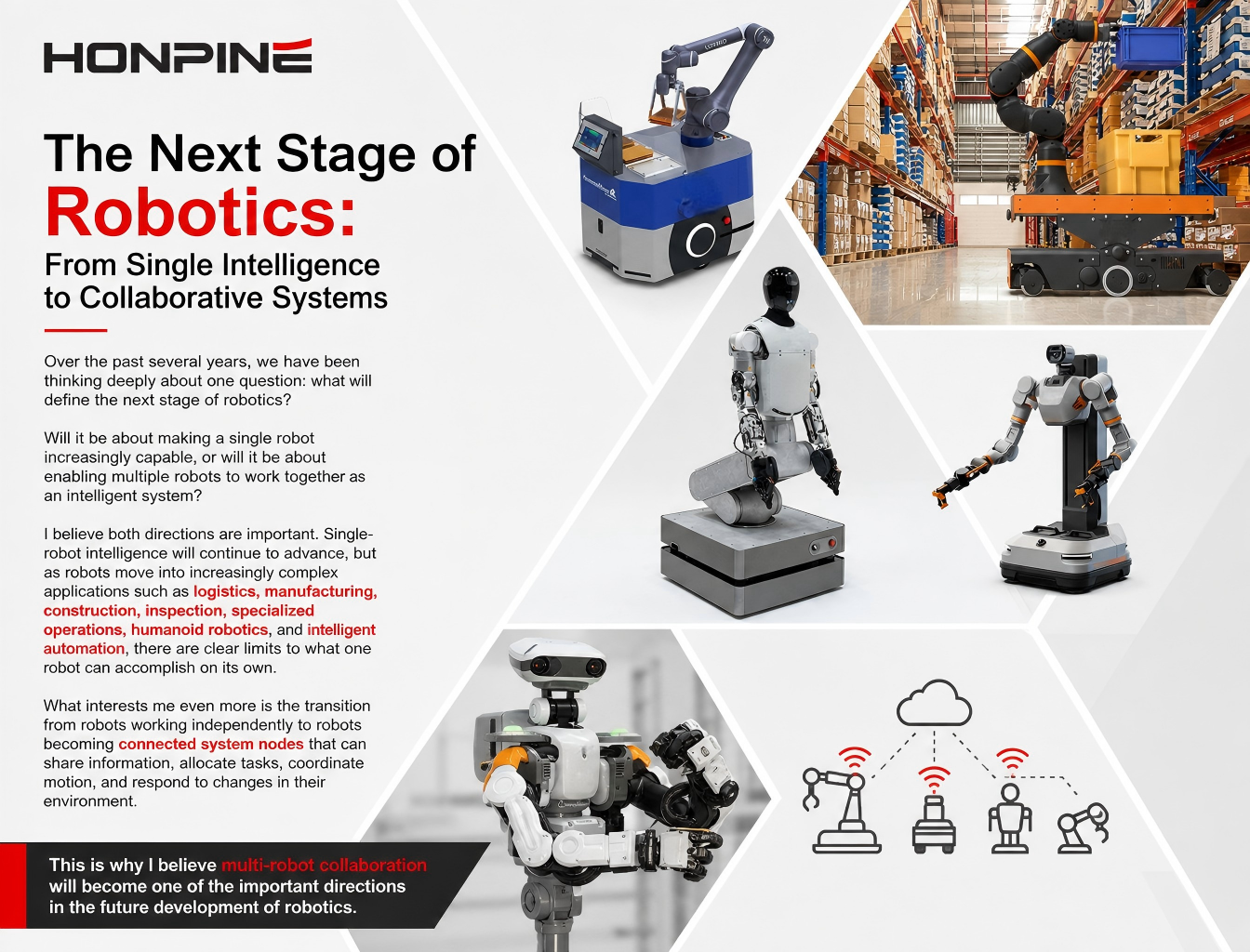
Over the past several years, we have been thinking deeply about one question: what will define the next stage of robotics? Will it be about making a single robot increasingly capable, or will it be about enabling multiple robots to work together as an intelligent system?
I believe both directions are important. Single-robot intelligence will continue to advance, but as robots move into increasingly complex applications such as logistics, manufacturing, construction, inspection, specialized operations, humanoid robotics, and intelligent automation, there are clear limits to what one robot can accomplish on its own.
What interests me even more is the transition from robots working independently to robots becoming connected system nodes that can share information, allocate tasks, coordinate motion, and respond to changes in their environment.
This is why I believe multi-robot collaboration will become one of the important directions in the future development of robotics.
Multi-Robot Collaboration Is More Than Simply Adding More Robots
When people first think about a multi-robot system, it is natural to assume that if one robot can complete one task, ten robots should be able to complete ten times as many tasks.
In practice, it is much more complicated.
When a single robot operates independently, the fundamental question is usually: “How can I complete my task?”
When multiple robots operate in the same environment, the question becomes much more difficult: “How can we complete our tasks together without interfering with one another?”
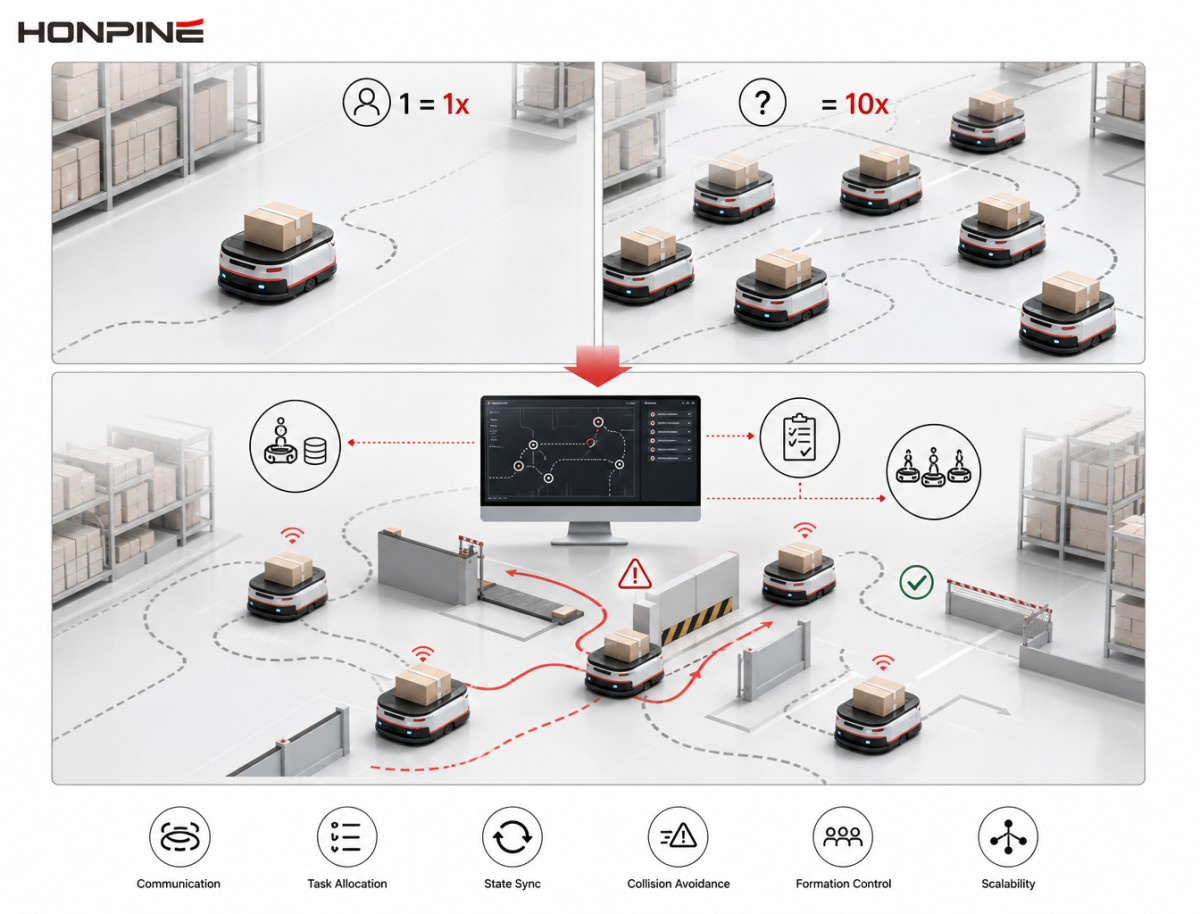
Consider an automated warehouse where multiple AGVs are transporting materials at the same time. If two mobile robots approach a narrow passage simultaneously, which robot should have priority? If several robots are available for the same task, which one should be selected? If the robot closest to the task suddenly fails, which robot should take over? If several robots need to enter the same workspace, how should access and motion be coordinated?
These are no longer simply motion-control problems for an individual robot. They are problems of system-level coordination and organization.
A successful multi-robot system therefore requires more than additional machines. Robots need a shared understanding of their own status, the status of other robots, the tasks being performed, and the actions that may take place next.
In a typical ROS2 multi-robot architecture, distributed communication, namespace management, task allocation, formation control, state synchronization, and collision avoidance work together to create the foundation for coordinated robotic operations.
This leads me to an important conclusion: the future competitiveness of robotics will not depend only on how capable an individual robot is, but also on how effectively an entire robot system can work together.
From Single-Robot Intelligence to System Intelligence
I believe this represents an important transition for the robotics industry.
Traditionally, when we evaluate a robot, we focus on parameters such as payload, positioning accuracy, speed, repeatability, joint torque, rigidity, and reliability. These specifications will remain fundamental.
However, once robots begin operating as coordinated systems, we need to ask a broader set of questions.
Can a robot continuously understand where other robots are located? Can it know what tasks other robots are performing? Can it share its own operating status in real time? Can it identify abnormal conditions before they become failures? Can the system quickly redistribute tasks when operating conditions change? What happens if communication is interrupted or one robot becomes unavailable?
These questions reveal a fundamental change in robot architecture.
A robot is no longer simply a machine that executes a predefined task. It is becoming a networked, state-aware, and collaborative intelligent node.
The development of multi-robot systems already involves distributed communication, task allocation, state synchronization, formation control, and collision avoidance. As these technologies mature, the boundary between an individual robot and the larger robotic system will become increasingly interconnected.
This makes me think about another question that is particularly important to us at HONPINE:
If the intelligence of robots is moving upward into the system, what should happen to the joints that physically create the robot's motion?
Robot Joints Should Become More Than the "Muscles" of a Robot
This is one of the questions we have been exploring at HONPINE.
In the traditional definition of a robot joint, the primary responsibility is straightforward: convert the motion command from the controller into mechanical movement.
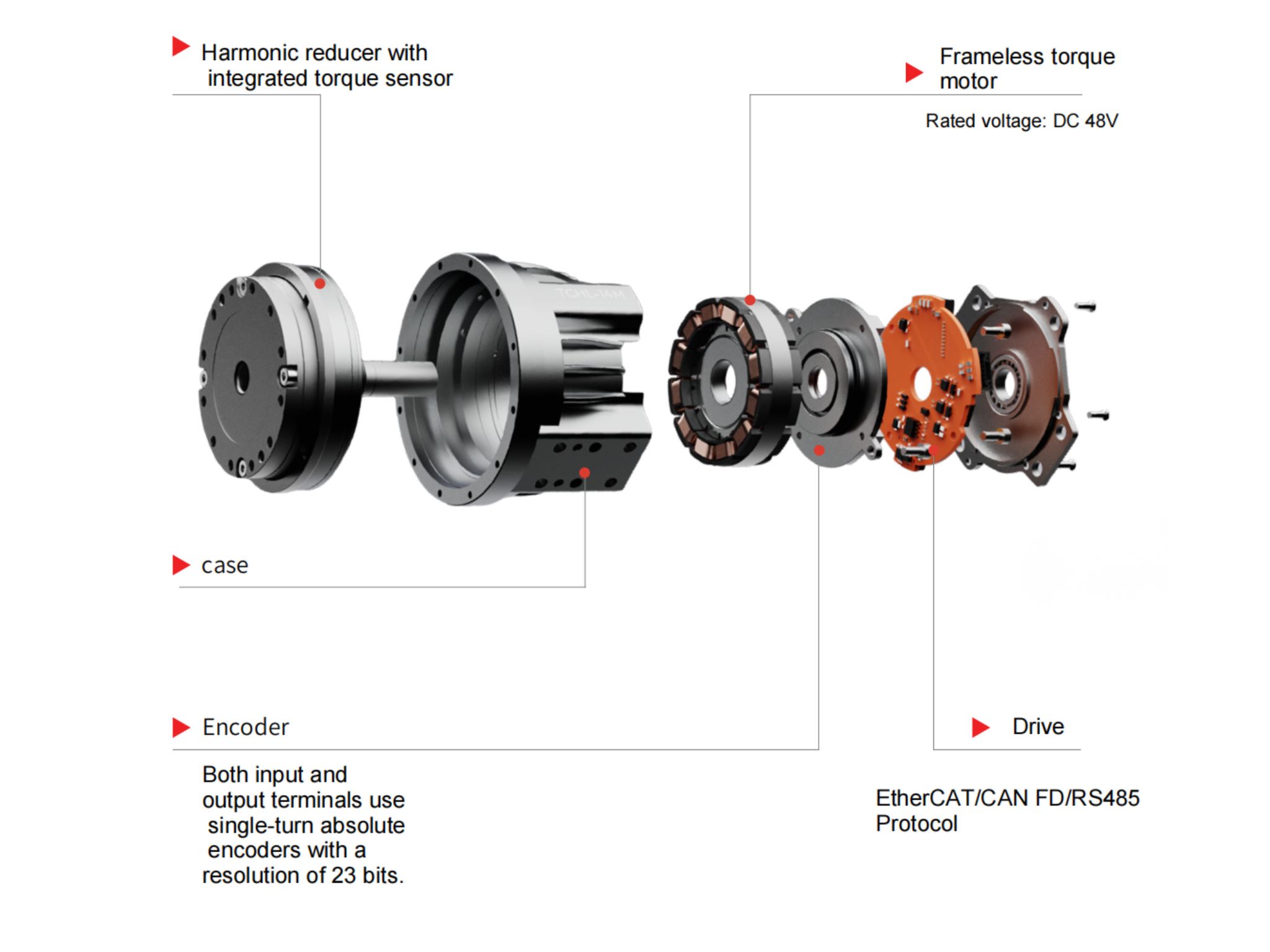
A typical integrated robot joint module may therefore consist of a precision reducer, motor, encoder, brake, and drive system. This architecture has proven highly effective for conventional industrial robots.
But I believe future robots will require something more.
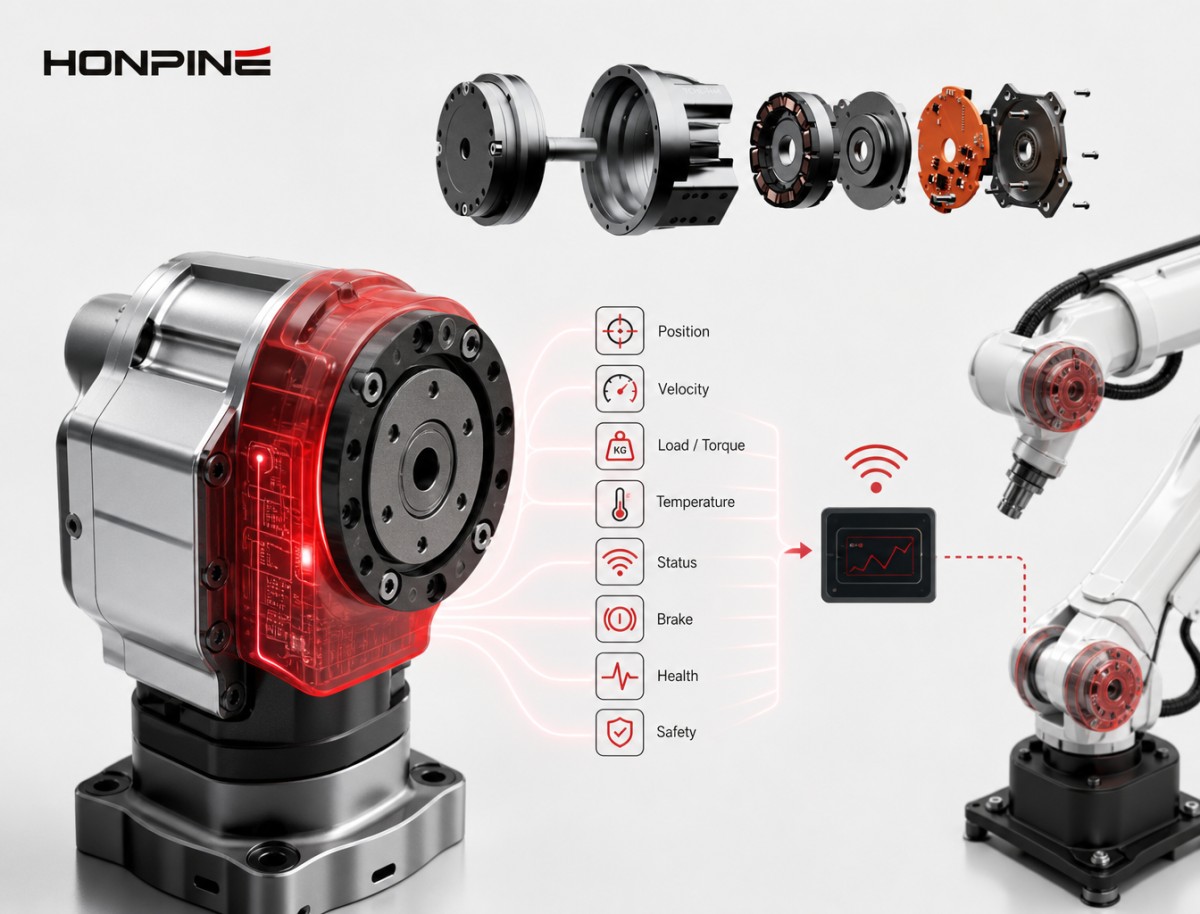
If a robot is expected to participate in multi-robot collaboration, its joints cannot only know how much they have been commanded to rotate. They also need to understand their own operating condition.
What is the actual output position? What is the current velocity? What load is the joint carrying? Is the temperature within a safe range? Is the communication link functioning correctly? Is the brake operating normally? Is there an abnormal difference between motor-side and output-side position? Is the joint experiencing an abnormal torque or overload condition?
When this information can be continuously collected and transmitted to the robot control system, the joint becomes more than a passive actuator.
It becomes an important source of robot motion state information.
This is how I understand the next generation of intelligent robot joints.
Why Dual Encoders Are Becoming Increasingly Important?
This is also why HONPINE places significant emphasis on dual-encoder technology.
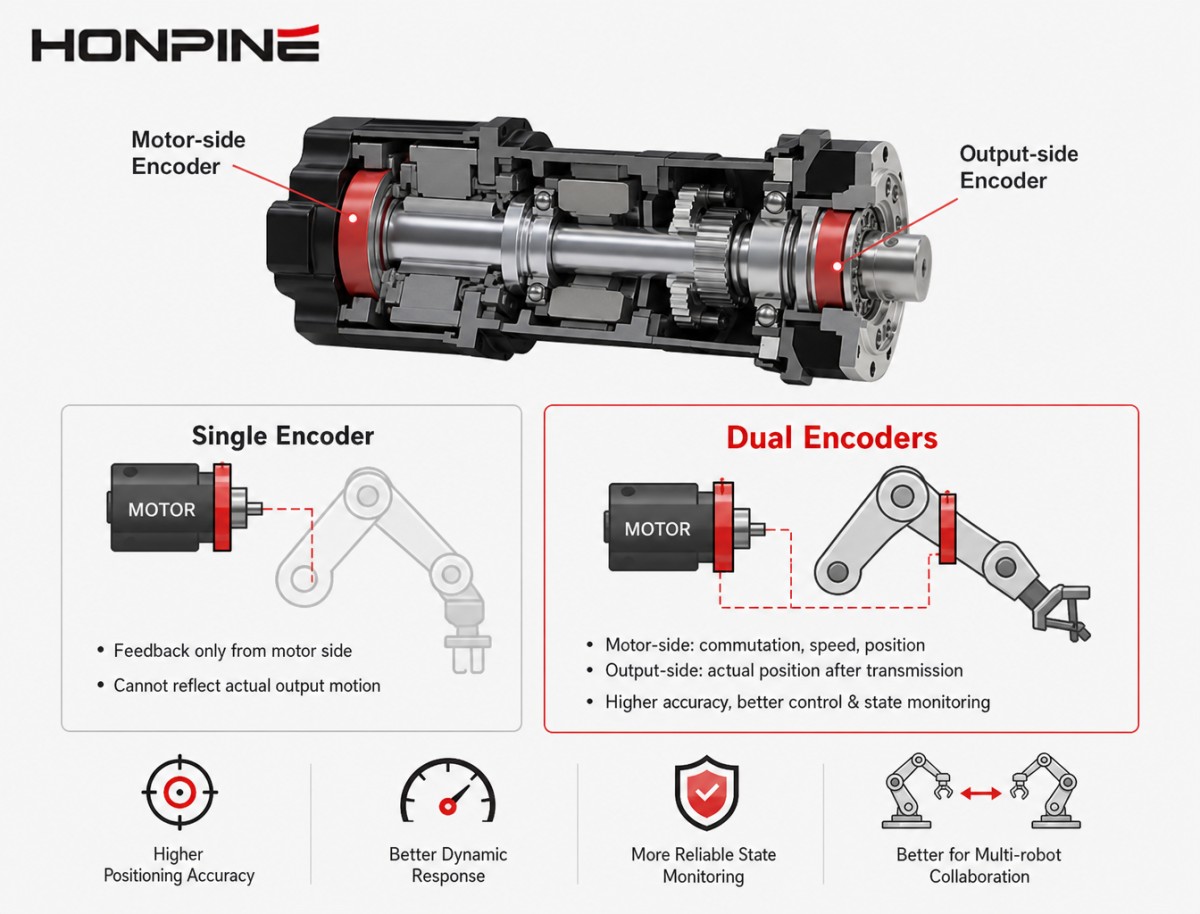
In a conventional single-encoder configuration, the system can obtain feedback from the motor side. However, the actual mechanical movement of the robot occurs at the output side of the reduction mechanism.
The amount of motor rotation does not necessarily represent the exact motion taking place at the final output.
For this reason, motor-side and output-side encoders can serve different but complementary functions.
The motor-side encoder can provide feedback for motor commutation, velocity control, and motor position. The output-side encoder can directly measure the actual position of the robot joint after the transmission stage.
As robots become more demanding in terms of motion accuracy, dynamic response, and state monitoring, output-side feedback becomes increasingly valuable.
For multi-robot collaboration, this becomes even more important. If each joint can accurately determine its own actual motion state, the robot controller can build a more reliable real-time model of the robot.
From this perspective, dual encoders are not simply a way to improve joint positioning accuracy. They provide a more complete feedback mechanism for understanding the actual motion state of the robot.
From Position Feedback to Torque and Force Sensing
However, knowing where a joint is positioned is not enough for many future robotic applications.
For collaborative robots, humanoid robots, force-controlled systems, and multi-robot manipulation, another question becomes essential:
How much force or torque is the robot experiencing?
Consider two robots working together to carry the same object. If each robot only knows its own position but has no information about the force or torque being applied to the object, maintaining stable coordinated motion becomes much more difficult.
Humanoid robots face a similar challenge when interacting physically with people or their environment. Position information alone cannot fully describe the interaction between the robot and the external world.
This is why I believe the development of robot joint modules will gradually move from position feedback toward a combination of position, torque, force, and comprehensive joint-state information.
The question is no longer simply whether a joint can move accurately. We also need to understand whether the joint can accurately sense what is happening during that movement.
For HONPINE, this makes integrated torque-sensing robot joints an important area for continued research and development.
Robot Joints Are Becoming Networked Motion Nodes
Another important trend is the increasing connectivity of robot joints.
In traditional robotic architectures, the relationship between the controller and the joint can be relatively simple: the controller sends a command, and the joint executes it.
Future robotic systems are likely to require a much richer interaction.
Each joint can become a node within the robot's real-time control network. It can receive motion commands while simultaneously reporting information such as position, velocity, torque, temperature, current, fault status, brake status, and safety status.
This concept fits naturally with the development of distributed multi-robot systems, where real-time communication and state synchronization are essential for coordinated operation.
From HONPINE's perspective, this means that the development of a robot joint module cannot focus only on mechanical performance.
We need to consider the complete architecture of mechanical transmission, electrical integration, sensing, communication, and safety.
The precision reducer remains fundamental, but the value of the complete joint increasingly comes from how effectively these technologies work together.
Safety Will Become a Fundamental Capability of Intelligent Robot Joints
As robots move closer to humans, safety will become increasingly important.
This is particularly true for collaborative robots, humanoid robots, mobile robots, engineering robots, and other systems operating in dynamic environments. A failure in one joint may affect not only the robot itself but also the operation of the entire robotic system.
Future robot joint modules therefore need more comprehensive safety mechanisms, including overcurrent protection, overtemperature protection, encoder error detection, position deviation monitoring, abnormal torque detection, communication fault detection, and safe torque control.
For example, HONPINE's HAG series integrates STO (Safe Torque Off) as part of its safety architecture, in addition to braking functionality.
A brake and STO serve different purposes. A brake can help maintain the mechanical position of a joint under specific conditions, while STO provides a drive-level safety function that prevents the motor from generating torque.
From my perspective, these functions should not be viewed as substitutes for one another. They can form complementary layers within a more comprehensive robot safety architecture.
I believe that safety functions will gradually move from being optional features to becoming fundamental capabilities of intelligent robot joints.
Why HONPINE Is Rethinking the Robot Joint Module?
When we put all these developments together, it becomes clear that the future robot joint will probably be much more than a combination of a harmonic reducer, motor, encoder, and brake.
An advanced integrated robot joint may combine precision transmission, motor technology, dual-encoder feedback, torque sensing, integrated drive electronics, real-time communication, safety functions, and joint-state monitoring within a compact architecture.
More importantly, these functions should not exist as isolated components. They need to work together as an integrated intelligent motion node.
This is an important direction for HONPINE's robot joint module research and development.
We are not only interested in making robot joints smaller, lighter, or capable of higher torque. These remain important engineering objectives, but they are not the whole picture.
We are also asking how a robot joint can provide more complete motion-state sensing, communication, safety, and execution capabilities.
That is what I believe will distinguish the next generation of intelligent actuators from conventional robotic actuators.
HONPINE's Direction for the Next Generation of Robot Joint Modules
From a product and technology perspective, I believe HONPINE should develop several complementary robot joint platforms for different robotic applications.
HPJM: High-Reliability and High-Torque Robot Joints
HPJM is positioned for applications where high torque, rigidity, reliability, and long-term stability are critical.
Industrial robots, engineering robots, mobile robots, and heavy-duty robotic systems often require more than positioning accuracy. Their joint modules must withstand demanding loads while maintaining reliable motion performance over extended operating periods.
For these applications, the development priorities remain high torque, high rigidity, precision transmission, and high reliability.
HAG: Integrated Drive, Safety, and Communication
HAG represents another direction toward a more highly integrated intelligent robot joint.
By integrating the precision reducer, motor, encoders, drive electronics, communication interfaces, and safety functions into a compact joint architecture, we can reduce system integration complexity and make the joint easier to integrate into complete robotic platforms.
This architecture is particularly relevant to humanoid robots, collaborative robots, mobile robots, and other applications where space, wiring, system integration, and distributed control are important considerations.
TCHL: Robot Joints for Force Control and Dynamic Interaction
For collaborative robots, humanoid robots, and robotic systems that require controlled physical interaction, torque information becomes increasingly important.
Integrated torque sensing allows the robot to understand not only the position and movement of its joints, but also the forces and torques associated with those movements.
In my view, the question for a future robot joint is no longer simply:
Can this joint move accurately?
It is also:
Can this joint accurately understand what it is experiencing while it moves?
This is why torque-sensing robot joints will be an important part of HONPINE's future technology roadmap.
The Real Opportunity Is Joint Intelligence
If I had to summarize HONPINE's understanding of the next generation of robot joint modules, I would not focus on one individual hardware specification.
The concept I believe deserves the most attention is Joint Intelligence.
An intelligent robot joint should have the ability to monitor its own operating condition and provide useful information to the robot controller.
For example, it should be able to identify abnormal temperature conditions, recognize unusual differences between motor-side and output-side encoder feedback, detect abnormal torque, respond appropriately to communication interruptions, and enter a predefined safe state when necessary.
As operating data accumulates, the joint may also support health monitoring and early fault detection.
In other words, the joint should evolve from simply executing commands toward a more complete capability involving sensing, monitoring, feedback, protection, and motion execution.
This is where I believe intelligent actuators will create significant value for future robotic systems.
What Will Happen to Robot Joint Modules in the Era of Multi-Robot Collaboration?
Let us return to the question we started with.
Why will multi-robot collaboration become increasingly important?
Because robots are gradually evolving from independent machines into connected systems that can share information, allocate tasks, coordinate movement, and respond collectively to changing conditions.
Within this system, higher-level software is responsible for task planning, path planning, task allocation, robot coordination, and system-level decision-making.
The robot joint is responsible for converting those decisions into precise, reliable, and safe physical movement.
This makes the robot joint module a critical interface between robot intelligence and robot motion.
As robotic architectures evolve, the upper-level system may become increasingly intelligent, while the joint needs to provide increasingly accurate sensing, communication, safety, and motion execution.
The joint therefore becomes an important part of the intelligent motion layer of the robot.
HONPINE Should Not Only Build a Better Reducer
This is one of the questions I often consider as the founder of HONPINE.
If we define ourselves only as a reducer manufacturer, our research and development naturally focuses on transmission efficiency, accuracy, service life, torque capacity, rigidity, size, and weight.
These are fundamental technologies, and HONPINE will continue investing in them.
However, when I look at the broader development of robotics, I believe our ambition should go further.
We should continue moving from precision reducers to actuators, from actuators to integrated robot joint modules, and from integrated joint modules toward intelligent motion nodes.
This is not simply a matter of adding more products to our portfolio.
It represents a change in how we understand the role of core motion components in robotics.
A precision harmonic reducer provides the foundation for accurate transmission.
An integrated actuator combines transmission and motor technologies.
An intelligent robot joint adds sensing, control, communication, and safety.
Together, these technologies can form a critical motion layer between the robot's intelligence and its physical interaction with the real world.
The Future Robot May Not Be Just One Robot
I believe the robotics industry is moving toward a significant structural change.
In the past, we primarily talked about what a robot could do.
In the future, we may increasingly talk about what a robot system can accomplish.
We used to focus on how capable an individual robot could become.
The next question is how multiple robots can work together to accomplish tasks that would be difficult or impossible for a single machine.
As robotics moves from individual machines toward coordinated systems, and from single-robot intelligence toward system intelligence, robot joint modules must evolve as well.
They cannot remain simply the mechanical "muscles" of a robot.
They need to become intelligent motion components that can sense operating conditions, execute precise motion, communicate with the robot control system, and contribute to overall system safety and reliability.
This is the direction I believe HONPINE should continue investing in.
Our goal is not simply to manufacture a better harmonic reducer or a higher-performance robot joint.
We want to help build the intelligent motion layer for future robots.
That is how I see HONPINE's role in the next stage of robotics.
Powering the Future of Intelligent Automation.
— Allen Li
Founder, HONPINE

About Author
Allen Li is the founder of Honpine and is currently responsible for setting the company’s overall strategic direction, including factory development, R&D roadmap planning, and the approval of major initiatives.
Allen Li founded Honpine with the vision of building a Chinese equivalent that integrates the strengths of Harmonic Drive, Nabtesco, and Apex. His goal is to help customers shorten development cycles by providing comprehensive technical support, as well as high-quality pre-sales and after-sales services.
Through large-scale manufacturing, Honpine aims to reduce costs while delivering advanced precision transmission solutions, driving innovation and progress across industries such as humanoid robotics, precision machinery, and automation equipment.

Read More
Learn more about the story of HONPINE and industry trends related to precision transmission.
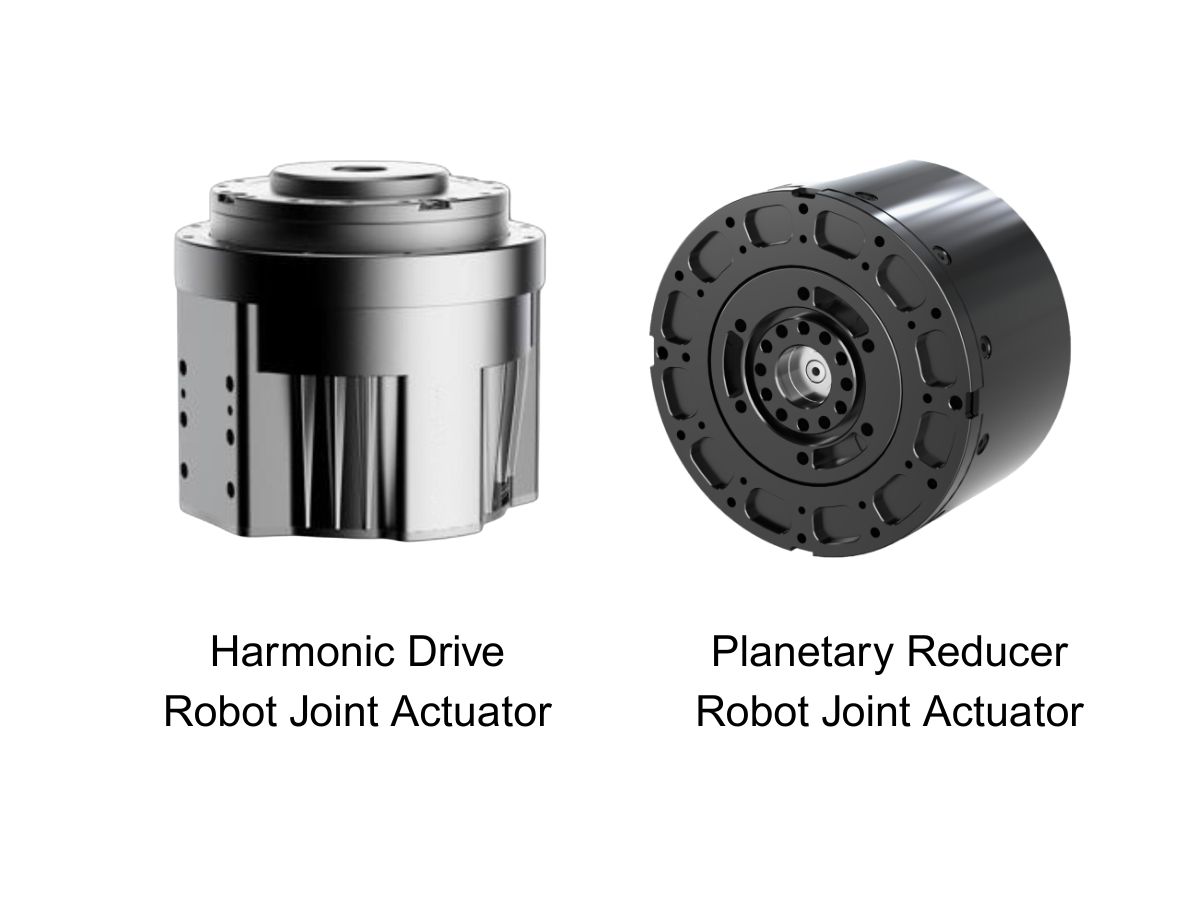
 What is robot joint actuator?How to Choose the Best Robot Rotary Joint Actuator?In core robot joint transmission solutions, planetary and harmonic rotary actuators each have their own strengths. Choosing the right type based on application requirements is essential to achieve the optimal balance between performance and cost.
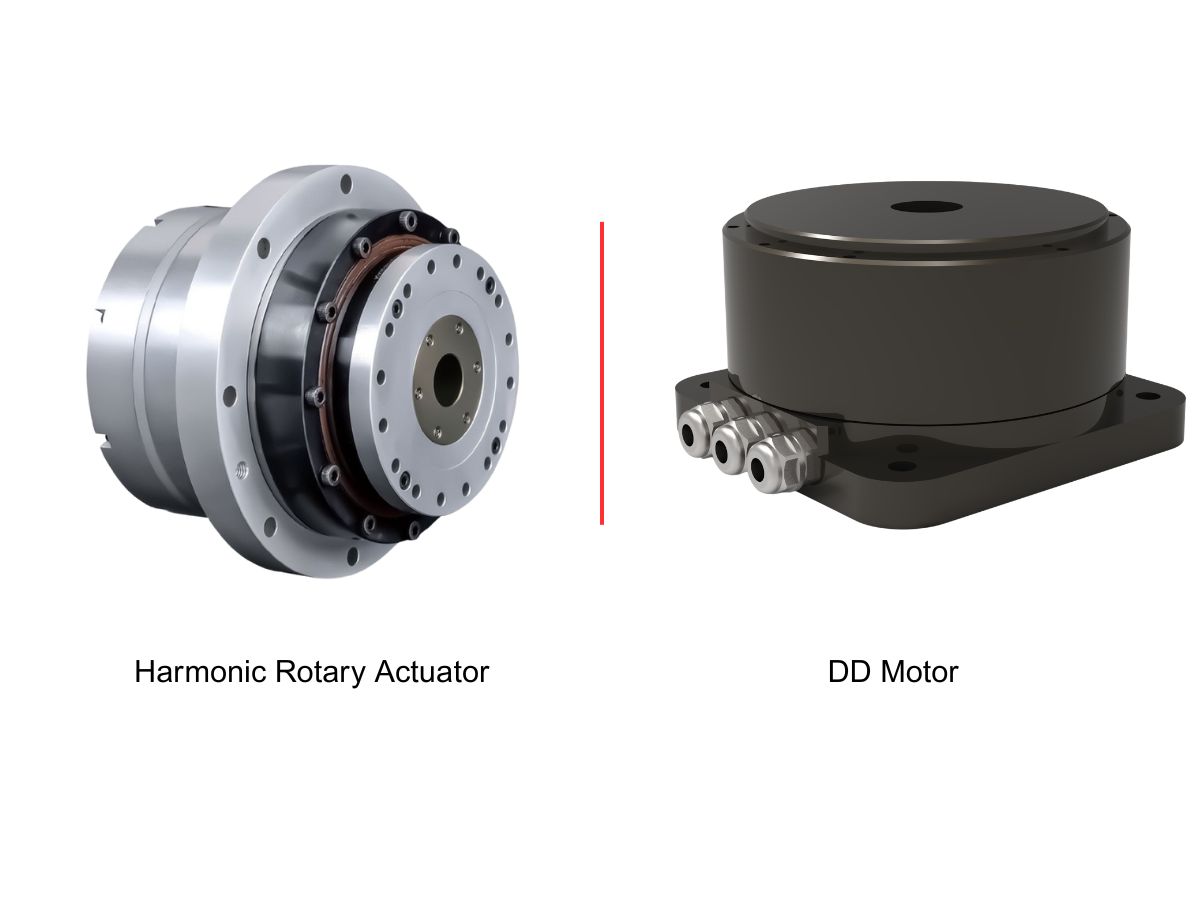
 DD Motors VS Harmonic Rotary ActuatorsThis article provides an in-depth comparison between Direct Drive (DD) motors and harmonic rotary actuators, covering their transmission principles, advantages and disadvantages, and typical application fields.
 OMG Ultra Compact Harmonic Drive Joint Module with Built-in Torque SensorHONPINE TCHL series harmonic drive joint module is a game-changing product that achieves disruptive improvements in multiple aspects such as lightweight design, integration level, and connection convenience. This article will analyze its revolutionary enhancements with you.
 The Role of Harmonic Drive Gears in Achieving 5–10 μm Accuracy in Dental Milling MachinesA dental milling machine is a CNC machining system used to directly process digital dental models into restorations such as crowns, bridges, veneers, inlays, and implant abutments. Dental milling machines require far higher operational accuracy and motion stability than ordinary equipment. This article explains how harmonic drive gear help dental milling machines achieve stable, continuous, and controllable operation.
 Why Are Harmonic Rotary Actuators Perfect for Medical Equipment?Harmonic rotary actuators (typically integrated systems consisting of a harmonic drive reducer, frameless torque motor, encoder, and optional brake) are regarded as key components in medical equipment. The core reason is that they simultaneously meet the most stringent medical requirements for precision, compact size, safety, and controllability. The following explanation is structured from three perspectives: technical characteristics, application scenarios, and medical value.
 High-Precision RV Reducers Perfectly Matched for Walking RobotsThe walking axis of a robot is a core component for power transmission and support. RV reducers provide extremely high rigidity, precision, and torque while maintaining a compact size and exceptional reliability, making them an ideal match for the demanding requirements of walking robot joints in terms of load capacity, impact resistance, and precision.
 Outdoor Robot Joint Solution: Harmonic Joint Module with Built-in Torque SensorHello everyone, I’m Theodore Li, Technical Director at HONPINE. As robots move beyond controlled factory environments, outdoor robotic applications are creating new requirements for robot joint design. Rain, dust, humidity, temperature fluctuations, low-temperature conditions, and unpredictable external loads can all affect how a robotic joint performs in the field. In these environments, a joint needs to provide more than precise rotation. It also needs reliable torque feedback, suitable environmental protection, stable operation under changing temperatures, and practical mechanical integration. In this article, I will explain the key engineering considerations behind our outdoor robot joint solution, including the harmonic joint module, built-in torque sensor, IP65 protection, low-temperature lubrication, cable outlet protection, and mechanical integration, based on our experience with outdoor robotic applications such as solar panel installation, construction, and cleaning robots.
 Multi-Robot Collaboration: From Single-Robot Intelligence to System IntelligenceHello, I’m Allen Li, Founder of HONPINE. As robotics continues to evolve, I believe the next major step will not come only from making individual robots more intelligent, but from enabling multiple robots to work together as coordinated systems. Multi-robot collaboration introduces new requirements for communication, task allocation, motion coordination, state awareness, and safety. This evolution also changes the role of the robot joint. A future intelligent robot joint will need to do more than generate precise motion. With technologies such as dual encoders, torque sensing, integrated drives, real-time communication, and safety functions, the robot joint can become an intelligent motion node connecting robot intelligence with physical movement. In this article, I would like to share how I see the relationship between multi-robot collaboration, system intelligence, and the next generation of HONPINE robot joint modules.
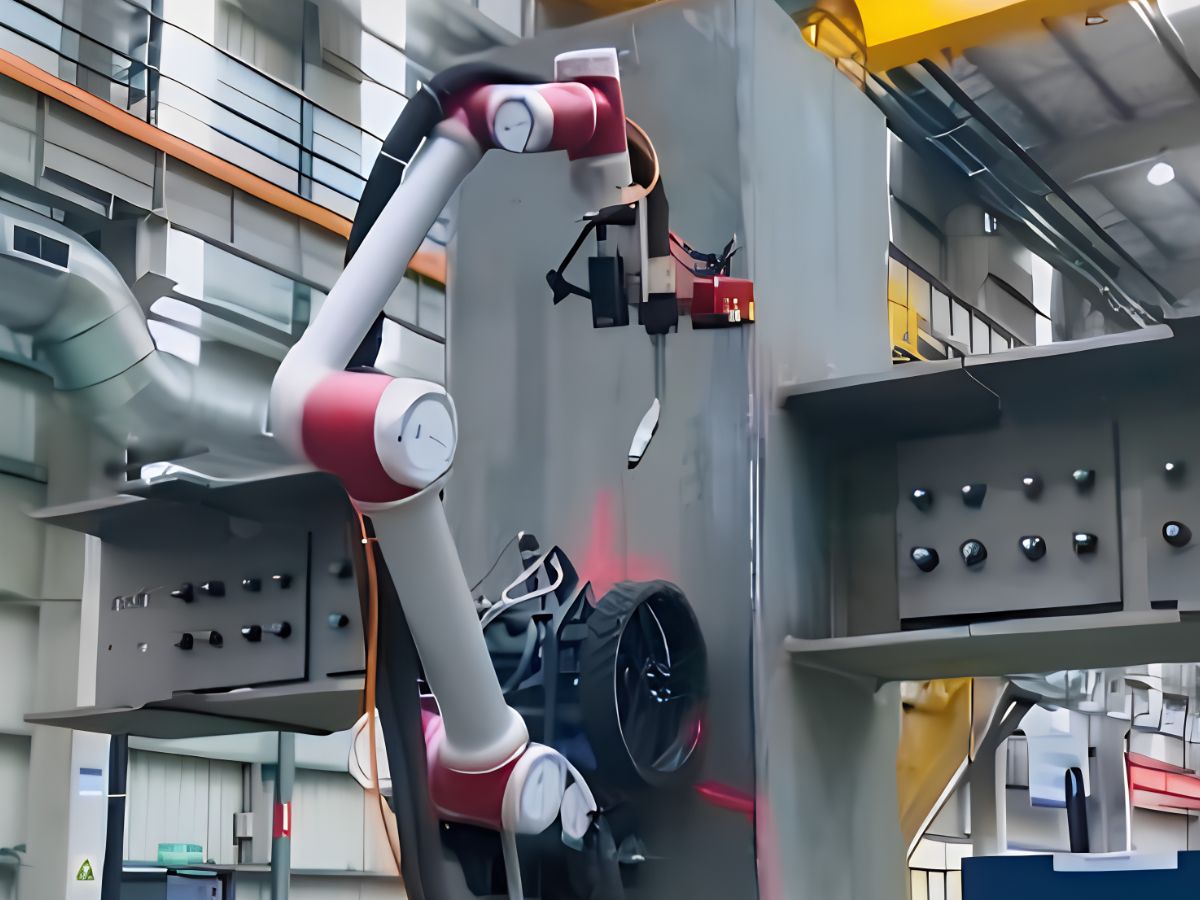
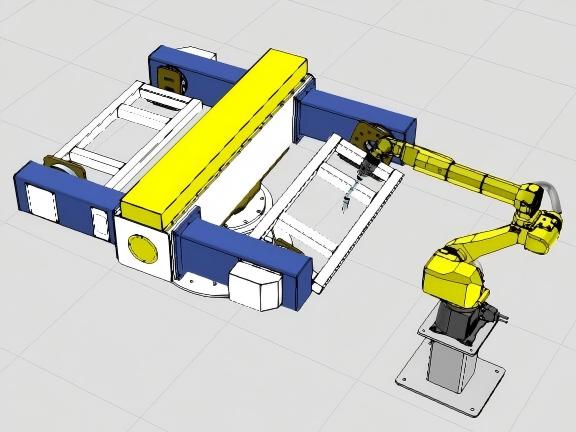
 RV Reducer for Welding Positioners: Selection and Torque Calculation for Heavy-Duty Welding ApplicationsSelecting the right RV reducer for a welding positioner requires more than simply matching the reducer to the workpiece weight. A heavy-duty welding positioner must provide sufficient output torque, high torsional rigidity, stable low-speed rotation, accurate positioning, and reliable performance during acceleration, deceleration, and reversing. In this article, we explain how to select an RV reducer and servo motor for a welding positioner by calculating output speed, reduction ratio, workpiece inertia, gravity load torque, acceleration torque, motor torque, and peak torque. A practical 500 kg welding positioner example is also used to show how these parameters affect RV reducer selection.
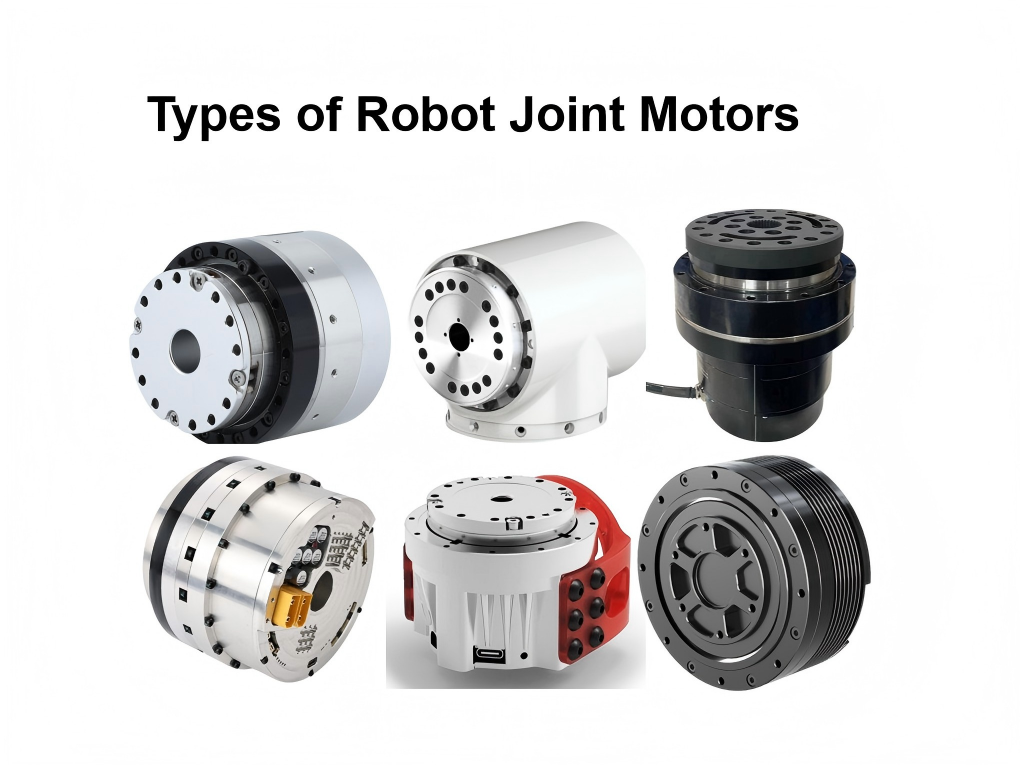
 Types of Robot Joint Motors: Model Selection, Advantages and DisadvantagesRobot joint motors are one of the key components that determine the performance, precision, efficiency, and load capacity of a robot. Depending on the application, robot joints can use electric, hydraulic, pneumatic, or other drive technologies. Among them, electric-drive solutions have become the mainstream choice for modern robots, especially humanoid robots, industrial robots, collaborative robots, and mobile robots. Electric robot joint motors can be further divided according to their transmission methods, including harmonic drive, planetary reducer, cycloidal reducer, ball screw, and direct drive solutions. Each type has its own advantages and disadvantages in terms of precision, torque density, efficiency, impact resistance, size, cost, and backdrivability. Understanding these differences is essential for selecting the right robot joint motor for a specific application.
 Hollow Rotary Platform vs. Harmonic Rotary Actuator: Application Comparison and InterchangeabilityHello everyone, I’m Theodore Li, Technical Director at HONPINE. For engineers designing precision rotary stations for industrial automation, one question often comes up: when a machine requires high-precision rotation, indexing, or rotary positioning, should you choose a hollow rotary platform or a harmonic rotary actuator? Can they be used interchangeably? Although both are precision rotary motion solutions, their mechanical structures and application characteristics are quite different. In actual equipment, choosing the wrong solution can lead to insufficient load capacity, inadequate rigidity, vibration, speed limitations, or reduced service life. In this article, I’ll compare their application characteristics and explain where they can be used interchangeably, where one is more suitable than the other, and what engineers should check before making a replacement.
 How HONPINE Manufactures Precision Harmonic Reducers: Technology, Quality and Manufacturing Challenges?A precision harmonic reducer is more than a compact high-ratio transmission component. Its actual performance depends on how accurately every critical component is designed, manufactured, assembled, and tested. Tooth profile accuracy, flexspline material, heat treatment, machining tolerances, wave generator geometry, assembly precision, and production consistency can all influence backlash, torsional stiffness, efficiency, durability, and positioning accuracy. For robotics, CNC equipment, semiconductor manufacturing, optical inspection, and other precision automation applications, these factors become even more important. This article explores how HONPINE manufactures precision harmonic reducers, the key technologies and manufacturing challenges involved, and why stable production capability is essential for achieving reliable transmission performance at scale.
Double Click
We provide harmonic drive reducer,planetary reducer,robot joint motor,robot rotary actuators,RV gear reducer,robot end effector,dexterous robot hand
 Multi-Robot Collaboration: From Single-Robot Intelligence to System IntelligenceHello, I’m Allen Li, Founder of HONPINE. As robotics continues to evolve, I believe the next major step will not come only from making individual robots more intelligent, but from enabling multiple robots to work together as coordinated systems. Multi-robot collaboration introduces new requirements for communication, task allocation, motion coordination, state awareness, and safety. This evolution also changes the role of the robot joint. A future intelligent robot joint will need to do more than generate precise motion. With technologies such as dual encoders, torque sensing, integrated drives, real-time communication, and safety functions, the robot joint can become an intelligent motion node connecting robot intelligence with physical movement. In this article, I would like to share how I see the relationship between multi-robot collaboration, system intelligence, and the next generation of HONPINE robot joint modules.
 HONPINE Dexterous Robot Hand: The Future of Embodied AI and Intelligent RoboticsThis article introduces HONPINE’s advanced dexterous robot hand series and highlights its innovations in embodied AI, high-precision robotic manipulation, and autonomous robotic self-learning, aiming to bring human-like robotic skills into factories, homes, and future intelligent industries.
 How Did the HONPINE HPJM Humanoid Robot Harmonic Reducer Integrated Joint Module Win the Attention of Humanoid Robot Manufacturers?Hello everyone, I’m Allen Li, founder of HONPINE. Today, I’d like to talk about how HONPINE seized the opportunity during the rapid rise of the humanoid robotics industry and how the HPJM harmonic reducer integrated joint module managed to stand out in this highly competitive market.
 HONPINE’s New Factory: Building the Future of Robot Joint Actuators and Dexterous HandsHONPINE is set to establish a new factory in Yuhang, Hangzhou, China, focusing on the development, manufacturing, and sales of robot joint actuators,dexterous hands and other high-end robotic hardware, while providing integrated solutions.