








Why Do Robot Joint Modules Use Dual Encoders?
Dual encoder robot joints are becoming increasingly important in high-performance robotics. But adding a second encoder is not simply a matter of installing another sensor.
The real purpose is to answer two different questions:
How much has the motor moved?
and
How much has the robot joint actually moved?
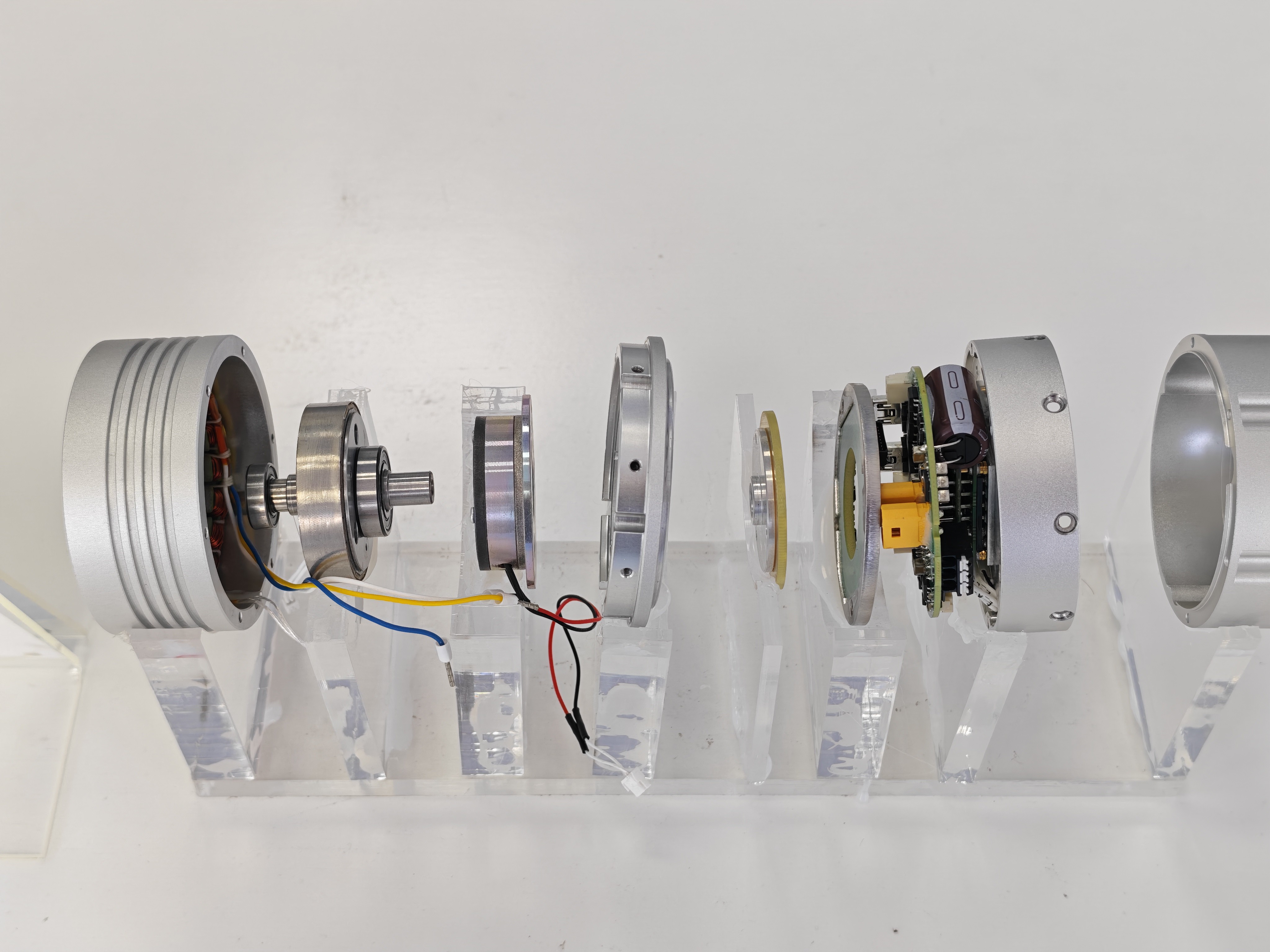
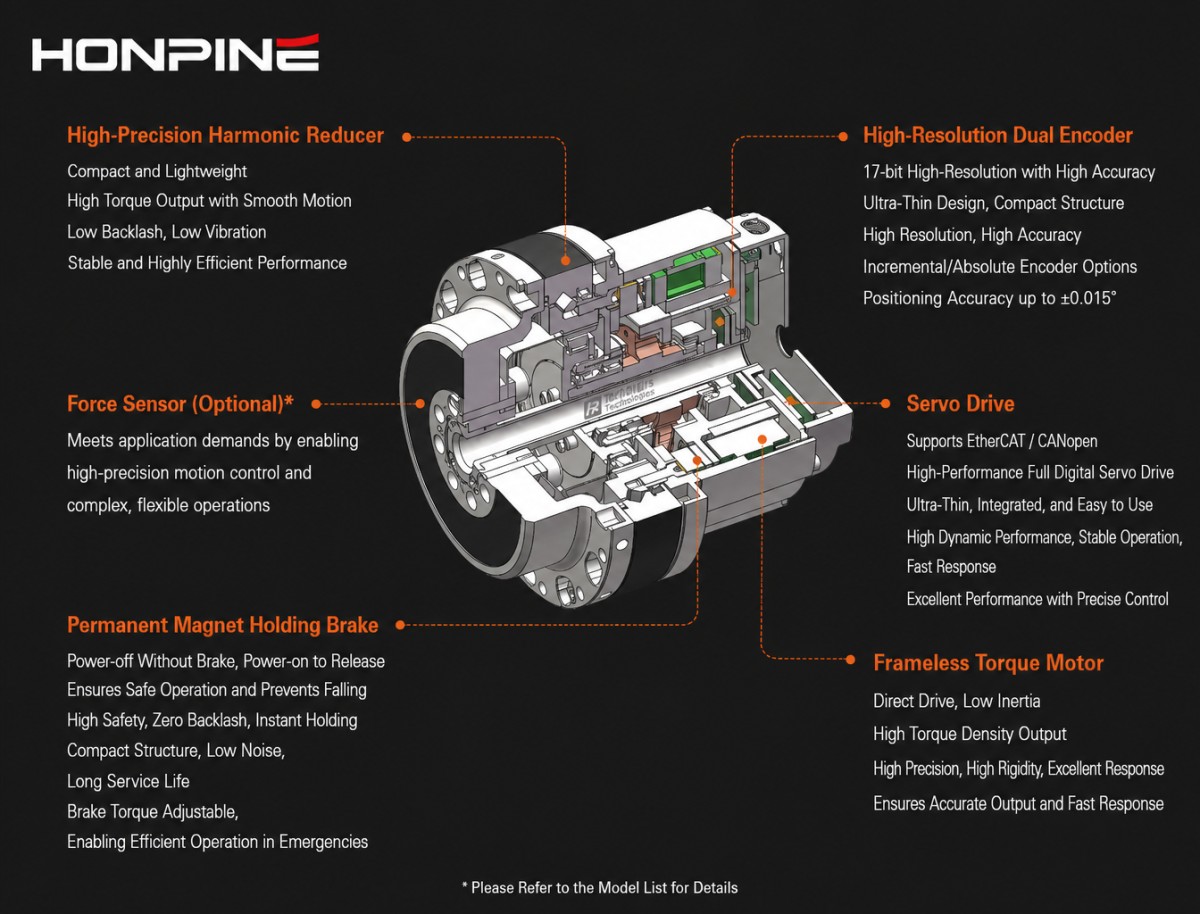
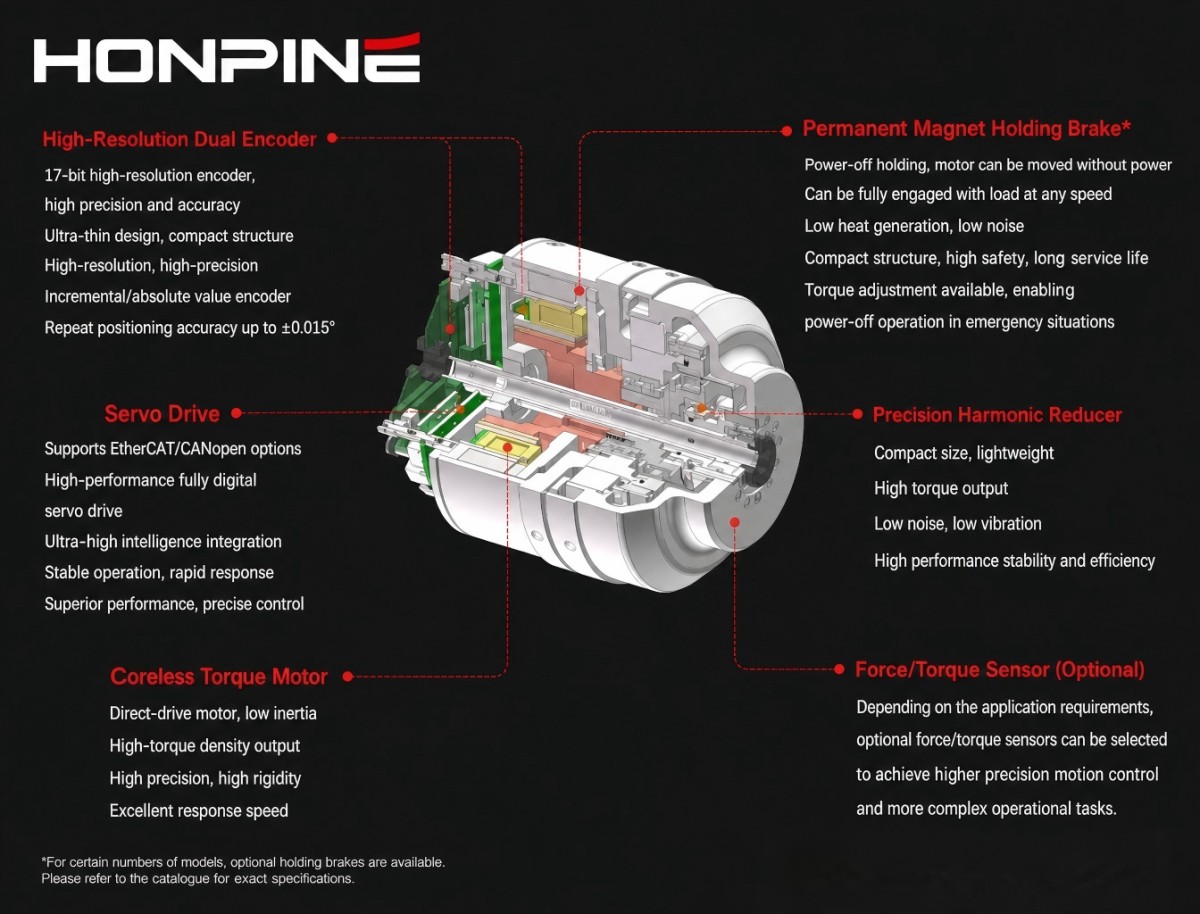
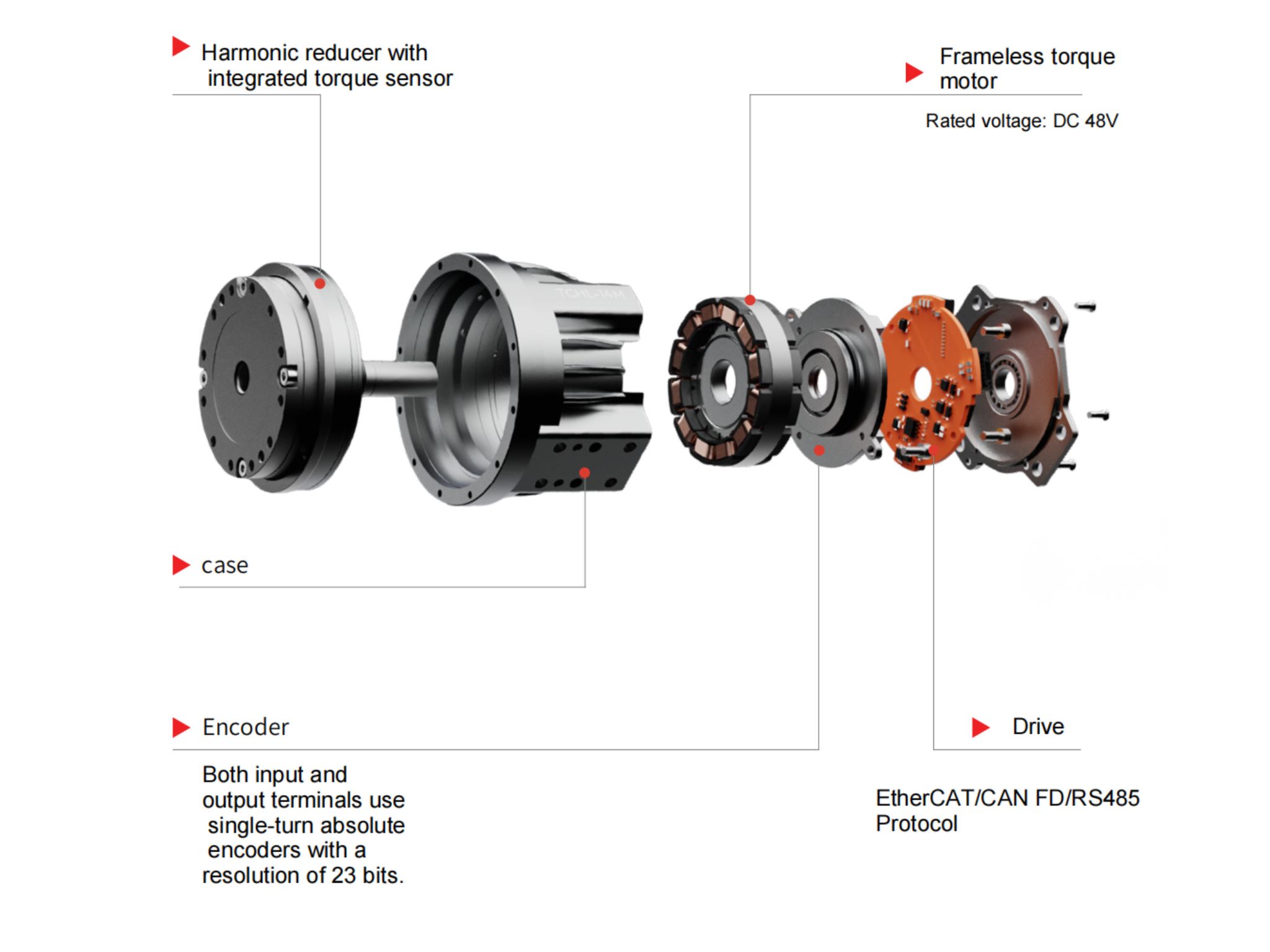
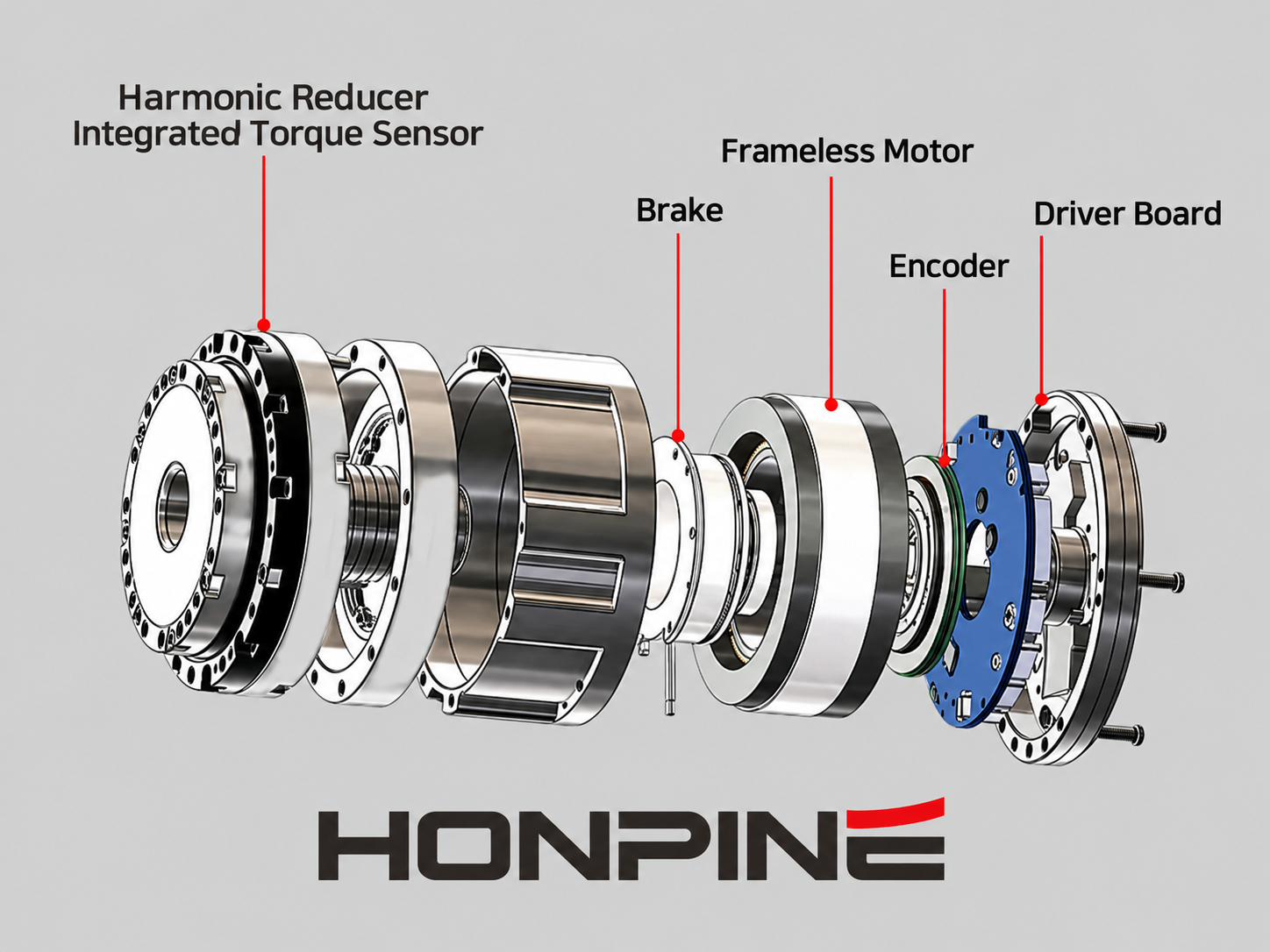
In a robot joint module consisting of a frameless torque motor, precision reducer, encoder and output flange, the motor-side encoder can accurately measure motor position and speed. However, the actual joint output can still be affected by transmission error, torsional deformation, friction, thermal drift, assembly tolerances and changes in external load.
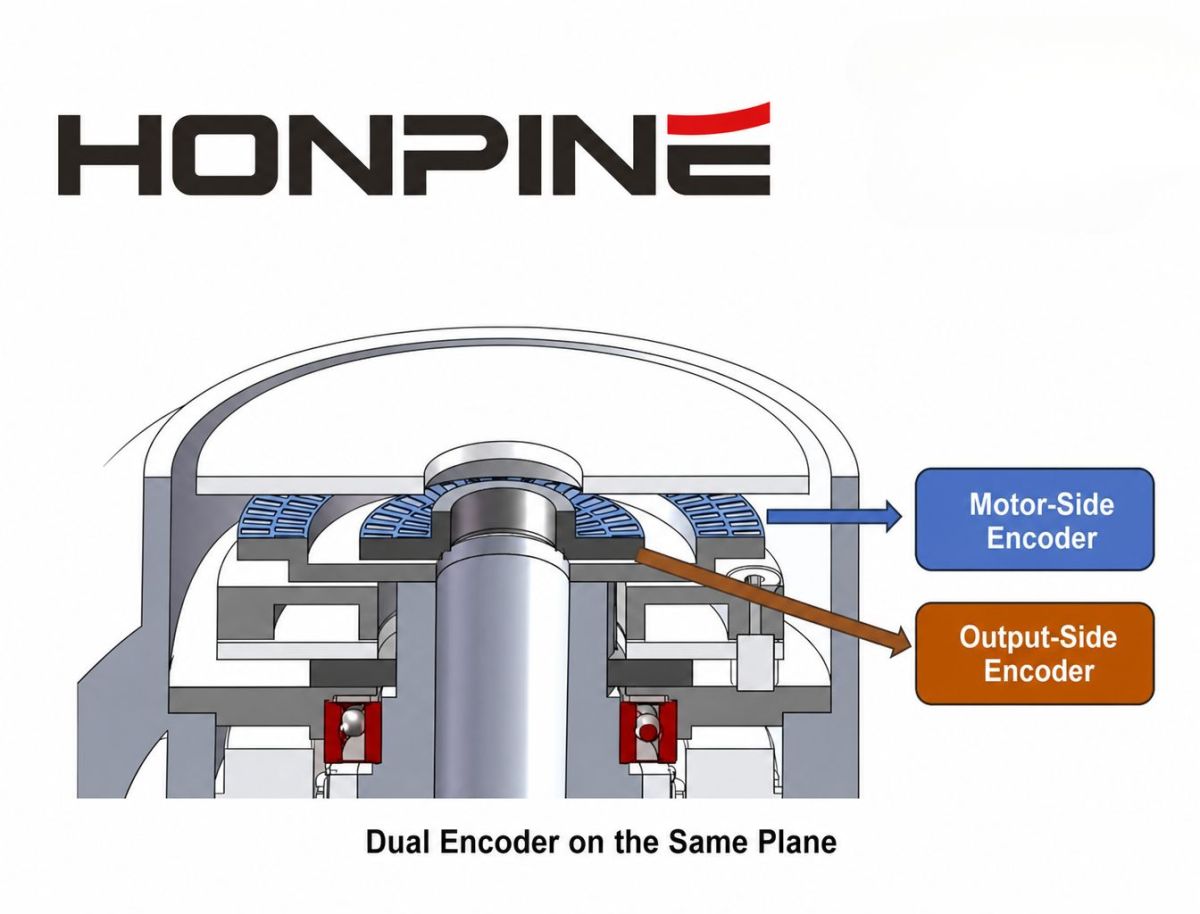
This is why a dual encoder robot joint can provide a more complete feedback architecture. One encoder monitors the motor side, while the other measures the joint output side. Together, they allow the controller to observe both the motor dynamics and the actual joint position.
What Is a Dual Encoder Robot Joint?
A typical robot joint dual encoder architecture can be simplified as:
Motor → Motor-Side Encoder → Precision Reducer → Output-Side Encoder → Joint Output
The motor-side encoder is installed near the motor rotor or input shaft. It primarily provides high-speed feedback for motor commutation, field-oriented control (FOC), velocity control and motor state estimation.
The output-side encoder, also known as a joint-side encoder, is installed after the reducer and measures the actual angular position of the robot joint.
This architecture is commonly described as:
Dual encoder
Dual feedback
Dual-loop control
Motor-side and joint-side feedback
The two encoders do not necessarily have to use the same technology. Depending on the application, a robot joint may use incremental encoders, single-turn absolute encoders or multi-turn absolute encoders.
Why Is a Motor-Side Encoder Not Enough?
In a conventional single-encoder robot joint, the encoder is usually installed on the motor side.
The controller knows the motor position and calculates the theoretical output position according to the reduction ratio:
θout ≈ θmotor / N
where N is the reduction ratio.
This approach works well when the transmission system can be considered sufficiently rigid and predictable.
However, a real robot joint is not an ideal rigid transmission system.
The reducer may introduce transmission error, while flexible components can deform under load. Bearings, couplings and output flanges can also introduce small mechanical deviations. Temperature changes may further affect both the mechanical structure and encoder measurements.
As a result:
Calculated Joint Position ≠ Actual Joint Position
This difference is one of the main reasons why output-side encoders are used in high-performance robot joints.
A secondary encoder can provide additional feedback for identifying and compensating transmission errors, especially in robot joints affected by flexibility, backlash, friction and other mechanical disturbances.
The Core Advantage of Dual Encoders: Measuring What Happens After the Reducer
The most important concept behind a dual encoder actuator is simple:
The motor-side encoder measures the input side of the transmission.
The output-side encoder measures the actual joint output.
The controller can then compare the two feedback signals and identify differences between the motor motion and the joint motion.
For example, the motor may rotate to the commanded position while the output flange is still slightly displaced because of torsional deformation, transmission error or load-dependent mechanical behavior.
A single-encoder system may assume:
The motor has reached the commanded position, so the joint has reached the commanded position.
A dual encoder system can identify:
The motor has reached the commanded position, but the joint output still has a position error.
This is one of the fundamental advantages of dual-loop feedback in robot joint modules.
1. Improve Robot Joint Position Control
One of the main advantages of a dual encoder architecture is that the position loop can use feedback from the actual joint output.
In a conventional motor-side feedback system, the position controller primarily observes motor position.
With dual feedback, the control architecture can separate the two functions:
Motor Encoder → Motor Control
Output Encoder → Joint Position Feedback
This allows the controller to regulate not only the motor but also the actual output position after the reducer.
This architecture is particularly useful for:
High-precision robot joints
Collaborative robots
Precision motion systems
CNC rotary axes
High-performance servo mechanisms
For applications requiring accurate trajectory tracking, output-side position feedback can help reduce the influence of transmission-related errors on the final joint position.
2. Measure and Compensate Reducer Transmission Error
A common misunderstanding is that a dual encoder can simply “eliminate backlash.”
This is not technically accurate.
A dual encoder robot joint does not mechanically eliminate backlash. Instead, the second encoder allows the control system to measure the difference between motor-side and output-side motion and compensate for part of the transmission error through control algorithms.
Depending on the reducer and mechanical design, relevant error sources may include:
Transmission error
Torsional deformation
Hysteresis
Friction
Elastic deformation
Assembly error
Thermal drift
By comparing motor-side and joint-side position feedback, the controller can build an error model and apply compensation according to joint position, direction, speed, load and other operating conditions.
Therefore, a more accurate description is:
Dual encoders enable transmission-error measurement and compensation.
Rather than:
Dual encoders eliminate backlash.
This distinction is important when evaluating the actual performance of a harmonic drive robot joint or other precision reducer-based actuator.
3. Improve Actual Joint Position Feedback
High encoder resolution does not automatically mean high robot positioning accuracy.
Three technical concepts should be clearly distinguished:
Resolution
Resolution describes the smallest position increment that an encoder can distinguish.
For example, a 23-bit single-turn encoder provides:
2²³ = 8,388,608 counts per revolution
The theoretical angular increment is approximately:
0.154 arcsec per count
However, this is encoder resolution, not the overall positioning accuracy of the robot joint.
Accuracy
Accuracy describes how closely the measured position corresponds to the actual physical position.
Repeatability
Repeatability describes how consistently the system returns to the same position when the same motion is repeated.
Therefore:
High Encoder Resolution ≠ High System Accuracy
The final performance of a robot joint depends on the complete system, including encoder accuracy, reducer transmission error, bearing runout, mechanical stiffness, thermal effects, calibration and control algorithms.
This is why dual encoder feedback should be evaluated as part of the complete motion-control architecture rather than by encoder bit count alone.
4. Separate Motor Motion From Actual Joint Motion
This is another important advantage of a robot joint dual encoder architecture.
Consider a robot joint using a 100:1 reduction ratio.
The motor may rotate through a relatively large angle while the output joint rotates only a small fraction of that angle.
At the same time, the reducer and mechanical structure may deform slightly as the external load changes.
The controller can therefore calculate a theoretical joint position from the motor encoder, but this does not necessarily represent the actual output position.
The output encoder provides direct feedback from the joint side.
The control system can therefore observe two different states:
Motor Dynamics
and
Joint Dynamics
This distinction becomes increasingly important in high-speed robot motion, dynamic load changes and high-precision trajectory control.
Can Dual Encoders Prevent Position Loss After Power-Off?
The answer is:
They can help, but dual encoders alone do not automatically eliminate homing.
Whether a robot joint can retain its position after power loss depends mainly on the encoder type and the multi-turn position retention mechanism.
Incremental Encoder
An incremental encoder generally does not retain absolute position information after power loss and may require a reference or homing procedure.
Single-Turn Absolute Encoder
A single-turn absolute encoder can identify the angular position within one revolution, but it does not by itself provide unlimited multi-turn position information.
Multi-Turn Absolute Encoder
A multi-turn absolute encoder can provide both single-turn position and accumulated rotational position over multiple revolutions.
Multi-turn position retention can be implemented using different technologies, including battery-backed systems, mechanical counting mechanisms and battery-free position retention technologies.
For example, Oriental Motor's ABZO encoder uses a battery-free mechanical absolute position system that can retain position information after power is removed.
Therefore, the engineering relationship is better described as:
Dual Encoder + Appropriate Multi-Turn Absolute Feedback → Potentially Reduced or Eliminated Conventional Homing
rather than:
Dual Encoder → Automatically Eliminates Homing
Can Dual Encoders Improve Robot Functional Safety?
Yes, but an important distinction must be made:
Two encoders do not automatically mean functional safety redundancy.
If two encoders are simply connected to a conventional controller without appropriate diagnostics, fault detection and safety architecture, the system cannot automatically claim PL d, PL e, SIL 2 or SIL 3.
The value of dual feedback in safety-related applications is that the controller can compare two different position measurements.
For example:
Motor Encoder Position ≠ Joint Encoder Position
may indicate:
Encoder failure
Mechanical transmission failure
Reducer damage
Shaft or coupling problems
Unexpected mechanical displacement
Communication or signal errors
The control system can then detect the abnormal condition and execute an appropriate fault response.
IEC 61800-5-3 addresses safety-related encoders, while IEC 61800-5-2 covers safety-related functions for power drive systems.
Therefore, the technically correct statement is:
Dual encoders can support a functional-safety architecture, but the final PL or SIL capability depends on the complete safety-related system, diagnostics, architecture and validation.
How Do Dual Encoders Relate to Functional Safety Standards?
Functional safety in a robot joint is not determined by a single encoder.
It is based on the complete safety-related control system.
Relevant standards may include:
IEC 61508
Provides the general framework for functional safety and Safety Integrity Levels (SIL).
IEC 61800-5-2
Defines safety-related functions for power drive systems, including functions such as Safe Torque Off (STO) and other drive-related safety functions.
IEC 61800-5-3
Provides requirements for safety-related encoders used in functional-safety applications.
EN ISO 13849-1
Addresses safety-related parts of control systems and defines Performance Levels (PL).
ISO 10218-1:2025
Specifies safety requirements for industrial robot systems.
ISO 10218-2:2025
Addresses safety requirements for industrial robot applications and robot cells.
The key point is that a dual encoder can be part of a safety-related feedback architecture, but the encoder count alone does not determine the final safety level.
System architecture, diagnostic coverage, fault response, common-cause failure protection and validation must all be considered.
Dual Encoder vs. Single Encoder Robot Joints
The choice between a single encoder and a dual encoder depends on the application.
Feature Single Encoder Dual Encoder
Motor position feedback Yes Yes
Direct output position feedback Usually no Yes
Transmission error monitoring Limited Improved
Dual-loop control Limited Yes
Reducer error compensation Limited Improved
Multi-turn absolute position Depends on encoder Depends on encoder
Fault cross-checking Limited Improved
System complexity Lower Higher
Cost Lower Higher
Suitable for high-performance joints Application dependent Strong advantage
A single encoder may be sufficient for cost-sensitive robot joints or systems where the transmission accuracy is already adequate.
A dual encoder architecture becomes more attractive when the application requires high positioning performance, transmission-error compensation, advanced motion control or additional position diagnostics.
Why Are Dual Encoders Not Used in Every Robot Joint?
If dual encoders provide additional feedback, why not use them everywhere?
The answer is system complexity.
Adding an output encoder increases:
BOM cost
Mechanical integration complexity
Wiring requirements
EMC design requirements
Calibration requirements
Controller complexity
Diagnostic requirements
Assembly requirements
The output-side encoder can also be sensitive to mechanical installation errors.
Encoder eccentricity, shaft runout, flange deformation and coupling errors can all influence the measured output position.
Therefore, the objective is not to install as many sensors as possible.
The objective is to use the right feedback architecture for the required robot joint performance.
Typical Dual Encoder Robot Joint Architecture
A high-performance robot joint can be understood as three main feedback layers.
Motor-Side Feedback
The motor-side encoder primarily supports:
Commutation
Field-Oriented Control (FOC)
Current and velocity control
Motor position feedback
The feedback needs to be fast and stable enough for dynamic motor control.
Joint-Side Feedback
The joint-side encoder primarily provides:
Actual joint position
Output position feedback
Transmission-error monitoring
Mechanical state monitoring
Because it is installed after the reducer, it provides information that cannot be obtained directly from the motor-side encoder.
Controller
The controller combines both feedback sources:
Motor Position → Motor State
Output Position → Joint State
Position Difference → Transmission and Mechanical Error Information
This creates a more complete feedback loop for the robot joint.
Dual Encoders Are About More Than Higher Accuracy
The most important reason for using two encoders is not simply to increase encoder resolution.
It is to make the measurement target more complete.
A single encoder primarily measures:
Motor
A dual encoder system measures:
Motor + Joint
This allows the control system to distinguish between motor movement and actual joint movement.
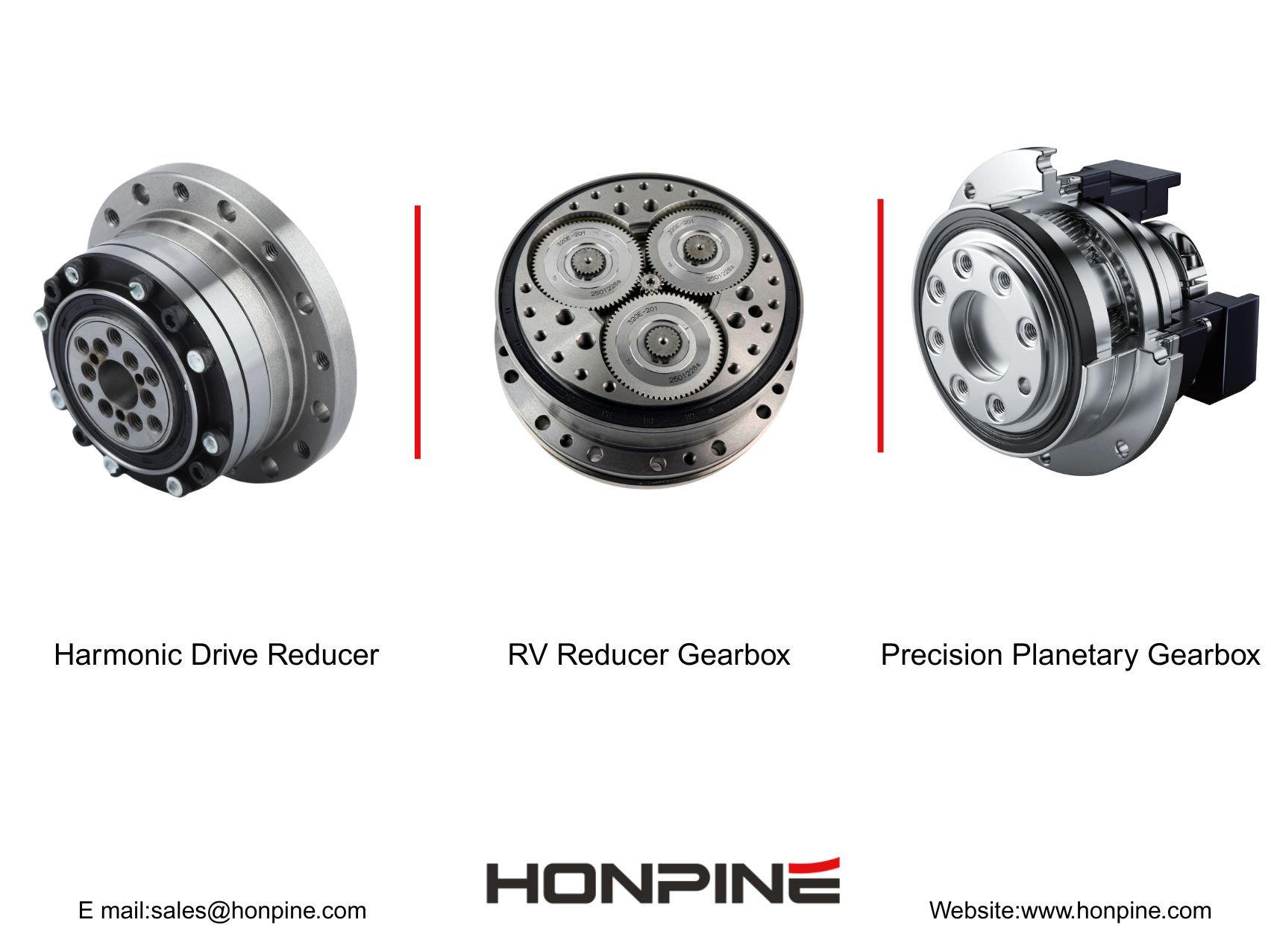
That distinction is particularly valuable when the robot joint includes a high-ratio precision reducer such as a harmonic drive or RV reducer.
When Should You Use a Dual Encoder Robot Joint?
A dual encoder architecture is worth considering when the robot joint requires one or more of the following:
High-precision joint positioning
When the final output position matters more than the calculated motor position.
Transmission-error compensation
When reducer and mechanical transmission errors need to be measured and compensated.
Advanced motion control
When the control system needs accurate feedback from both the motor and joint sides.
Absolute multi-turn positioning
When the robot needs to retain joint position information after power loss.
Position-based diagnostics
When motor-side and joint-side positions need to be continuously compared to detect abnormal mechanical behavior.
Functional-safety architecture
When redundant or cross-checked position feedback is required as part of a complete safety-related control system.
Why Dual Encoder Feedback Matters for Next-Generation Robot Actuators?
As collaborative robots, humanoid robots and high-performance industrial robots continue to demand higher precision, faster response and better diagnostic capabilities, robot joint architectures are becoming more sophisticated.
The traditional structure:
Motor + Reducer + Encoder
is increasingly evolving toward:
Motor + Motor Encoder + Precision Reducer + Joint Encoder + Controller
The key change is not simply the addition of another sensor.
It is the transition from estimating the joint position from motor motion to directly measuring the actual joint state.
For robot joints using harmonic reducers, this distinction can be particularly important. Precision reducers provide high reduction ratios, high torque density and compact mechanical structures, but the final joint performance is still influenced by transmission error, torsional stiffness, thermal effects, mechanical tolerances and external loads.
A dual encoder architecture gives the controller access to both sides of the transmission chain.
This provides a stronger foundation for:
High-precision position control
Transmission-error compensation
Joint-state monitoring
Dual-loop motion control
Advanced robot motion control
Selected functional-safety architectures
In other words, a dual encoder is not simply “one more sensor.”
It creates a more complete input–transmission–output feedback chain inside the robot joint.
For next-generation robot actuators, this shift from estimating joint position to directly measuring joint behavior can be more valuable than simply increasing encoder resolution.
Read More
Learn more about the story of HONPINE and industry trends related to precision transmission.
 What is robot joint actuator?How to Choose the Best Robot Rotary Joint Actuator?In core robot joint transmission solutions, planetary and harmonic rotary actuators each have their own strengths. Choosing the right type based on application requirements is essential to achieve the optimal balance between performance and cost.
 DD Motors VS Harmonic Rotary ActuatorsThis article provides an in-depth comparison between Direct Drive (DD) motors and harmonic rotary actuators, covering their transmission principles, advantages and disadvantages, and typical application fields.
 OMG Ultra Compact Harmonic Drive Joint Module with Built-in Torque SensorHONPINE TCHL series harmonic drive joint module is a game-changing product that achieves disruptive improvements in multiple aspects such as lightweight design, integration level, and connection convenience. This article will analyze its revolutionary enhancements with you.
 The Role of Harmonic Drive Gears in Achieving 5–10 μm Accuracy in Dental Milling MachinesA dental milling machine is a CNC machining system used to directly process digital dental models into restorations such as crowns, bridges, veneers, inlays, and implant abutments. Dental milling machines require far higher operational accuracy and motion stability than ordinary equipment. This article explains how harmonic drive gear help dental milling machines achieve stable, continuous, and controllable operation.
 Why Are Harmonic Rotary Actuators Perfect for Medical Equipment?Harmonic rotary actuators (typically integrated systems consisting of a harmonic drive reducer, frameless torque motor, encoder, and optional brake) are regarded as key components in medical equipment. The core reason is that they simultaneously meet the most stringent medical requirements for precision, compact size, safety, and controllability. The following explanation is structured from three perspectives: technical characteristics, application scenarios, and medical value.
 High-Precision RV Reducers Perfectly Matched for Walking RobotsThe walking axis of a robot is a core component for power transmission and support. RV reducers provide extremely high rigidity, precision, and torque while maintaining a compact size and exceptional reliability, making them an ideal match for the demanding requirements of walking robot joints in terms of load capacity, impact resistance, and precision.
 Harmonic Reducer vs. Harmonic Rotary Actuator: Which Is Better for CNC Machine Tools?Choosing between a harmonic reducer and a harmonic rotary actuator is an important decision in CNC machine tool design. Both solutions offer high-precision motion control, but they differ in integration, installation requirements, rigidity, and system flexibility. For CNC fourth-axis rotary tables and compact five-axis machining systems, selecting the right harmonic drive can significantly influence machine performance. In this article, HONPINE Technical Director Theodore Li compares harmonic reducers and harmonic rotary actuators to help engineers identify the most suitable solution for their CNC applications.
 How to Choose Harmonic Joint Actuators for a 7-DOF Robotic Arm?I'm Theodore Li, Technical Director at HONPINE. Choosing harmonic joint actuators for a 7-DOF robotic arm starts with the torque, weight, and installation needs of each joint. This guide uses a TCHL 20 shoulder and TCHL 14 wrist configuration as an example, then explores torque sensing, compliant control, and HAG Series considerations for demanding robotic applications.
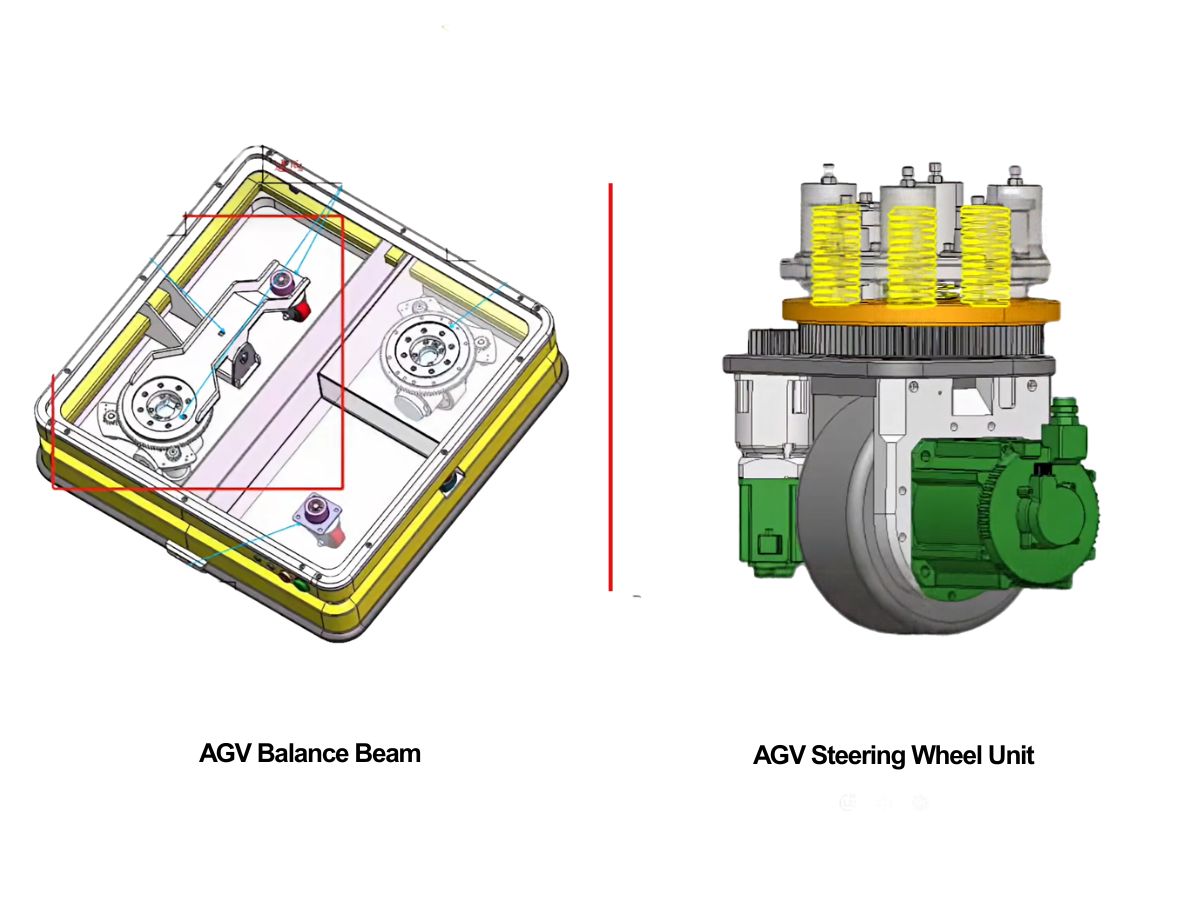
 AGV Suspension: Should You Choose a Balance Beam or a Spring-Loaded Steering Drive Unit?Choosing an AGV suspension system starts with the vehicle’s load range and floor conditions. Balance beams and spring-loaded steering drive units offer different approaches to maintaining wheel contact and managing wheel loads. This HONPINE guide compares both options and explains how to evaluate traction, suspension travel, installation space, and maintenance before choosing a configuration.
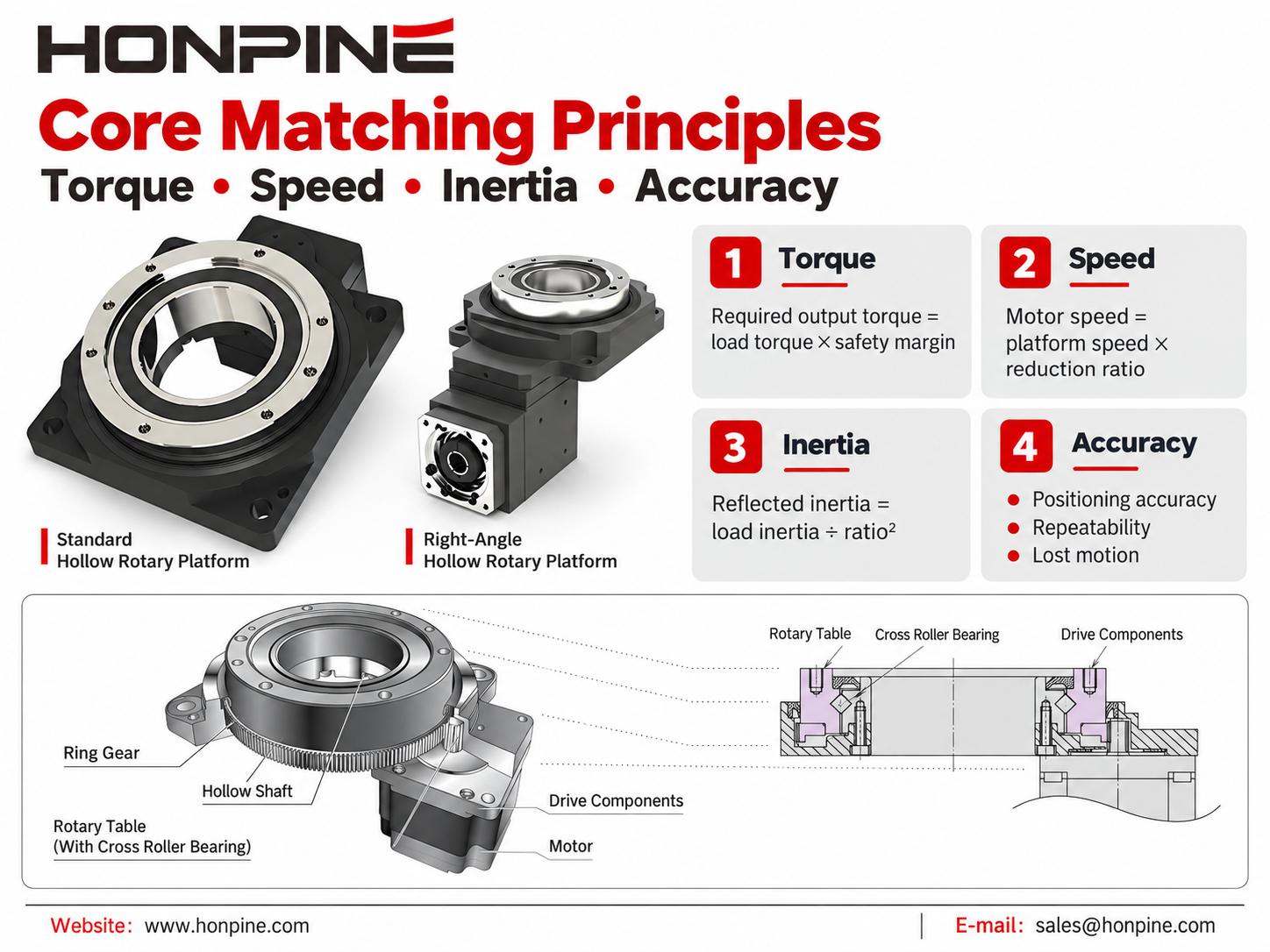
 Hollow Rotary Platform Motor Matching: A Complete GuideSelecting the right motor for a hollow rotary platform is essential for achieving precise positioning, stable operation, and efficient automation. This guide explains how to match servo motors, stepper motors, and brushless DC motors with hollow rotary platforms based on torque, speed, inertia, accuracy, and installation requirements. Explore practical motor selection guidelines, typical application combinations, and space-saving mounting solutions to find the right configuration for your automation project.
 Can Robots Feel Touch? HONPINE HAG Force-Controlled Harmonic Robot Joint MotorsCan robots respond to a gentle touch? The HONPINE HAG robot joint motor with torque sensor combines a harmonic reducer, integrated torque sensing, and closed-loop control to detect external forces and support smooth, compliant motion. In this article, HONPINE founder Allen Li demonstrates the module's response to light contact and hand-guided movement, explains its key force-control technologies, and shares the vision behind joint modules designed for practical industrial robotics.
 Does a Higher Gearbox Ratio Mean More Torque? Planetary, Harmonic, and RV Gearboxes ExplainedDoes a higher gearbox ratio mean more torque? This engineering guide explains the relationship between gearbox ratio, output torque, and output speed, and compares planetary gearboxes, harmonic gearboxes, and RV gearboxes. Learn why reduction ratio alone cannot determine gearbox torque capacity, efficiency, dynamic response, precision, or service life, and what engineers should consider when selecting a gearbox for robotics, CNC machines, servo systems, and industrial motion control.
Double Click
We provide harmonic drive reducer,planetary reducer,robot joint motor,robot rotary actuators,RV gear reducer,robot end effector,dexterous robot hand
 What is robot joint actuator?How to Choose the Best Robot Rotary Joint Actuator?In core robot joint transmission solutions, planetary and harmonic rotary actuators each have their own strengths. Choosing the right type based on application requirements is essential to achieve the optimal balance between performance and cost.
 DD Motors VS Harmonic Rotary ActuatorsThis article provides an in-depth comparison between Direct Drive (DD) motors and harmonic rotary actuators, covering their transmission principles, advantages and disadvantages, and typical application fields.
 OMG Ultra Compact Harmonic Drive Joint Module with Built-in Torque SensorHONPINE TCHL series harmonic drive joint module is a game-changing product that achieves disruptive improvements in multiple aspects such as lightweight design, integration level, and connection convenience. This article will analyze its revolutionary enhancements with you.
 Harmonic Reducer vs. Harmonic Rotary Actuator: Which Is Better for CNC Machine Tools?Choosing between a harmonic reducer and a harmonic rotary actuator is an important decision in CNC machine tool design. Both solutions offer high-precision motion control, but they differ in integration, installation requirements, rigidity, and system flexibility. For CNC fourth-axis rotary tables and compact five-axis machining systems, selecting the right harmonic drive can significantly influence machine performance. In this article, HONPINE Technical Director Theodore Li compares harmonic reducers and harmonic rotary actuators to help engineers identify the most suitable solution for their CNC applications.
 How to Choose Harmonic Joint Actuators for a 7-DOF Robotic Arm?I'm Theodore Li, Technical Director at HONPINE. Choosing harmonic joint actuators for a 7-DOF robotic arm starts with the torque, weight, and installation needs of each joint. This guide uses a TCHL 20 shoulder and TCHL 14 wrist configuration as an example, then explores torque sensing, compliant control, and HAG Series considerations for demanding robotic applications.
 AGV Suspension: Should You Choose a Balance Beam or a Spring-Loaded Steering Drive Unit?Choosing an AGV suspension system starts with the vehicle’s load range and floor conditions. Balance beams and spring-loaded steering drive units offer different approaches to maintaining wheel contact and managing wheel loads. This HONPINE guide compares both options and explains how to evaluate traction, suspension travel, installation space, and maintenance before choosing a configuration.
 Hollow Rotary Platform Motor Matching: A Complete GuideSelecting the right motor for a hollow rotary platform is essential for achieving precise positioning, stable operation, and efficient automation. This guide explains how to match servo motors, stepper motors, and brushless DC motors with hollow rotary platforms based on torque, speed, inertia, accuracy, and installation requirements. Explore practical motor selection guidelines, typical application combinations, and space-saving mounting solutions to find the right configuration for your automation project.
 Can Robots Feel Touch? HONPINE HAG Force-Controlled Harmonic Robot Joint MotorsCan robots respond to a gentle touch? The HONPINE HAG robot joint motor with torque sensor combines a harmonic reducer, integrated torque sensing, and closed-loop control to detect external forces and support smooth, compliant motion. In this article, HONPINE founder Allen Li demonstrates the module's response to light contact and hand-guided movement, explains its key force-control technologies, and shares the vision behind joint modules designed for practical industrial robotics.
 Does a Higher Gearbox Ratio Mean More Torque? Planetary, Harmonic, and RV Gearboxes ExplainedDoes a higher gearbox ratio mean more torque? This engineering guide explains the relationship between gearbox ratio, output torque, and output speed, and compares planetary gearboxes, harmonic gearboxes, and RV gearboxes. Learn why reduction ratio alone cannot determine gearbox torque capacity, efficiency, dynamic response, precision, or service life, and what engineers should consider when selecting a gearbox for robotics, CNC machines, servo systems, and industrial motion control.
 High-Precision Hollow Harmonic Rotary Actuator for CNC Machines and Heavy-Duty Rotary AxesHONPINE 58 Series Hollow Harmonic Rotary Actuator is designed for CNC rotary tables, precision rotary axes, laser processing equipment, and heavy-duty rotary positioning applications. With a 50 mm hollow bore, up to 2,722 N·m peak torque, integrated crossed roller bearing, multi-turn absolute encoder options, positioning accuracy below 30 arcsec, and repeat positioning accuracy below 5 arcsec, it combines high torque capacity with precision rotary motion and flexible mechanical integration.
 How Does the HONPINE JRM Planetary Robot Joint Module Address Temperature Rise in Continuous Operation?HONPINE JRM planetary robot joint modules are designed for long-duration and high-load robotic operation. This article examines how motor electromagnetic optimization, high-efficiency planetary transmission, GaN-based drive technology, and system-level low-loss design help control temperature rise. Using the C6345 planetary robot joint module as a test example, HONPINE also presents full-load thermal validation under continuous operation, including motor efficiency up to 92%, planetary gearbox efficiency up to 97%, and a final equilibrium temperature of 61.42°C at a 25°C ambient temperature.
 Direct Drive Motor Sizing: A Complete Guide to Torque Calculation and SelectionSelecting a direct drive motor for a precision rotary system requires more than matching motor torque to the equipment weight. Engineers need to evaluate gravity torque, inertial torque, wind torque, friction, rotational inertia, speed, acceleration, duty cycle, and positioning requirements. In this guide, Theodore Li, Technical Director at HONPINE, explains a practical approach to direct drive motor sizing and torque calculation using an azimuth and elevation turntable as an engineering example. The article covers continuous and peak torque calculation, motor selection criteria, and the application of frameless direct drive motors in integrated rotary systems.